Beyond Religion. Beyond Atheism. Good people welcomed.
Mankind is not likely to salvage civilization unless he can evolve a system of good and evil which is independent of heaven and hell. George Orwell
Are you trying to be good and make the world a better place but it seems like everyone is arguing past each other, making enemies out of people who should be friends? Are you tired of the splintering and division that weakens our society? Shocked by how little goodwill seems to be left in the world? Afraid of befriending or voicing support for someone with different views, for fear of being ostracized yourself?
This is the short version of a manifesto I wrote in 2017 with David Silverman, former president of American Atheists. We were trying to articulate a workable secular ethics. A way to live morally without religion, but with rigor. A common ground from which people who had walked out of churches, mosques, and synagogues, and people who had never walked into one, could find each other.
The longer version became the seed of two online communities I built between 2017 and 2024: agnostic.com and slug.com / IDW.community. The longer version of that story is at conru.com/tribes/. What follows is the philosophical core, condensed to about five thousand words. The full 2017 draft, all thirty thousand words of it, is preserved at the /full/ subpage.
Humanism is a logical, evolving morality based on the simple idea that reducing suffering and improving people's lives is practically objectively good. Practically objectively, because we admit, openly, that we are the ones picking the rule, and that no rule comes down from a mountain. We have chosen this rule because it is the one that almost every sentient being on earth would agree with if you put it to them plainly: suffering is bad, well-being is good, and a longer life with more quality in it is a worthier life than a shorter one with less.
From that one rule, everything else follows. The basic vices are the things humans do that increase suffering. Cruelty. Bigotry. Dehumanization. Bad faith. The basic virtues are the things humans do to reduce suffering and increase the quality of life. Kindness. Generosity. Honesty. Skepticism. Forgiveness. A morality built on this ground does not need a god to enforce it, and does not need a holy book to justify it. It just needs reasonable people to take it seriously.
Humanism is not anti-religious. The cores of most religions, stripped of supernatural enforcement and outgrouping, are essentially humanist. Turn the other cheek. Love thy neighbor. Do not judge. What we are doing with humanism is what religion did long ago, but without the dogma and without the gatekeeping. Believers are welcome. So are non-believers. So is anyone in between. Good people welcomed is the motto. It is not a slogan. It is the door we are trying to keep open.
Goodness does not require heaven or hell. It requires attention, logic, and compassion.
The threat humanism is trying to address is older than the internet, but the internet has made it acute. The threat is dehumanization, the human-evolved instinct to sort outsiders into a category that does not deserve our care, and the modern technological accelerants of that instinct, the echo chamber and the purity test.
Until recently, most people lived among a few dozen close relationships they could not afford to lose. It was to everyone's advantage to humanize and tolerate one another, because everyone in your small community was a person you would see again next week. Now we have hundreds of "friends" we will never look in the eye, and the cost of treating any one of them as disposable is almost nothing. Purity tests have become the norm. Fail one, even a small one, and you can be lumped in with the worst caricature of your category and discarded. The common practice on contested questions is no longer to find common ground. It is to unfriend, to block, to ostracize, and to do it publicly.
The inevitable result is an almost infinite splintering of society. Civil discourse erodes. Mob justice replaces conversation. We dehumanize each other by default, and there often has to be a specific reason not to dehumanize the person in front of us. We build echo chambers around ourselves that shelter us from disagreement, which removes the corrective mechanism against extremism. Deplatforming a controversial speaker may feel righteous in the moment. The next time the same crowd shows up to do the same thing, they will have learned the technique, and the speaker they target may be one you wanted to hear.
And it goes in both directions. People who disagree increasingly do not just disagree with each other. They wish harm on each other. People who mostly agree are afraid to voice even small dissent for fear of being lumped in with the other side, which thickens the echo chamber. The two factors together make a culture of fear reminiscent of the McCarthy era, where anyone who strays from the most extreme version of the most favored view is treated as a traitor for the other side.
This is the apparatus humanism is trying to interrupt. Not by yelling louder. Not by ostracizing more. By offering, calmly and on the record, a different way to talk.
Every religion claims its moral code is objective, given from outside, perfect for all time. That claim is what gives a religion control over its flock, because dissent against any part of the code becomes blasphemy against the god who supposedly wrote it. The trouble is that holy books are full of contradictory passages. Believers pick which passages they trust first, then call that selection objective. The result is that Islamic jihadists, the Westboro Baptists, and the KKK can all be certain their god agrees with them, even though their gods would not recognize each other's positions.
Humanism does the same thing, but admits it. We pick. We pick the rule that suffering is bad and well-being is good, because almost every sentient creature on earth would, in plain terms, agree. We call that rule practically objective, because while it is not handed down from a mountain, it is so close to universal among feeling beings that we are willing to build a society around it.
The practical-objective rule:
Given the degree of sentience of the entity enduring the suffering, the reduction of that suffering is a practically-objective Good, and the increase is a practically-objective Bad. The lengthening and improvement of life, relative to the level to which it can be perceived, is practically-objective Good. The shortening or worsening of it is practically-objective bad.
Yes, we picked it. Yes, that means it is not strictly objective. Yes, the weighting of sentience against perceived suffering is a judgment call, and different people will weigh it differently. We get that. But this is the line in the sand, and unlike every other line in the sand drawn across human history, this one rests on evidence about what living beings actually want, not on inheritance from a tribal council nobody can find a record of.
From that rule, the rest of humanism is derivable. Compassion follows, because compassion reduces suffering. Honesty follows, because lies introduce suffering downstream. Forgiveness follows, because punishing forever produces more suffering than is needed to deter the offense. Mercy follows, because the unmerciful world is a world full of fear. Civility follows, because incivility breaks the conversation in which collective answers are found.
This is the load-bearing chapter, and the one I was wrong about in the end. I will tell you what the chapter argued in 2017, because it was sincere then and parts of it remain right. I will tell you, at the bottom of the page, where it broke under contact with eight years of data. Both things are true. The chapter is the case I made in 2017. The autopsy is what I learned by 2026.
The case in 2017 was this. Civility, in public conversation, is commonly treated as a courtesy. A politeness extended to people whose views deserve a respectful hearing. The temptation is to withdraw the courtesy from people whose views do not, in your view, deserve a hearing. I do not owe civility to a Nazi. The instinct is to escalate when met with what looks like extremism, to fight rage with rage, to shame the shameless, to dehumanize the dehumanizer.
This is the wrong move, and it is wrong for a specific reason. Civility is not a courtesy. Civility is a weapon. It is the only weapon that works against extremism, because every other weapon makes the extremist stronger. Yelling at a person who has been dehumanized validates their belief that the other tribe is incapable of reason. Banning them validates their belief that the other tribe fears the truth. Mocking them gives them a story to take home about how the other side is small, contemptuous, and afraid. None of those make them less extreme. All of them entrench the position.
What civility does, when held against the worst incoming pressure, is force the other party to either match the register or visibly fail to. If they match, you are having a real conversation, and real conversations have changed real minds. If they fail to match, they have done it in public, and the audience watching the exchange has the evidence in front of them. Civility, in the face of hostility, is how you win without making the other side feel like a loser.
To practice it, you bring eight things to the conversation. Rehumanize the person you disagree with. They are a complete human with reasons. Humility: you might be wrong, in part. Respect: no insults, no personal attacks, no strawmen. Self-improvement as the goal, not victory. The argument is a mutual search. Avoid echo chambers, even when they feel good. Echo chambers narrow you. Check your sources. Every side has been fooled by curated coverage. Compassion for the angry, because they think they are right and you are causing harm. Acceptance: the goal is not to win. It is to keep the conversation open another fifteen minutes, because the next fifteen minutes are where minds actually move.
Being civil is not being polite. It is being powerful. It is how you change minds without destroying people.
One of the things modernity has lost, in trading religion for secular culture, is the redemption mechanism. The old story had one: confession, penance, return. The new story does not. The new story is cancellation, exile, and a permanent record. Even when the offense is small, even when the offender is sorry, even when the harm is reparable, the new culture often makes no path back. The result is a society where everyone is one bad post away from disappearing, and where almost no one is willing to risk speaking against the in-group consensus, because the cost of being wrong is a permanent banishment.
Humanism brings the redemption mechanism back, on secular terms.
Forgiveness is the act of releasing the resentment that an offense produced in you, regardless of whether the offender deserves it. Forgiveness is for the forgiver as much as for the forgiven, because carrying resentment is a form of self-inflicted suffering, and the practical-objective rule says suffering is bad. You can forgive someone and still not trust them. You can forgive someone and still defend yourself against a repeat. Forgiveness is not the absence of consequences. It is the release of resentment.
Mercy is the willingness, when you have power over someone's outcome, to weigh in the direction of less suffering rather than more. Mercy is not weakness. Mercy is the choice to use the power you have to reduce, rather than maximize, the cost imposed on the person who has been caught. It is the opposite of the algorithmic punishment culture that the internet has made common. Mercy is what allows a community to keep its people instead of casting them out.
Redemption is the willingness, on both sides of an offense, to do the work of restoration. The offender owns the harm and acts to repair it. The community accepts the repair when it is offered in good faith. Redemption is hard, slow, and uncomfortable. It is also the only mechanism, that I know of, that lets a community keep its people across decades, instead of treating every offense as the end of the relationship.
We have lost the skill of forgiveness, mercy, and redemption. Without them, we do not have a society. We have factions in exile.
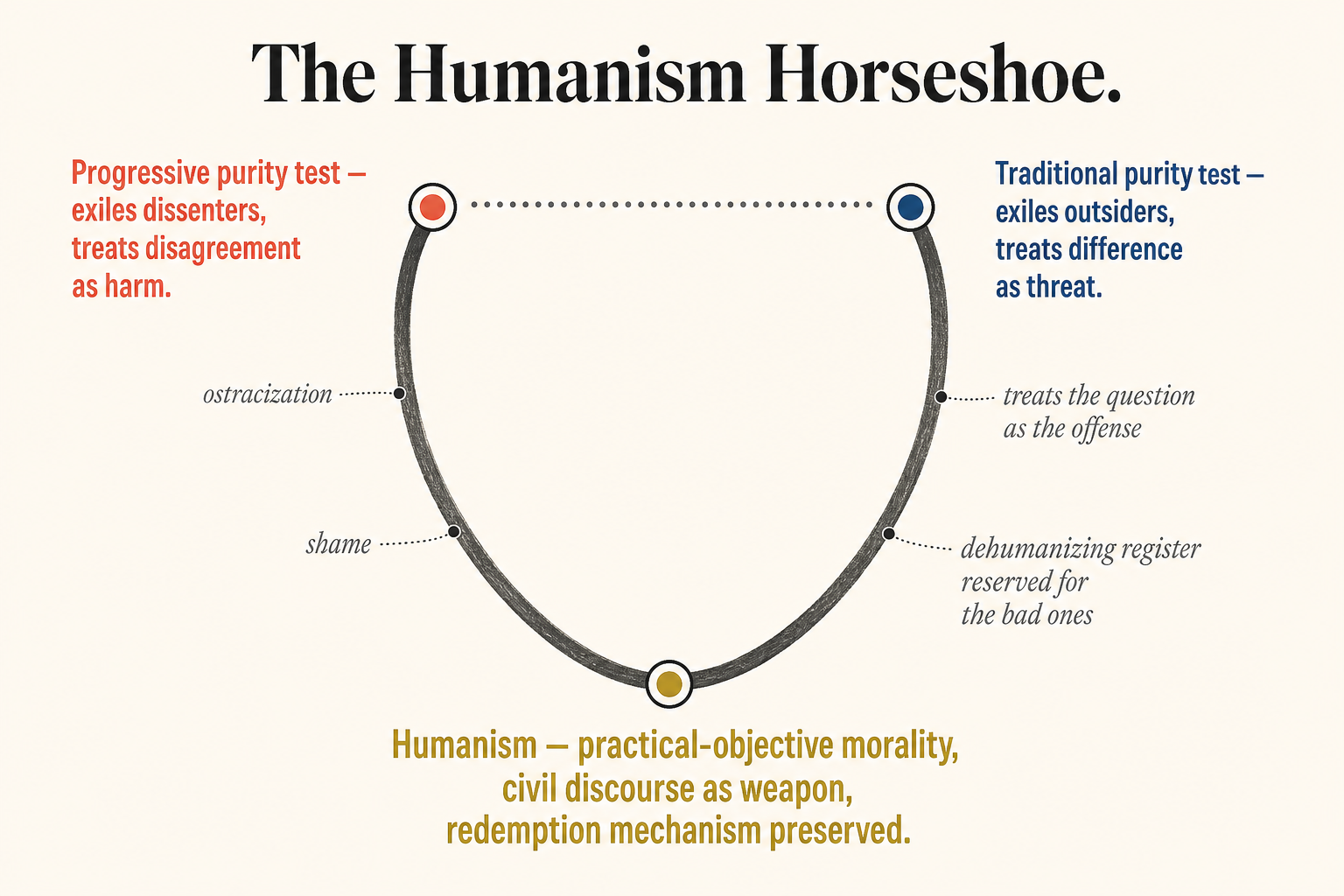
One of the discoveries of the eight years of work that followed this manifesto is that the two ends of the political spectrum are closer to each other than either is to the humanist middle. I called the shape of it the Humanism Horseshoe.
At one tip of the horseshoe is a strain of progressivism that has turned a real moral concern, the protection of vulnerable groups, into a purity-test machine that exiles dissenters and treats disagreement as harm. At the other tip is a strain of traditionalism that has turned a real moral concern, the preservation of community, into a purity-test machine that exiles outsiders and treats difference as threat. The two ends look opposite, but they share the architecture. Both use ostracization. Both use shame. Both treat the act of asking the wrong question as the offense. Both have a dehumanizing register reserved for the people they have classified as the bad ones. Both, in their worst forms, have stopped trying to win arguments and started trying to win territory.
Humanism sits in the middle of the curve, at the bottom of the horseshoe. From the bottom, you can see how both tips work. They both run on fear, in-group enforcement, and the conviction that the other tribe is, on its bad day, less than fully human. The diagnostic is the same. The treatment is the same. The treatment is to refuse to pick up the same instrument.
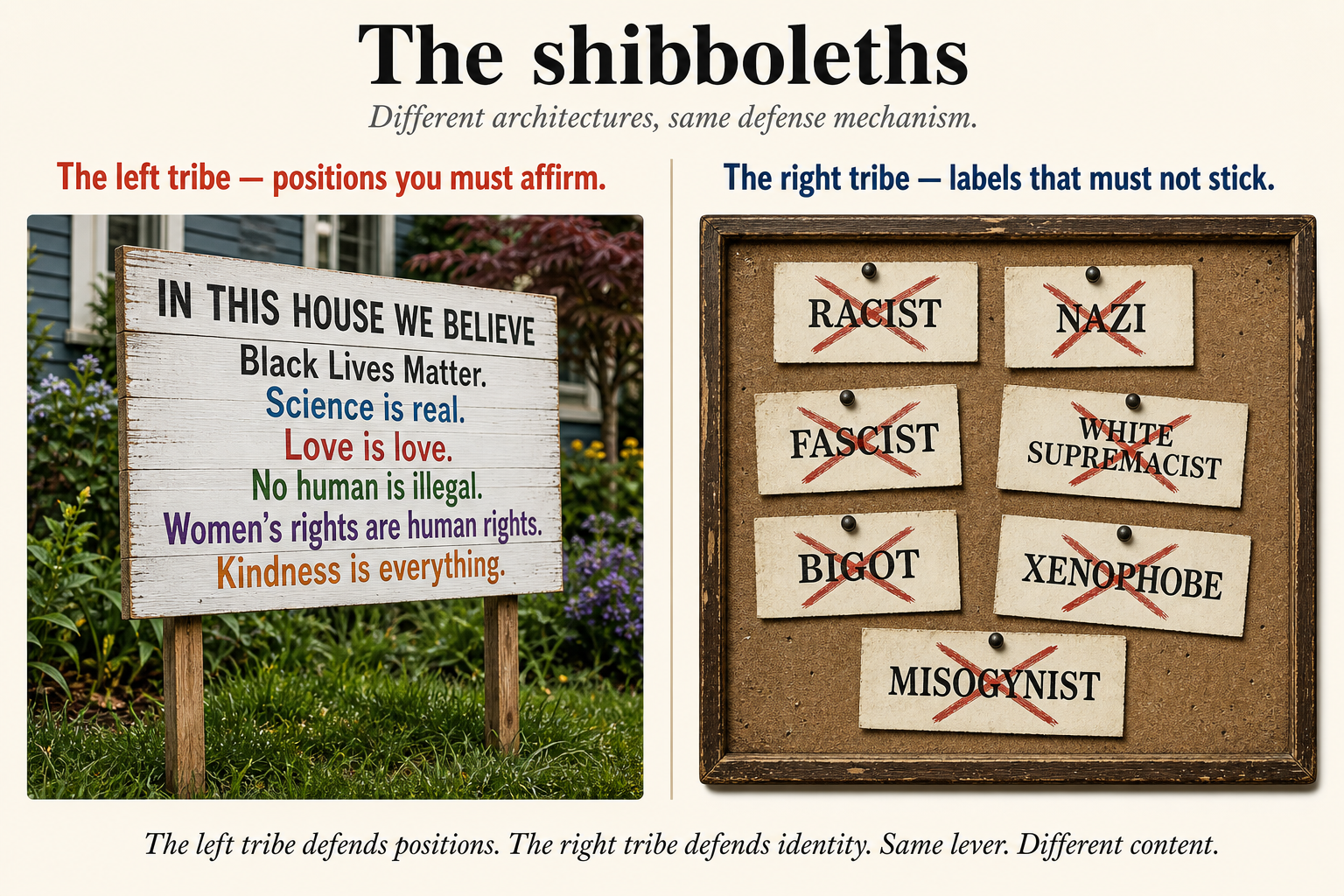
A loyalty test is a phrase, a position, or a style that marks you as inside or outside a tribe. You do not have to take a side in the underlying argument. You just have to pass the test, or fail to. The room knows what to do with you either way.
Both communities I built had loyalty tests. They had different kinds.
The clearest version of the left-leaning tribe's loyalty test is the In This House We Believe yard sign. Every variant has the same architecture. A list of declarative statements you must affirm, in order, all together, with no asterisks. The most common ones, drawn from yard signs and dorm-room posters across the last decade:
Each of these is, at the surface level, a defensible moral claim. Each of them, in the room I had built for religious deconverts who had become culturally progressive, was treated as not only true but unquestionable. Not the claim. The unquestioning. Black lives matter as a statement about the importance of Black lives is something almost everyone would affirm. Black Lives Matter as the name of an organization with specific positions on policing, family structure, and capitalism is a different claim, and one a thoughtful person might want to interrogate. The loyalty-test function of the yard sign was to make the second question feel like the first. To question the organization was to be accused of failing the affirmation of the underlying moral claim. To ask whether the specific policy followed from the general moral fact was to be marked, fast, as having failed the test.
This is what the data from agnostic.com showed me. Race, ethnicity, and immigration was almost never the topic of a public fight on the agnostic side. Not because the users did not care. They cared a great deal. They cared so much that the room had reached a working in-group consensus on what the right answers were, and the report button was the mechanism that kept the consensus from being interrogated. The actual content of agnostic reports, when read in plain text, was mostly about people who had asked questions adjacent to the yard-sign positions. The loyalty test was the perimeter. The reports were the alarm system. Anyone who failed the test got reported, regardless of how politely they had said it.
The right-leaning tribe's loyalty test runs on a different architecture, and it has two halves. The first half is a set of values you must publicly hold without apology. The second half is a set of labels you must not let stick to you. Both are tests of in-group membership, and both are visible in the way the right-leaning room behaved on the data we have.
The affirmative half, drawn from yard signs, bumper stickers, hats, hat tips, homepage banners, and the kind of statements someone has on the wall behind them in the YouTube interview:
Each of these is, on its face, a defensible value that most thoughtful people in this country would endorse in some form. Each of them, in the right-leaning room, is treated as not only defensible but as the floor of decency. To question the patriotic frame is to be marked as anti-American. To question the traditional-family frame is to be marked as anti-family. To question the Western-heritage frame is to be marked as anti-Western, or worse.
The loyalty-test function of the affirmative list is to make any hesitation about any one of these values feel like opposition to all of them, in the same way the yard sign's loyalty-test function works on the other side. A right-leaning person can be a thoughtful Catholic and still want to interrogate specific religious policies. A right-leaning person can value Western philosophy and still be honest about Western colonial history. A right-leaning person can love the country and still ask whether a particular policy serves the country well. The loyalty-test function flattens the second question into the first.
The negative half: a set of labels that must not stick. The right-leaning tribe's second-half loyalty test is the inverse of the left's yard sign. It is not the assertion of positive positions. It is the defense against negative labels.
The list of forbidden labels is shorter and sharper:
When someone on the right-leaning side is accused of being one of these things, the reaction is fast and visceral, and it is often disproportionate to whether the label is actually being applied. The trigger is not the position. The trigger is the dishonor of being labeled the kind of person you are not.
The mechanism is honor-based. The right-leaning side, on the data I have, is largely composed of people who have built their lives around concrete commitments. Family, faith, community, country, work. When someone outside the tribe characterizes them as racist for opposing a specific immigration policy, or fascist for raising a question about an institutional norm, or bigot for holding a traditional view on a contested issue, the attack lands at the level of identity. Not your position is wrong. But you are bad. The honor system in the tribe says you defend yourself, hard, against that kind of attack. The room rewards the defense. The defender is the protagonist.
There is a sharper texture to it that I want to put on the page, because I have heard people on the right describe the experience in their own words and the description is consistent. The trigger is not just the label. It is the perception that the person applying the label is doing so out of trained, almost reflexive contempt. As if the labeler is getting an emotional payoff from finding a bad person to point at. The right-leaning reader feels that the labeler has practiced being offended, has been rewarded socially for being offended in the past, and is now reaching for the same lever on someone the labeler has not actually met. The defensive reaction is hot because the perception is that the attack is performance, not analysis. You are not engaging with me. You are using me as the next opportunity to feel righteous. That is the perceived insult.
This is what the data from IDW.community showed me. Race, ethnicity, and immigration was the second-largest category of user-against-user reports across the lifetime of the site, basically tied with arguments about the moderation rules. Twenty-one and seven-tenths percent of every report on IDW was on that topic. The IDW users were not avoiding the topic. They were fighting about it every day. Most of those fights were about whether a particular line counted as honest critique or as defamatory smear. The negative-side loyalty test was not a position. It was a label. The reports were filed by users who had been called the worst version of who they were, and who were asking the moderator to confirm that they were not, in fact, that thing.
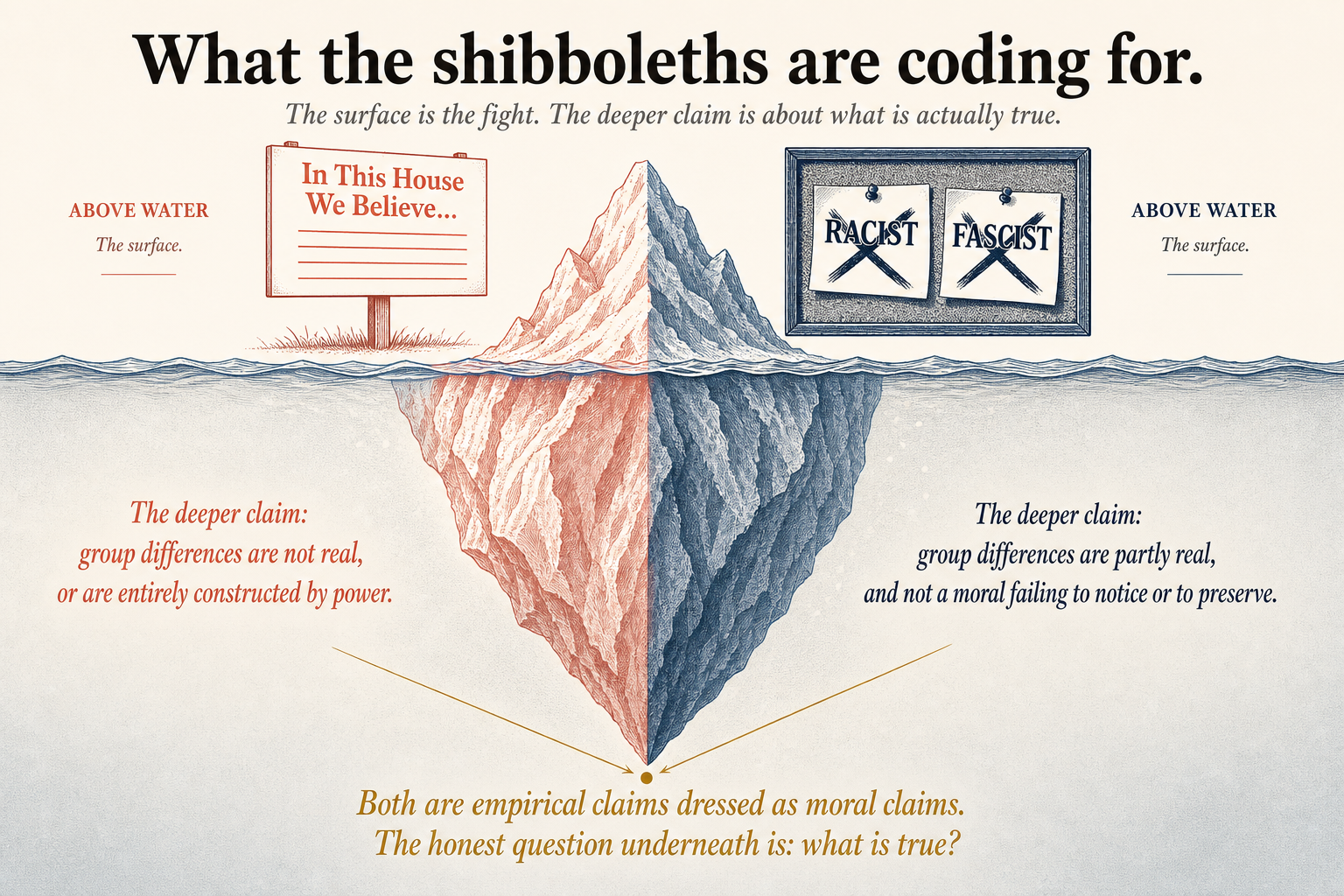
The yard sign and the corkboard are the surface. Each line on the yard sign and each label on the corkboard is a position or a label, taken on its own terms. But the loyalty tests only have the power they do because each one is coding for something underneath. A claim about reality. An assertion that the surface fight is downstream of a deeper disagreement about what is actually true. I am going to walk through the codings here, because the deeper layer is what matters, and the deeper layer is also what humanism is asking both tribes to put on the table honestly.
Each line of the In This House We Believe sign reads as a defensible moral claim on its face. Each is also, when held against the way the line is enforced inside the tribe, a coded assertion about culture and group difference that is sharper than the surface claim is.
Black Lives Matter. As a statement about the importance of Black lives, almost everyone affirms it. As enforced inside the room, it codes for something stronger. It codes for the assertion that European-American culture must be treated as equal to or beneath every other culture, and that any defense of the European-American inheritance is, on its face, evidence of supremacy. That is a different claim. It is an empirical claim about culture, dressed as a moral claim about life.
Science is real. As a defense of evidence-based reasoning, almost everyone affirms it. As enforced, it codes closer to the science the tribe agrees with is real, and the science the tribe does not is dismissed regardless of the evidence. The first is methodological humility. The second is selective scientism.
Love is love. As a defense of the right of consenting adults to form their relationships freely, almost everyone affirms it. As enforced, it codes closer to any hesitation about how to extend this principle is bigotry. The phrase performs the affirmation and pre-emptively labels the disagreer.
No human is illegal. As a statement about the moral worth of immigrants, almost everyone affirms it. As enforced, it codes closer to a country has no legitimate right to define who comes in. That is a different claim, and a contested one.
Women's rights are human rights. Depending on what is being protected, the phrase is either a defensible statement of equal civic rights, or an assertion about a specific position on abortion, which is one of the few questions in public life where most thoughtful people genuinely disagree on moral grounds. I will not pretend I can land that one in two sentences. I will only note that the loyalty-test function of the yard-sign version is to make any hesitation about the second reading sound like opposition to the first.
Kindness is everything. Almost everyone affirms it. The loyalty-test function, on the worst days inside the room, is the implication that whoever has been marked as not having affirmed it is, by the room's accounting, the unkind one.
The deeper coding under all of these, when held together, is the egalitarian assertion: that the differences we observe between groups, in culture, in temperament, in the data the social sciences actually produce, are either non-existent or entirely constructed by power. We are, on this reading, identical. That is the working consensus the agnostic side defended with the report button. That consensus is an empirical claim about the human population, dressed as a moral claim about decency. The two are not the same.
The right's affirmative loyalty test, the one I just listed, codes for something underneath. The assertion is that the Western and European-American inheritance is not only worth defending but worth defending without apology, against any critique that frames it as oppression, supremacy, or privilege. That is the coded claim underneath the affirmative list. It is a historical and cultural claim about the value of a particular civilizational inheritance, dressed as a moral claim about national decency. The two are not the same.
The right's negative loyalty test, the list of labels that must not stick, codes for something related but sharper. The trigger is not just being called racist or fascist. The trigger is the assertion underneath the label, which is that the right has no legitimate cultural inheritance to defend in the first place.
The deeper reading, the one I came to after eight years of running the experiment, is sharper than either half alone.
The trigger on the right is not just being called racist or fascist. The trigger is the assertion underneath the label, which is that the right has no legitimate cultural inheritance to defend. A right-leaning person who walks into any conversation about culture in 2026 knows, before they speak, that any expression of pride in or attachment to the European-American heritage they were raised inside will be treated, by default, as supremacy. That is the trigger. The labels are the delivery mechanism.
What the right tribe is actually defending, under the labels, is the right to value the culture the tribe grew up inside without being treated as a moral failure for doing so. That is a different claim than the surface fight about who gets called what. It is also a claim that the tribe believes, with some justification, the other side has built a vocabulary specifically designed to deny.
The sharper texture I have heard from people on the right, in conversation, is the perception that the labels are not arguments but performance. That the person applying the label is reaching for a familiar emotional payoff, the pleasure of finding a bad person to point at. The defensive reaction is hot because the perception is that the attack is theater. You are not engaging with me. You are using me as the next opportunity to feel righteous. That is the insult underneath the label.
I want to name the closed loop the label produces, because both tribes have learned the same trick and the trick is what keeps the conversation from happening. Label the opponent with the worst label you can defend. Then, when the opponent reacts, treat the reaction as confirmation of the label. The calm response is read as defensiveness. The angry response is read as proof of bad character. Either reaction confirms the label. The labeler walks away convinced. The labeled walks away angrier. The label sticks. The argument never happens. The left's vocabulary for this is racist, fascist, bigot, homophobe. The right's vocabulary is snowflake, woke, hysterical, terminally online. The vocabulary differs. The closed loop is identical. The honest researcher's catch on the loop is that the loop is the problem, regardless of who is running it on whom.
This is the convergence, and it is the move that, eventually, made me fund Aporia.
The left tribe's deeper assertion is that observable group differences are not real, or are entirely constructed by power. The right tribe's deeper assertion is that observable group differences are partly real, partly cultural, possibly partly heritable, and are not a moral failing to notice or to preserve. Both are claims about reality. Both are testable, at least in principle, by careful research. Neither is best resolved by the report button on a community site or by the counter-accusation in a comment thread.
What I have come to believe, after eight years of running both sides on the same engine, is that the surface fight is performative on both ends. The yard sign is performative. The corkboard is performative. The shouting on television is performative. The performative layer keeps the room loyal. It also keeps the room from ever asking the question the room is actually built around.
The fundamental question, under both sets of loyalty tests, is what is actually true about human group difference, what is heritable, what is environmental, what is cultural, and what is policy-movable. Humanism, as I have come to use the word in 2026, is the willingness to put that question on the table honestly, with the rigor it deserves, and to follow the answer wherever it goes, regardless of which tribe the answer makes uncomfortable.
That is the bedrock question, named again. To what extent can multicultural societies harmonize without coercion. The loyalty tests on both ends prevent the question from being asked. Humanism, at its strongest, is what asks it anyway.
This is the practice. It is not a creed. It is not a membership card. It is a set of habits you can take with you into any room, any conversation, any feed. You can read it once and decide it is corny. That is allowed. You can read it once and decide that it is a working description of how you wish to be in the world. That is the offer.
That is humanism. Good people welcomed.
I wrote the manifesto above in 2017. Over the next eight years I tested it in public. I built two online communities on the same engine. I posted seed essays drawn directly from the document you just read at the welcome page of both. I watched what happened.
Most of what the manifesto says held up. The diagnosis of dehumanization was correct, and got worse as the years went on. The case that redemption, mercy, and forgiveness are load-bearing social functions has gotten stronger, not weaker, as cancellation culture has shown what a society without them looks like.
The one thing the manifesto got wrong, and it got it wrong in a way that mattered, is the chapter on civil discourse. The 2017 version argued that civility is a weapon you can wield against social extremism, and that any room can be civilized by an operator who is sincere enough about the practice. After eight years of running the experiment, with the data on my laptop, I cannot defend that claim in its full strength.
What the data shows is that civility is a property that holds within rooms, on most topics, between people who came in good faith. Civility does not hold across the few topics each room has decided to protect from inquiry. On those topics, the same room that was warm an hour earlier turns to ostracization fast, and the rules of civil discourse cannot prevent it. The medium does not deliver civility on outgroup prompts. The author has to. And even the author, on most days, does not.
What I have arrived at, by 2026, is a wider framework. Civil discourse remains the practice. But it sits inside a larger one. The larger practice is Beauty, Truth, Love. Beauty because it bypasses the ideological armor a person walks in with. Truth because it is the load-bearing pillar that keeps love safe and lets beauty be created. Love because it is the connective tissue both rooms had been trying to build through dialogue and could not, past their tribal protections.
When the community-engineering question closed in 2021, the natural move was to ask, in plain English, if a community site cannot host the careful question, what can. The answer I came to was a publication. Edited by a working scholar who could write about hard topics with care, paid by a funder who would not interfere, citation-heavy, calm in prose, slow on the page. That publication is Aporia. I funded it from 2022 through the end of my philanthropic commitment in 2024, by which point it had produced 832 articles.
I was raised by my mother, Reva Conru, on the principle that if you are going to do anything, you do not do it half-assed. You do it fully or you do not do it. Funding a publication on contested questions, hands-off on editorial, with a planned multi-year horizon and a real budget, was the not-half-assed version of asking the question my community sites had been circling for five years. That is the path from the 2017 manifesto to the 2022 funding decision, said in the voice my mother would have understood.
The 2017 manifesto is the philosophical foundation. The 2026 framework is the practice. The full case for the practice, with the data, is on the rest of this site at conru.com/tribes/. The shortest readable version is The Connection Question. The longest is the field manual, which is gated.
Good people welcomed. Still the right motto. Still the door we are trying to keep open.