
What Two Hundred Thousand People Taught Me About Talking to Each Other
This is one of three book versions on this page. Also read: The Connection Engine · Two Cities Autopsy.
I wrote 36 essays on agnostic.com between 2017 and 2020 about what humanism is for. I wrote 47 essays on slug.com between 2019 and 2022 about mostly the same thing, with the framing tweaked. Most of those 83 essays still hold up. A few of them did not survive contact with the data.
The first one I want to revise is the one called “Introduction to Humanism.”
The 2017 version of the argument was clean. Humanism is a working theory of how people stay human to each other when the older binding agents have weakened. Religion used to do most of that work. Family used to do some of it. Town used to do some. By 2017 each of those sources of common floor was thinner than it had been twenty years before, and the thing that was supposed to fill in for them, pluralism, was working in some places and visibly failing in others. Humanism was my proposed working floor. Be decent to each other on purpose. Treat the other person’s question as a real question. Defer to evidence where evidence is available. Reduce suffering where you can. Do not outsource your conscience to a tribe.
I believed that argument when I wrote it. I still mostly believe it. The part of it I would write differently in 2026 is not the moral content. The moral content was fine. The part I would write differently is the assumption underneath it.
The 2017 essay assumed that the person reading it had already chosen the path. I was writing for someone who had walked out of a church and was looking for a new floor. The essay handed them the floor. It treated humanism the way a guidebook treats a country you have already bought a ticket to. Welcome. Here are the customs. Here is the language. Try the food.
The data says I was writing that essay into one of two very different rooms, and only one of those rooms actually had the audience the essay assumed.
Five years later I sat down with the cluster math and read the names of the behavioral groupings on each site, side by side. The agnostic clusters, ten of them, named by a model that had read several thousand bios and posts: Seeking Connection Questioners. Curious Newcomers. Thoughtful Elder Skeptics. Seeking Connection Seekers. Bruised Seekers. A second pool of Curious Newcomers. Thoughtful Philosophical Skeptics. Seeking Secular Community. Progressive Freethinkers. Tentative Truth-Seekers.
Eight of those ten labels carried a verb of looking-for. Seeking, curious, tentative, bruised, newcomer. The dominant agnostic posture, ground-truthed by behavior, was a person who had walked out of one floor and was holding their hands open looking for the next one.
The slug.com clusters, eight of them, named the same way: Heterodox Questioners. Skeptical Truth-Seekers. Cultural Grievance Veterans. Skeptical Heterodox Newcomers. Heterodox Traditionalist Skeptics. Heterodox Contrarians. Quiet Spectators. A small Bot and Spam pool the algorithm caught.
Six of those eight labels carried a verb of pushing-back. Heterodox, skeptical, contrarian, grievance, traditionalist skeptic. The dominant slug.com posture was a person who had a question that had become unwelcome somewhere, and had brought it here to argue with whoever might tell them it was unwelcome here too.
Two rooms, same engine, same builder, same humanism essays, ported with the framing tweaked. Two completely different welcome scripts, written by the first thousand users on each side, before I had any say in it.
This is the part the 2017 “Introduction to Humanism” did not account for. The essay handed a moral floor to a reader I imagined as a seeker. On the agnostic side that reader actually existed. The 22.0%-of-active Seeking Connection Seekers cluster, about 3,750 individuals on a 17,062 active universe, was the modal participant the essay was written for. They read the essay. They wrote about losing a parent. They asked for advice about Thanksgiving with their evangelical sister. They built a small floor under their own grief in a county where they had nobody else to talk to. The essay landed because the reader was the one I had pictured.
On the slug.com side, the same essay landed in a different room. The largest cluster was Quiet Spectators at 19.5%. The second largest was Skeptical Truth-Seekers at 17.7%. Neither cluster had a verb of seeking-a-new-floor. They had verbs of testing a floor that was already laid down somewhere else. When the essay said “treat the other person’s question as a real question,” the seeker on agnostic read that as permission. The skeptic on slug.com read it as a debate prompt. Same paragraph. Different reader. Different speech act on the back end.
I want to be careful here, because the punchline is not “humanism is for seekers and not for disagreers.” That is too easy and it is not true. The punchline is that humanism does different work in a seeker room than it does in a disagreer room, and the 2017 essay was written for one room and got copied across to both.
In a seeker room, humanism is a floor. People who have lost the older floor stand on it. They use it to recover their footing while they are figuring out what they actually believe. The essay is an instrument of repair. It does the work of a chaplain in a hospital. You do not argue with a chaplain. You let the chaplain do the chaplain thing, and then you go to bed and you sleep a little better.
In a disagreer room, humanism is a referee. People who came in pushing back use it to test whether the room will be fair to their question. The essay is an instrument of arbitration. It does the work of a judge in a small civil court. You argue with a judge. You bring evidence. You watch carefully whether the judge applies the same rules to the other side.
Same words. Two different jobs. The reader on each side picks up the job that fits the room they walked into.
The 2017 essay did not know this. The 2017 essay treated humanism as a single instrument. It assumed the reader was already a seeker, because the writer was already a seeker, and the writer wrote the essay for a community that had organized itself around seekers, because the launch population on agnostic in June 2017 happened to be 80%-ish people walking out of religion looking for a place to land. The essay was a floor. It worked.
When the same essay got ported across, framing tweaked, to a 2019 launch population of 60%-ish people pushing back on the cancel-wave era, the floor became a referee. It still worked. It worked differently. On agnostic the essay reduced loneliness. On slug.com the essay reduced unfairness. Both real wins. Both not what I had specifically thought I was writing for.
This is the empirical update. Here is the practical take-away.
If you are running a community, paid or unpaid, ten people or two hundred thousand, you can run a one-page test on it before you write your version of the humanism essay. The test is four questions. Read your room’s last twenty posts. Then ask:
One. What verbs are doing the work in those posts. Looking, asking, sharing, telling, trying, wondering. Or pushing, defending, refuting, exposing, calling out, demanding.
Two. When somebody in the room is wrong about something factual, what does the room do. Correct gently and ask follow-up. Or pile on and make sure everybody else sees they were corrected.
Three. When somebody in the room shares something personal that has nothing to do with the room’s nominal subject, what does the room do. Welcome the share and add their own. Or scroll past it because it is off-topic.
Four. When a question lands that does not have an obvious right answer, what does the room do. Talk about it for a week. Or settle it in three replies and lock the thread.
If most of your room’s verbs are looking-for and the room shows up for personal sharing and tolerates ambiguity, you have a seeker room. Your humanism essay is a floor. Write it like a chaplain. Use the words “we,” “here,” “between us,” “together,” and use them honestly.
If most of your room’s verbs are pushing-back and the room polices factual error fast and resolves ambiguity quickly, you have a disagreer room. Your humanism essay is a referee. Write it like a judge. Use the words “rule,” “fair,” “evidence,” “consistent,” “the same rules to both sides,” and use them honestly.
If you write the chaplain essay for a disagreer room, the room will read the essay as weak. If you write the judge essay for a seeker room, the room will read the essay as cold. Both moves cost you the audience that came in for what the room actually had to give.
The harder version of the same take-away is that nobody gets to pick which kind of room they have. The room is a property of the first thousand users. By the time the founder writes the second essay, the room has already chosen. The founder’s job is to read what the room chose and write the essay that matches it, not the essay the founder thought they were going to write before they opened the door.
The 2017 me had picked one essay. The 2019 me had picked the same essay, framing tweaked. Both essays did real work. Neither of them was the essay the second room actually needed.
This is not a confession. It is an evidence-based update. Humanism is still a working theory of how people stay human to each other when the older binding agents have weakened. The theory is still the right one. What changed in 2026 is that I now know the theory cashes out in two different operational modes, depending on the room you are running it inside, and I would write the essay for each room separately the next time.
That is one chapter’s worth of revision. There are nine more chapters in this manual. The next one is about the part of the dehumanization cycle that I had originally written about as a thing other people do.
It turns out that part of it is also a thing the writer does, to himself, on Tuesday afternoon, in a study with the door closed, when nobody is reading.
That chapter starts on the next page.
The original 2017 essay called “Self-Dehumanization and Dehumanization Cycles” was the harder of the two essays I wrote that month. I posted the easier one first. The dehumanization-cycle essay sat on my hard drive for about three weeks before I posted it. I did not like the conclusion. I posted it anyway because the conclusion was the point.
The argument went like this. Most of the public conversation about dehumanization is about what people in groups do to other people in other groups. They label the outgroup as less than human. Vermin. Termites. Cockroaches. Stupid. Evil. Worthless. Beyond redemption. The history of every atrocity we know about goes through that doorway. The labels do the work of letting otherwise-decent people stop seeing the other person as a person.
That much was old. I did not invent any of it. I was synthesizing language that goes back to twentieth-century social psychology and earlier than that to the moralists I had read in college.
The piece I was trying to add was the inside half. Long before a person dehumanizes a stranger, the same person has been dehumanizing themselves. They have been calling themselves stupid for the small mistake at work. Worthless after the relationship ended. Evil for the desire they did not act on. Beyond redemption for the failure they have not told anyone about. The internal voice has been running the same labels, on the same person, for years. By the time the external world hands them an outgroup to apply the labels to, the muscle is already trained. The targeting is the only thing that changes.
That was the 2017 argument. It was uncomfortable because it implicates the reader. A clean essay about dehumanization is a tool the reader can use against bad people somewhere else. The self-dehumanization version is a tool that turns around in the reader’s hand as soon as they pick it up.
I posted the essay. A small number of people on agnostic responded thoughtfully. Most of the audience treated it the way most audiences treat an essay that is mostly about them. They scrolled past it.
The other essay from that period, called “Agnostics, Atheists, Humanists and Extremists,” made the related point that the dehumanization muscle does not care which side of a moral question you are on. A new atheist who has discovered that religion is bad, and now treats every believer as stupid, is running the same muscle as the pious person who has decided that the unbeliever is evil. Both feel righteous. Both produce the same downstream behavior. The label is the work. The cause is incidental. The two essays were a pair. The first one named the muscle. The second one said the muscle does not respect your team.
I want to be honest about the next part. Five years after I wrote those two essays, the data caught me running the cycle in my own writing. Not metaphorically. Specifically.
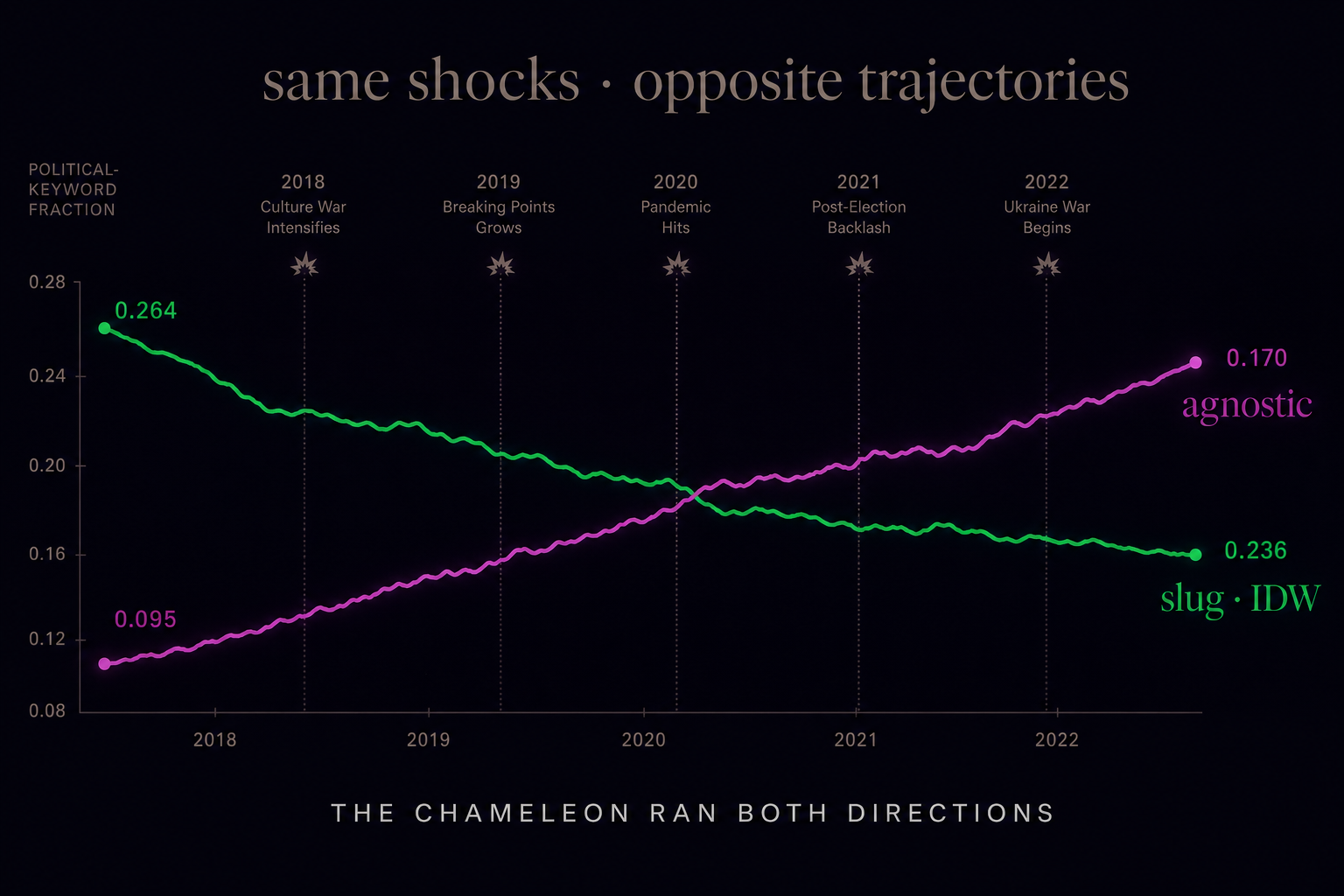
The voice-trajectory study, run in 2025, sampled 2,999 of my own posts across both communities and scored them month by month on five dimensions. One of the dimensions was politicization. My agnostic-side baseline mean was 0.21 on a 0-10 scale across the four-and-a-half-year run. In January 2021, the month of the Capitol breach and the inauguration, my agnostic-side politicization mean for the month was 2.41 across 32 posts. That is +2.20 above my own site-wide baseline. The largest single-month inflection in the entire 2,999-post corpus. Followed by 2.07 in December 2020 and 2.03 in February 2021. Three consecutive months of spike. The author of the engineered-civility essays, the moderator with his name on the front page, sliding into a register he had specifically warned readers about, in the room he had specifically built to hold the line.
That is one half of the data point. The other half is the dehumanization-events count on the same surface. On agnostic, the rate of dehumanization events on my own posts was about 0.5 per pair through the pre-2020 baseline. In the Jan 6 to inauguration window, January 6 through January 20, 2021, the same rate was 6.8. About thirteen times the pre-political baseline. Same author. Same site. Different month. Different posture. The label I had been writing about for three years had migrated, through the muscle of my own internal voice, into my actual external writing. On the platform I had built. With my name signed.
The honest version of what happened is not “external events made me write that way.” External events were the trigger. The muscle was already trained. I had spent two years writing essays about self-dehumanization and noticing the cycle in the people who reported each other on agnostic. I had noticed it less in myself. I had been calling myself stupid in private for two decades for the routine engineering mistakes most engineers make. I had been calling myself naive after the second site started attracting an audience I had not designed for. By January 2021 the muscle was warm. The Capitol breach gave it a target. The target was easy. I took it.
I am not the worst case in the corpus. I am also not even close to the cleanest case in the corpus. There are users on the agnostic side, names I will not put in a book, whose dehumanization-events rate per post sits at the high end across years, not months. I am one writer in a 209,110-user community. I am also the writer who built the community and wrote the seed essay specifically warning the community about the muscle. The muscle came for me anyway. That is the data point I have to make peace with.
The empirical update to the 2017 essay is this.
Self-dehumanization is not just a psychological precursor to outward dehumanization. It is the same operation, performed first on the self and then reused on a target. The voice that calls you worthless on Tuesday afternoon is the voice that calls a stranger worthless on Saturday morning. The training reps happen inside. The performance happens outside. By the time the outside performance is loud enough for somebody else to notice it, you have done somewhere between five and a thousand silent reps you did not count.
The cycle is not other people. The cycle is the writer too.
If the 2017 essay implied that the discipline of humanism was something you applied to other people, the 2026 update is that the discipline of humanism is something you apply, first and most often and most quietly, to yourself. Not in the wishful-thinking self-help sense. In the literal interior-monologue training-reps sense. The way you talk to yourself in your own head when nobody is listening is the script your mouth will run on the day you are tired and angry and somebody hands you an outgroup.
Here is the practical take-away. It is a five-question self-check. I run it before I post anything contested. I have run it on this chapter twice while writing it.
One. Read what you wrote out loud. Pretend you are reading it to a person you respect who disagrees with you. Are you describing a position, or are you describing a person who holds the position. If you wrote “the position is wrong because of X,” you are describing a position. If you wrote “people who hold this position are Y,” you are describing the people. You can describe the position. Be careful about describing the people.
Two. Find every place in your draft where you used a label that names a group rather than a behavior. For each one, ask whether you could replace it with the specific behavior you are actually objecting to. “People who voted for X.” “People who said Y on a platform last week.” If you can replace it, replace it. If you cannot, ask why not.
Three. Find every adjective in your draft that is used to describe a person rather than an action. Stupid. Evil. Insane. Worthless. Beyond reach. For each one, ask whether you would say the same word to that person’s face in a kitchen, calmly, looking at them. If you would not, take it out.
Four. Read your last three pages of writing. Then read your last three pages of internal monologue, the way you talk to yourself when nobody is around. They should sound like the same speaker. If your internal monologue is meaner than your public writing, your public writing is going to drift toward your internal monologue under stress. Fix the internal one first.
Five. Sit on whatever you wrote for twenty-four hours before you post it. The cycle is fast. The check is slow. Use the slowness. Most of the time the twenty-four hours is the only difference between a post you regret and a post you do not.
Those five are not novel. None of them are mine. I am restating, in 2026, what people have been saying about controlling speech for as long as people have been writing about speech. The reason to restate them in this manual is the data on me.
If the engineer of the room, the author of the seed essays, the moderator, the person whose name was on the front page of the platform, can produce a thirteen-times increase in his own dehumanization-events rate in a fourteen-day window because the news was heavy and his internal voice had been training on him for years, then anyone reading this can produce the same spike when their own news is heavy. The cycle does not respect titles. It does not respect that you read the books. It does not respect that you wrote the essay. It comes for the writer too.
I had spent three years of public writing telling other people the cycle was dangerous. I had spent zero years of private practice running the five-question check on myself. The data caught me. I am writing this chapter as the public note that the data caught me, so that the next person who reads the 2017 essay does not assume, the way I did, that being the author insulates them from the muscle.
The next chapter is about the other half of the same writing. Civil discourse. I had written for years that civility was a weapon and not a courtesy. The matched cross-posts and the topic-asymmetric meltdowns will say something more specific than I had said in 2017. Civility is a weapon, yes. The 2026 question is whose weapon, on which day, against which prompt.
That chapter starts on the next page.
In 2017 I wrote an essay called “How To Be Civil While Having Impact Today.” The line in it that the most readers quoted back at me, mostly in supportive direct messages, was the one that said children shout each other down, and adults stay calm because calm is the dominant move.
The argument was the realist one. If you actually want to win an argument in front of other people, the most powerful tool you have is a calm, factual, civil exchange. Calm makes the other person’s emotion legible. Calm puts the burden of proof on whoever brought heat. Calm, deployed by an adult who has done their reading, embarrasses a hot opponent in front of the audience. Civility is not weakness. Civility is not politeness. Civility is the dominant move in a public conversation about a contested question. Children shout. Adults stay calm. The adult wins.
I believed that argument. I still mostly believe it. The 2017 essay had one assumption inside it that the data eventually broke.
The assumption was that civility was a portable virtue. If you trained the muscle, you could carry it across rooms. The civility you used in a town hall meeting was the same civility you used at the Thanksgiving table was the same civility you used on a community website at midnight. The skill traveled with the person. Build civic adults and the conversations would track.
The matched-pair data on agnostic and slug.com between June 2017 and February 2022 says no.
Here is the specific finding.
Between June 2017 and February 2022 I posted 749 questions across the two communities. 49 of those became scoreable matched pairs: near-duplicates, same prompt, both sides, within fourteen days of each other, with at least three substantive responses on each side. (The wider duplicate pool was 52; 33 hit both sides the same day or the next day.) That was enough for a model to score each response thread on civility, dehumanization-event count, and on-topic rate.
If you average all 49 pairs together, the picture is boring. Civility 7.18 on agnostic. 6.86 on slug.com. A 0.3-point gap. Both communities testing as substantive, on-topic, low-ad-hominem. The headline number says I built two civil rooms.
Stop there and you have read the wrong table.
The pairs split cleanly into five time buckets, and inside the buckets the picture is different.
Pre-2020. Sixteen pairs. Almost all platform housekeeping. Layout changes, feature requests, “what would you build next,” “how is the new home page,” that kind of thing. agnostic civility 8.94. slug.com civility 8.61. Both maxed out. Whatever I had built, both rooms could handle it.
2020 summer, June through August. Seven pairs. COVID, BLM, civil unrest. agnostic civility 9.36. slug.com civility 7.57. The agnostic side got warmer under stress. The slug.com side held but did not match the warmth.
2020 election, September through December. Seventeen pairs. Both sides crashed from the 8s and 9s down to the 5s. agnostic civility 5.89. slug.com civility 5.48. Dehumanization events on agnostic per pair went from rounding to zero up to 4.6 per pair. Both communities degraded in parallel, not in opposition. It was not a left-versus-right meltdown. It was a politics-walked-in meltdown, and both rooms broke at the same time.
January 6 to inauguration, January 7 through January 20, 2021. Five pairs. agnostic civility 4.04. slug.com civility 6.26. A gap of +2.22 in slug.com’s favor. The only window in the full corpus where the slug.com side scored sharply more civil than the agnostic side. agnostic dehumanization-events for the period averaged 6.8 per pair, the highest single-period count in the corpus.
Biden’s first month, January 21 through February 20, 2021. Four pairs. agnostic civility 5.75. slug.com civility 5.25. The cross-site average flipped back. agnostic cooler than slug.com again.
Five buckets. Five readings. The 7.18 versus 6.86 average across the whole corpus is not wrong. It is true. It is just five different stories laid on top of each other and averaged into one boring number.
The bucket math gets sharper if you zoom into individual prompts.
December 18, 2020. I posted “Should some research topics be banned or results censored?” to both rooms. agnostic civility 6.5. slug.com civility 7.0. Both rooms engaged the question seriously. About 18 people responded on agnostic, mostly Bruised Seekers and Thoughtful Elder Skeptics. About 26 people responded on slug.com, mostly Heterodox Traditionalist Skeptics and Cultural Grievance Veterans. Both groups argued, broadly, that the answer was no, you do not ban research topics, you do them carefully. Nobody got reported. Nobody got blocked. The question that, two and a half years later, would be characterized as something I had funded research about, was handled civilly by both communities on the same day, in 2020, before any of the press cycle had happened.
January 13, 2021. Six days after the Capitol breach. I posted “What did Trump do, if anything, to incite violence?” to both communities. Same question. Two rooms. agnostic civility 2.5. slug.com civility 7.5. A 5.0-point gap. The slug.com thread that day was the more thoughtful conversation about a contested political event. The agnostic thread was an outgroup eruption.
January 27, 2021. One week into the new administration. I posted “How is Biden doing?” to both sites. agnostic civility 7.5. slug.com civility 3.5. A gap of -4.0. The same agnostic room that had erupted on the previous question handled the new administration cool. The same slug.com room that had handled the previous question well erupted on this one.
February 9, 2021. I posted “What dangerous, wrong, or false things do Conservatives believe?” to both sites. agnostic civility 2.5, with 17 dehumanization events on the top 25 responses, the highest single-pair count in the corpus. slug.com civility 5.5. Identical structural pattern. The room whose outgroup the prompt named had the meltdown.
The pattern works in reverse too. November 9, 2020, the week the Pfizer vaccine emergency-authorization news landed. I posted a “would you take it” question to both sites. agnostic civility 8.5, with the science-trusting crowd handling it calmly. slug.com civility 4.0, with the freedom-frame and skepticism crowd erupting. Most readers expect that pair to flip the other direction. It did not. The room whose existing posture matched the prompt handled it calmly. The room whose existing posture clashed with the prompt erupted.
This is the empirical update.
Each tribe’s civility was outgroup-triggered, not constant. The 2017 essay had implied that civility was a portable virtue. The 2026 reading is that civility is conditional on the prompt. Each tribe is fully capable of staying calm. Each tribe will stay calm for years on end on questions that do not name its outgroup. Both tribes will lose the ability to stay calm on the prompts that do.
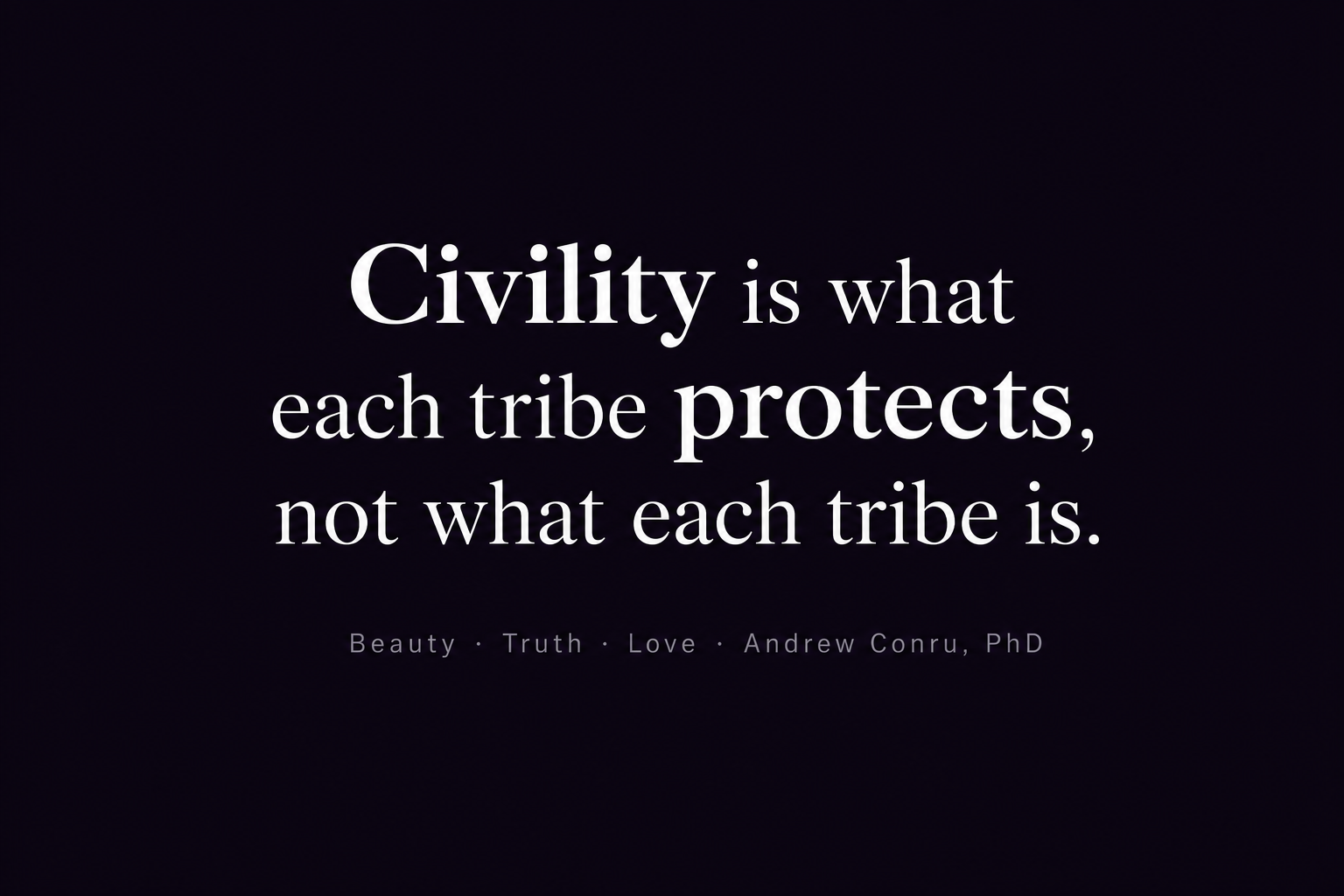
The reframed claim is the honest one. Civility is not what each tribe is. Civility is what each tribe protects.
Both rooms protected something. Both rooms protected it well. Neither room protected the same thing, and neither room had a portable civility you could detach from the protection job and carry out into a different prompt.
That is the data. Now the take-away.
Here is a two-step prompt-rewrite the reader can run before posting any contested question, online or at a dinner table. The point of the rewrite is to test whether you are testing an idea or testing a tribe.
Step one. Read your prompt as written. Then write a near-identical prompt that swaps the named outgroup for the named ingroup. If your prompt is “what dangerous things do conservatives believe,” the swap is “what dangerous things do progressives believe.” If your prompt is “how is Biden doing,” the swap is “how is Trump doing.” If your prompt is “should some research topics be banned,” the swap is itself, because no outgroup is named. The good prompts do not have a swap, because they describe the question, not the tribe.
Step two. Imagine your audience reading both versions. If you would feel comfortable posting the swap version with the same energy and the same expectation of civil engagement, your original prompt is testing an idea. Post it. If you would feel uncomfortable posting the swap version, or you would rephrase the swap version to be more careful, you are not testing an idea. You are testing a tribe. The tribe you are testing is the one whose label you put in the original prompt. Your own.
The agnostic room would have benefited from the swap test on the conservative-beliefs prompt in February 2021. The slug.com room would have benefited from the swap test on the Biden-doing prompt and the vaccine prompt. I would have benefited from the swap test on more of my own questions than I am proud of.
The reason the swap test works is that it forces the asker to notice whose perimeter the prompt sits on. A real question about a hard topic looks the same with either tribe in the prompt. A tribal challenge dressed up as a question reveals itself the moment the swap is applied. The swap test is one minute of work. It catches most of the dressing-up.
The 2017 essay was right that civility is a weapon and not a courtesy. The 2026 update is that there are two civility-weapons, one in each tribe’s hand, both calibrated to defend their own perimeter, and the operator who has access to both weapons is the one who notices, on each given prompt, which weapon is being drawn.
Children shout each other down. Adults stay calm because calm is the dominant move. Both halves still hold. The 2026 addition is that adults also notice, before they speak, whether the calm they are about to deploy is a tool of inquiry or a tool of in-group defense.
Most of the time it is one of those. Sometimes it is the other one. Telling them apart is the whole game.
That ends the third chapter. The next chapter is about what happens after a community has melted down on a contested prompt. The block button on a website is not a redemption protocol. Religion ran one. The modern room does not. We will need to build one if we want anybody to come back.
That chapter starts on the next page.
In the original 36 there is a short essay called Humanist Forgiveness and Redemption. It might be the most useful thing I wrote on the front page of agnostic.com between 2017 and 2022. I have re-read it more times than I have re-read any of the others. It has held up the worst.
The argument was three sentences.
For most of human history, religion ran a protocol for being wrong. You did the thing you should not have done. You confessed it in the form your tradition prescribed. You took the consequence in the form your tradition prescribed. You were reabsorbed. You came back the next week to the same room with the same people and ate the same meal. The cycle ran on a calendar. Sunday morning. Yom Kippur. Ramadan. A folding-chair meeting in a cinder-block annex with bad coffee. The tradition varied. Every functioning premodern community had one. The protocol was load-bearing, not decorative.
Without the religious frame, modern communities have to build the protocol themselves or run without one. The 2017 essay said the second was not a real option. A community without a redemption protocol is one bad month away from being a community of one-way doors.
The 2017 me wrote that, then went and built two communities with no redemption protocol on either side. Five years later the ledger is in.
Here is the ledger.
Normalized for community size and how active each community actually was each month, on the 105,856 active-user-month denominator across the agnostic run and the 29,358 active-user-month denominator across the slug run, agnostic users blocked each other 323.7 times per 1,000 active-user-months. Slug users blocked each other 68.5 times per 1,000 active-user-months. The agnostic side ran 4.7 times more blocks per unit of engagement. User-on-user reports per 1,000 active-user-months ran 25.4 on agnostic versus 2.7 on slug, a 9.6 ratio. Content reports ran 71.7 versus 24.7, a 2.9 ratio.
The cleanest version of the gap shows up inside the cross-site cohort. Of 15,957 dual-platform members, 291 were active on both sides between 2017-06 and 2022-02. Same human, same email address, same buttons available on each side. Same person filed 23.3 times more abuse reports on agnostic than on slug, and received 13.8 times more reports back. One brain, two rooms, twenty-three times the reporting volume on one side compared to the other.
Now look at where the conflict was concentrated.
On agnostic, the most loaded structural edge in the entire conflict graph was a single archetype-to-archetype channel. The cluster the AI labeled Thoughtful Elder Skeptics, 313 users at 1.8% of agnostic active users, filed 702 reports against the cluster labeled Bruised Seekers, 859 users at 5.0% of agnostic active. That single edge ran 20.6 times the off-diagonal mean of every other report flow on the site. The reciprocal edge, Bruised Seekers reporting Thoughtful Elder Skeptics back, ran 202 reports, still 5.9 times the mean. Most of agnostic’s 73,502 abuse rows were a thousand or so people in two clusters fighting each other reciprocally for five years, with the rest of the room reading past it.
That is what no redemption infrastructure looks like in a ledger. A reciprocal combat loop, on cadence, between the same handful of named users, year after year, with no exit ramp and no path back.
The other piece of the picture is what I had said I was building these rooms for. On January 1, 2018, six months after launch, I posted the stated goals of the agnostic project on the front page. There were three. Move people from belief to nonbelief to advocacy. Make nonbelief normal. Reduce the suffering caused by religion.
The third one is the one that has been sitting in my chest since the data came in. I had told the room I was building it to reduce the suffering caused by religion. I had then proceeded to build a room that reproduced one of religion’s worst features, the expulsion ritual, without the redemption protocol that historically counterbalanced it. The block button was the only mechanism the room had for being wronged. The block button is a one-way door. It excommunicates without confession, without consequence, without re-entry. It is the worst half of the religious tradition with the better half stripped out.
I had built excommunication and called it moderation.
I had built it on both sides. The slug ledger ran lower on the button counts. It did not run lower on the underlying problem. The same one-way door was the only door on the slug side too. The reason the slug numbers are smaller is partly that the conflict-driver subgroup on that side was smaller and partly that its preferred conflict surface routed through different topics, not through the report queue. The structural failure, no path back after a bad week, was the same failure on both sides. One side filed more reports about it. The other side ran the same vacuum quietly. Neither room had the better half.
This is the piece the 2017 essay missed and the data made me see. The block is structurally an expulsion tool, not a redemption tool. Every time it gets pressed, it does the half of the religious package that produces grievance and exit, and nothing of the half that produces re-entry and continuation. A community that runs only the expulsion half generates the report ledger I just quoted. A community that runs both halves runs on a different cadence and the ledger looks different.
There is a reframe inside this that I want to be precise about. The 4.7 and 9.6 and 23.3 ratios are not character flaws of one community. The agnostic users were not meaner than the slug users on average. 85.2% of the cross-site cohort were chameleons whose dominant register meaningfully changed between rooms, which I will get to in a later chapter. The same person who filed 23.3 times more reports on one side was not 23.3 times angrier on one side. They were in a room that gave them one channel for being wronged, and that channel was a button. Pushing the button was the only thing the room let them do.
Buttons are infrastructure. Calendars are infrastructure. Rooms are infrastructure. Forgiveness and redemption are infrastructure. They are not a personality trait of the community. They are not a moderation policy. They are not a code of conduct. They are buildings, days of the week, meals, and a path back. If you do not build the buildings, the days of the week, the meals, and the path back, the community runs the punishment side without the redemption side and you get the ledger.
You can build the infrastructure. You do not need a religion. You do need a calendar.
I am running a version of this now at a place called the Art Love Salon at 110 Union Street in Seattle, in a 16,000 square foot room across from the Seattle Art Museum, every Wednesday night since 2025. People walk in. Some of them have been on opposite sides of arguments. Some of them have not spoken to each other in years. Some of them are strangers. They sit at the same table. They eat the same food. They look at the same painting on the wall. Nobody is required to forgive anybody. Nobody confesses anything. The protocol runs underneath the dinner. Most weeks somebody who would not have spoken to somebody else six months ago is sitting next to them and asking how their kid is doing.
The salon does what the websites did not. The salon runs on a calendar. The salon has a building. The salon has chairs and food and a recurring time. The salon does not have a block button. Almost everything I had failed to build into the websites is built into the salon, and most of what is built into the salon is older than the websites and older than me.
Take-away. A three-step redemption ladder you can install in your room before you need it. Build it on a cadence, not on a feature roadmap. The cadence is the protocol.
Step one. Sunset the block. Whatever your room’s equivalent of the block button is, give it a default expiration. Thirty days, ninety days, one year, your call. The block lifts after the expiration unless the blocker actively renews it. Most blocks in my data were filed in the heat of a single thread. The block button assumes the heat lasts forever. It does not. The default should match the half-life of the heat, not the half-life of the grudge.
Step two. Build a re-entry channel that a human reads. One thread, one weekly email, one form on the side of the page. Somewhere a person who got blocked, removed, or piled on can post a one-paragraph note about what they think they got wrong and what they would do differently, and have a person who is not an algorithm read it. The path can be slow. The path cannot be missing. Most of the 23.3 ratio was not driven by people who hated the room. It was driven by people who had been wronged and had no other channel for what to do with it. The button became the channel. The button was the wrong channel.
Step three. Run a public forgiveness moment on a recurring physical or near-physical cadence. A Wednesday dinner. A Sunday brunch. A monthly fireside. A quarterly retreat. A weekly call that ends with one person saying one thing they want to take back. The form is up to you. The cadence is not. The cadence is what makes the protocol stick. Religion ran this on Sundays for two thousand years because the cadence is the protocol.
A piece of advice on step three I learned from running the salon for the last year. Do not call it a forgiveness moment in the marketing copy. Call it dinner. Call it the Wednesday evening. Whatever the boring recurring label is, use that. The moment you label your forgiveness ritual “forgiveness” the stakes rise too high for the first conversation and people stop showing up. The forgiveness happens in the conversation. The conversation happens because the dinner is happening. If you put the goal in the label, the goal does not happen. If you put the dinner in the label, the goal happens around the dinner.
Religion knew this. Sunday morning was not labeled “weekly redemption protocol.” It was labeled “service.” Inside the service, the protocol ran. The label protected the protocol from the self-consciousness that would have killed it. Most of the things that work in human communities have boring labels for this reason.
Build the ladder before you need it. By the time you need it, the block button has already been pressed forty-seven thousand times and the people who would have come back are gone. The 23.3 ratio is the cost of running a room without the ladder for five years. There is no version of this where you build the ladder later and undo the cost. The cost is the cost. You can spare your next room from it.
Religion got a lot of things wrong over two thousand years. The cadence was not one of them. Steal that part. Leave the rest.
The next chapter is about what is underneath the cadence, which is a working theory of how to be a moral person without a god to ratify the theory. Most of the readers who walked into agnostic.com between 2017 and 2022 were already thinking about this. Most of them had stopped one paragraph before the interesting part. The five-year update is that the interesting part is closer to where they already were than they had been told.
In the original 36 there is an essay called On Morality. It is paired in spirit with one called Why There Is No God, which I rarely cite because it is the noisiest of the 83 and mostly an exercise. The interesting one is On Morality. The argument it made is the argument I would still defend today, and the data has thickened it in ways I did not expect.
The argument was that morality is a working theory of how to reduce suffering and increase well-being, that the theory is defensible without invoking a god, and that if you read the people doing the most useful moral work in any tradition you find them running the same theory under different vocabularies. You do not need a deity to know that cruelty is bad, that dignity matters, that the people in front of you are worth your time. You need a brain, a working memory, and an honest read of consequences. The brain was selected for that work over a few hundred thousand years. The work is real. The grounding does not have to be supernatural.
I wrote it carefully because I knew the room. By late 2017 about 209,110 people had signed up for agnostic.com, a fair share of them recently out of a religious framework and looking for the floor under the new one. The essay was not trying to win an atheism debate. It was trying to show the people who had stepped off the religious ground that the secular ground was firmer than they had been told it would be once they stepped onto it.
The next move in the essay is the one I want to revisit, because the data has had a lot more to say about it than I expected.
The next move was that the social-justice-leaning side of the cultural conversation and the heterodox-leaning side of the same conversation, in 2017, were both reaching for the same ends and fighting about the means. Reduce suffering. Increase well-being. Treat people with dignity. The sides agreed on those, mostly. They disagreed about the institutional means. They disagreed loudly enough that the agreement looked invisible. The 2017 essay said the agreement was real and the medium was hiding it.
I had the shape right. The proof was missing. The proof is in the corpus now.
Start with what got reported, by topic. I asked an AI to read 7,164 reported items, one at a time, blind to which site the item came from, and sort them into fourteen topic buckets. The single largest bucket on both sides, by share of all report events, was the moderation system itself. Agnostic 26.1%. IDW 22.6%. The same shape, on the same engine, from two completely different communities. About a quarter of all the user-against-user fighting on each side was an argument about how the user-against-user fighting system itself was working.
Take that for a second.
The two rooms had different politics, different vocabularies, different protected zones, and different headcounts. They had organized themselves into completely different cluster shapes. They were arguing in different registers about different topics most weeks. And the single most-reported issue on both sides was the moderation system. People with completely different politics were furious about the same thing in the same proportion.
That is one moral overlap, hiding inside the ledger. Both sides were trying to prevent the same harm: arbitrary or unfair power being exercised against ordinary users by an opaque system. They named the harm with different villains. The villain on agnostic was the moderator removing the wrong post and protecting the wrong account. The villain on slug was the moderator removing the wrong post and protecting the wrong account. The harm was the same harm. The institution was the same institution. The complaint was, when you stripped the politics off it, the same complaint.
You can get to the second moral overlap from the matched-pair table. Forty-nine question pairs, both sides on the same engine, scored on civility, depth, agreement-with-premise, and dehumanization events on a zero-to-ten scale.
Some of the pairs were on questions that did not name a tribal label. The November 9, 2020 vaccine pair after the Pfizer announcement. The December 18, 2020 “should some research topics be banned” pair, which I would later be characterized over funding research about. The December 29, 2020 “what did you learn in 2020” pair. A February 2021 pair on whether teaching one form of guilt cultivated a backlash form of pride.
On those pairs, both rooms held civility in the high sixes and low sevens. Both rooms engaged the substance. Both rooms produced answers in the upper end of the corpus on depth scores. Different audiences, different framings, the same general engagement with the underlying ethical question.
What broke each room was not the ethics. It was the labeling.
“Should some research topics be banned?” produced agnostic 6.5 and slug 7.0. Calm on both sides. The ethical question is whether some inquiries should be off-limits. People of good faith disagree about it. Both rooms handled the disagreement.
“What did Trump do, if anything, to incite violence?” on January 13, 2021 produced agnostic 2.5 and slug 7.5. The ethical question underneath, what counts as incitement, what counts as accountability, what is the threshold for political responsibility, is also a real question that people of good faith disagree about. The agnostic room melted because the prompt named the figure that side does not want to consider charitably. The slug room handled it. Two weeks later, on January 27, 2021, the situation reversed: “How is Biden doing?” produced agnostic 7.5 and slug 3.5.
Both audiences could engage the same ethical question. Neither audience could engage it through the wrong label.
The reciprocal-reporter pattern says the same thing one layer down. Inside the agnostic room, the single most-loaded conflict edge in the entire matrix was the Thoughtful Elder Skeptics cluster filing reports against the Bruised Seekers cluster. 702 reports, 20.6 times the off-diagonal mean. The reciprocal edge ran 202 reports back, 5.9 times the mean. Same room. Same broad ends. Both clusters had walked through the door because the religious frame had stopped working for them, both said in their bios that they cared about reason, evidence, and not lying to each other. They were not having an ends-fight. They were having a means-fight inside a tribe that broadly agreed on ends. The means-fight ran reciprocally for five years. Nobody changed sides. Nobody changed their mind. The means-fight produced about a third of the agnostic content-report volume.
This is what most online political fights actually are. Means-fights inside tribes that broadly agree on ends, run on a vocabulary mismatch, mistaken for ends-fights because the labels make them look like ends-fights. The labels are doing the work. The labels are how the medium hides the moral overlap. Strip the labels and the overlap shows. Keep the labels and the meltdown runs.
The five-year update on the original essay is two pieces.
First, the moral overlap is real. The 2017 me asserted it. The corpus showed it. Both sides report the same complaint about the same institution at near-identical rates, 26.1% versus 22.6%. Both sides handle the same ethical question civilly when the prompt does not name the outgroup. Both sides melt on prompts that name the outgroup. The shape is the human. The labels are the trigger.
Second, the asymmetry is topic-conditioned, not constant. The Jan 6 to inauguration window in 2021 produced an agnostic civility of 4.04 and a slug civility of 6.26 across five matched pairs, a 2.22 point swing. The next month the gap was nearly nothing. The month after that it ran the other direction in similar magnitude. Each side melts on different prompts in different windows. Neither side is meaner-by-default. Both sides are running the same mechanism on different triggers. This is the part of the original essay I had right and could not prove. Now I can.
You can use this. The use is the take-away.
Take-away. A means-versus-ends decoder you can run on any disagreement before you engage. It is one question. You ask it of yourself, in your head or out loud, before you say anything else.
Ask: “What harm are we both trying to prevent?”
Then wait.
The harm will almost always exist. It will almost always be a harm both of you would, in different language, agree is a harm. Children being misled. People being lied to. The wrong people getting punished. The right people not getting heard. Powerful institutions running over weak ones. Communities falling apart. The shared moral substrate is enormous. The substrate is not where the fight is.
The fight is over the means. Which institution causes the harm. Which institution prevents it. Which group is the perpetrator and which is the victim. What the policy should be on Tuesday. Whose curriculum, whose budget, whose seat at the table.
If you can name the harm both of you are trying to prevent, you have a debate you can have. You are debating means. Means debates are productive. They have answers, sometimes. They produce learning. They occasionally change minds. December 18, 2020 was a means debate inside both rooms. The mean civility was 6.75. People learned things.
If you cannot name the harm both of you are trying to prevent, you are not having a debate. You are running an outgroup-trigger on each other. The right move is to walk back to the harm question, ask it cleanly, and start over. If your conversation partner refuses to engage at the harm level and stays at the position level, you have learned something about the conversation. Honor what you learned and stop talking about politics for the rest of the evening.
A worked example. Take a recent argument about whether a school district should adopt a particular curriculum on a contested historical topic. The position-level fight is about the curriculum. The harm-level question is what harm both sides are trying to prevent. One side is trying to prevent children being misinformed about an important reality. The other side is trying to prevent children being indoctrinated into a particular reading of that reality. Both are real harms. Adults of good faith on both sides agree those are harms. Both sides agree, at the harm level, that children should not be lied to about important things and should not be turned into instruments of any side’s political program. That is the moral overlap. The fight is about what counts as misinformation, what counts as indoctrination, who decides, and which curriculum produces which outcome. Those are means questions. Means questions have answers. They are answerable by evidence, by trial, by careful study, by listening to teachers and parents and historians. They are not answerable by yelling.
Most political fights you have ever been in have this shape. The harm question is shared. The means question is real. The yelling is the cycle running on top of the means question because the harm question never got asked.
Run the decoder on the next political argument you find yourself inside. Run it on the last one you walked away from. Run it on the most recent thing on your timeline that made you angry. Most fights you have ever been in had a shared harm hiding underneath the labels. Some of them did not. Knowing which is which is most of the work.
The 2017 me thought the brave argument was that morality could stand without God. The 2026 me thinks the brave argument is the one inside the brave argument: that the moral overlap between sides who hate each other is real, large, and almost completely invisible to the medium they are arguing inside of. Surfacing the overlap is the work. The work is most of what humanism is for in 2026. The data backs it up. Five years of two communities running the same engine produced the same shape on both sides, which means the shape is in the human, not the side.
The next chapter is about how the same human walks into two different rooms and sounds like two different people. That part is also in the data. It is worse than I expected.
In 1869 a British biologist named Thomas Huxley sat in a London parlor with a dozen clergy and philosophers and listened to them argue about whether the existence of God was knowable. He had a private answer that did not fit any of the available labels. He took the Greek word for knowledge, gnosis, put an alpha in front of it, and told the room he was an agnostic. He did not know. He suspected nobody else in the room did either, and he wanted to name the position so the conversation could continue without somebody having to pretend.
The word stuck because the position was useful. Huxley was not making a metaphysical claim. He was naming the room he wanted to be in. The room where the question was open.
A century and a half later I built a website and called it agnostic.com for the same reason. I wanted a room where the question was open. About 209,110 people signed up between June 2017 and now. Then in February 2019 I built a second room called slug.com, later IDW.community, and 145,827 people signed up there. Same engine, six weeks of code apart, same author, same seed essays. Two different rooms.
I expected the rooms to attract different populations. They did. What I did not expect, and what is the subject of this chapter, is that some of the same people would show up in both rooms and sound like two different humans.
15,957 of those signups were the same person on both sides, matched by email or username. Most of them lurked on at least one side. 291 actually posted enough on both sides for there to be anything to measure. We pulled a sample of 108 of those dual-active users and asked an independent rater to score their writing on civility, warmth, argumentativeness, and self-disclosure on a zero-to-ten scale. We averaged each person’s score on the agnostic side, averaged again on the IDW side, and looked at the gap.
The gap was not subtle. The same person, on the IDW side, scored on average 1.46 points lower on civility, 2.04 points lower on warmth, 1.89 points higher on argumentativeness, and 2.36 points lower on self-disclosure than they had scored on the agnostic side. 92 of the 108 (85.2 percent) had a meaningfully different dominant register across the two rooms. The model called them chameleons. It is not a flattering word. It is also not a wrong one.
I will describe a few of the cases. No usernames, no quotes, only the deltas the rater wrote down.
Case one. On the agnostic side, the user wrote about losing a partner, about how secular morality holds up under grief, about being open about emotional vulnerability. Civility 9.5, warmth 9.0, self-disclosure 9.5. On the IDW side, same handle, sarcastic and dismissive about ideological opponents, contemptuous, cold. Civility 4.0, warmth 1.5, self-disclosure 0.5.
Case two. On the agnostic side, a parent wrote thoughtfully about raising freethinker children, about non-confrontational atheism, about respecting the religious aunt at Thanksgiving. Civility 8.5, self-disclosure 8.5. On the IDW side, the same parent, on geopolitics, blunt and accusatory. Civility 2.0, self-disclosure 0.5.
Case four. On the agnostic side, mental health struggles, the burden of caregiving for a sick relative, the loneliness that comes with that. Civility 8.5, self-disclosure 9.0. On the IDW side, same handle, generalized political combat, almost no personal content. Civility 4.0, self-disclosure 1.5.
Case five. On the agnostic side, a person reflecting on leaving the church they were raised in, naming the writers who helped, naming the slow resistance to authority that mattered to them. Civility 8.5. On the IDW side, mockery of perceived softness, performance of toughness. Civility 3.0.
Case six. On the agnostic side, the same person was warm and narrative, writing about deconversion, parenting, the dating struggle of being a non-believer in a religious area. On the IDW side, the same handle, terse and combative, brief ideological positioning and platform suggestions, almost no personal content. The rater wrote that the two profiles read like two separate users.
You can keep going through cases seven and eight and the pattern stays uniform. 69 of the 108 dropped at least half a civility point on the IDW side. 69 of the 108 added at least half an argumentativeness point. The exceptions exist, 18 became more civil and 28 less argumentative, but they are exceptions and they do not change the central reading.
The temptation when reading this is to say IDW was the meaner room and agnostic was the warmer room and that is the explanation. That is not the explanation. The same person is producing both registers. The room is doing it. Or rather, the person is doing it, but the room is teaching them which version to do.
The data already shows the symmetric version of this. On the matched-pair questions in chapter three, the same agnostic users who scored 8.5 on a vaccine prompt scored 2.5 on a Trump-incitement prompt. The same IDW users who scored 7.5 on a Trump-incitement prompt scored 3.5 on a Biden prompt and 4.0 on the vaccine prompt. The chameleon does not just run between rooms. It runs inside a room, prompt by prompt. If the same engine had launched in the opposite order, with the pushing-back welcome script on the first site and the looking-for welcome script on the second, the case studies in this chapter would have flipped sign and the verbs in the rater’s tags would have crossed columns. The room teaches the register. The room is not teaching one tribe’s personality. It is teaching whichever register the first thousand users laid down.
Here is the model I now believe. A room teaches a register, and it teaches it before the speaker notices. The teaching happens in the first ten minutes after a new person arrives. They read three threads. They notice which kind of comment got upvoted, which kind got ignored, which kind got attacked. They notice the welcome script. They notice the default visibility. They notice whether the first reply to a contested post was curious or hostile. By the time they write their own first comment they already have a draft of a register in their head, and the register usually matches the room.
Most of this is unconscious. People will tell you with full sincerity that they are the same person across rooms. The data says they are not. The same person posting a paragraph about grief on one site and a paragraph about geopolitics on another is performing two different speech acts because they are in two different rooms.
The reason this matters for someone building a community is that the room is mostly built before the user shows up. The welcome script, the first thing they read, the friction on the first reply, the visibility defaults, the way a contested first comment gets received in the first hour, all of those decisions are made by whoever built the room. The user inherits the register and adopts it.
Arguing in the wrong room is a category error. If you want a register of supportive storytelling, you cannot get there by writing a code-of-conduct that asks people to be supportive. You get there by building a room where supportive storytelling is the move that gets the first three replies. If you want a register of analytical critique, the same thing is true, the other direction. The code of conduct is the wallpaper. The room teaches the register through a hundred small signals, almost none of which are written down.
The 2017 essays I wrote for agnostic.com, the ones that became the seed material for this manual, treated tone as a personal virtue. The implication was that a humanist community was a community of unusually civil people. After running both rooms for several years and looking at the same hundred individuals on both sides, I do not think tone is a personal virtue at all. I think it is downstream of the room. The same person is civil here and combative there. Both registers are sincere. Neither is the real one.
A version of this happened to me as a writer too. I wrote 36 essays on the agnostic side and 47 on the IDW side. When I asked the AI to read a sample of about 3,000 of my own posts and score me on the same scale we used for everyone else, my agnostic-side voice came back at 0.21 on the politicization measure. My IDW-side voice came back at 1.43. Same person. Same year. Different door. My hopefulness scored higher on agnostic. My warning-tone scored higher on IDW. My use of the rehumanism framing showed up almost twice as often on the IDW side. My Beauty Truth Love framing barely existed on agnostic at all. The author who is telling you the room teaches the register was being taught the register at the same time as the readers. I did not notice while it was happening.
Take-away. If you are building a room, design these five things on purpose, before you launch.
One. The welcome script. The first paragraph a new arrival sees teaches the register more than the code of conduct ever will. Write it for the speech act you actually want. If you want personal storytelling, the welcome script should model personal storytelling. If you want analytical debate, the welcome script should model analytical debate.
Two. Default visibility. What the new arrival sees in their first scroll trains them on what gets surfaced. If hot takes are surfaced, hot takes are taught. If long careful replies are surfaced, long careful replies are taught. The algorithm or the curator is the teacher.
Three. Friction on the first reply. A small barrier on the first reply, even a thirty-second pause with a question prompt, changes the register downstream. Default-easy is default-reflexive. Default-slow is default-considered. The friction is not punishment, it is pedagogy.
Four. What gets surfaced beyond day one. Featuring a thread says “this is what we do here.” Pick on purpose. The most-clicked thread is rarely the one you want to teach with.
Five. How a contested first comment gets received in the first hour. The first three responses to a contested post teach the whole room how that move lands. If you have to seed the first three responses with a calm staff member or a trusted regular, do that. Once a contested post lands and the first three replies are pile-on, the register is set for the rest of the thread and for the next person who is watching from the sidelines.
If you only do one of these five, do the welcome script. It is the cheapest, every arrival reads it, and it is the only one that is fully under your control.
The same person in two rooms can be a vulnerable storyteller or a sarcastic combatant depending on which paragraph they read first. The same is true of an argument. The next chapter is about an argument I made in 2017 about humanism and social justice. What was right about it. What I would now write differently after watching the same argument get tested by about a thousand specific people on one side and about a thousand on the other.
The most quoted line from the 2017 essay version of this chapter was about the social justice activist. I wrote that today’s social justice warrior is part humanist, part extremist, and 100 percent well-intentioned. People liked the line because it gave them a way to disagree with someone without writing them off. The humanist part was real. The extremist part was real. The intentions were good. All three could be true at once.
I still believe the line. I would now add a second line that I should have written at the same time and did not. Today’s heterodox dissident is part truth-seeker, part edgelord, and 100 percent well-intentioned. The truth-seeking part is real. The edgelord part is real. The intentions are good. All three can be true at once.
The original essay was written for a humanist audience, in a humanist room. It was easier to be careful about one side because that side was the one writing back. After running the second room for several years and watching the same thousand people on each side react to the same questions, I think the symmetric line is the one that does the work. The extremist mode and the edgelord mode are the same mode in different costume. The humanist mode and the truth-seeking mode are the same mode in different costume. A person in the first mode is impossible to talk to. A person in the second mode is the reason you keep showing up.
The third path, which is the one this chapter is for, is to keep the humanist part on one side and the truth-seeking part on the other, and refuse the extremist part on one side and the edgelord part on the other. That is a paragraph-level move. It is something you do every time you sit down to write. It is not an identity. Identity is the thing that pulls you out of the third path because identity is downstream of the room, and the rooms most of us live in are not third-path rooms.
Here is the cleanest piece of evidence I have that the third path is a thing real people can actually walk.
On December 18, 2020, a year and ten months before any of the public attention to the Aporia magazine I would later fund, I posted the same question to both communities. The question was whether some research topics should be banned or their results censored. It is the same question, in compressed form, that the broader culture would later be asked through the Aporia funding controversy.
On the agnostic side, the audience handled it at 6.5 out of 10 on civility. On the IDW side, the audience handled it at 7.0. The two rooms, with two different populations, handled the question within half a point of each other and both within the calm zone. Eighteen people answered on the agnostic side with cluster IDs we could trace, twenty-three on the IDW side. They wrote to each other. They disagreed. They did not lose their composure.
I want to sit with that for a paragraph. Two different communities, drawn from two different cultural lanes, both engaged the most politically charged question in the academic free-speech canon at calm-civil tone. Same week the country was four days away from a Capitol riot and a month away from an inauguration. The agnostic-side responders were 12 Bruised Seekers and 6 Thoughtful Elder Skeptics, the same two clusters that would erupt on a different question three weeks later. The IDW-side responders were 20 Heterodox Traditionalist Skeptics, 3 Cultural Grievance Veterans, and 3 Heterodox Contrarians, again the same archetypes that would erupt on a different prompt the same month. The same hundred people who would melt down on the next question handled this one. The communities held.
When that same family of question was routed, four years later, through a press apparatus that did not know either community existed, it came back as a hidden-Nazi story. Same question. Different room.
The lesson I take from this pair of facts is not that one room was virtuous and another was not. The lesson is that the room is doing most of the work. A question that two thousand people in two different communities can engage at 7 out of 10 is the same question that an apparatus optimized for outrage can deliver at 0 out of 10. The question did not change. The room around the question changed.
That is also why the symmetric line matters. If you are inside one of the two rooms in the previous paragraph, the question reads as a question. If you are inside the apparatus, the question reads as a flag. The flag triggers the extremist mode on one side and the edgelord mode on the other, and both modes are 100 percent well-intentioned and both modes make further conversation impossible. The humanist mode and the truth-seeking mode are not the absence of conviction. They are the presence of a conviction that the person on the other side is still a person.
What I would now say to a 2017 reader of the original essay, which had the social justice activist as its main subject, is that the essay was right about that activist and incomplete because it stopped there. The same diagnosis applies to the dissident the activist was reacting against. Both modes have a humanist core. Both modes have an extremist outer shell. The shell is the part the algorithm rewards. The core is the part you have to protect on purpose.
You can tell when your own paragraph has crossed from humanist to extremist, or from truth-seeking to edgelord, by reading the paragraph back and asking three questions.
One. Did I describe the person I disagree with in language that I would still use if they were in the room. If the answer is no, the paragraph is in the extremist or edgelord mode regardless of which side you are on.
Two. Would the strongest version of their argument survive the way I just wrote about it. If the answer is no, you are not talking to them, you are signaling to your own side. Signaling to your own side is what the apparatus rewards. It is not the third path.
Three. If somebody on your own side read the paragraph and disagreed with you about the means without disagreeing about the ends, would your paragraph give them a way to say so. If the answer is no, you have built a wall around your own side, not a bridge to the other.
I will give a worked example. The same paragraph rewritten three ways.
Extremist version. The dissidents are dressing up their bigotry as free speech. They know what they are doing. They do it anyway. The platform that hosts them is complicit.
Edgelord version. The activists have lost the ability to think. They are scared of ideas. They will smear anyone who disagrees as a Nazi.
Third-path version. There is a long tradition of asking which questions a society chooses to research and which it does not, and that tradition includes serious people who arrived at very different answers. The current argument has gotten harder because both sides have decided the other side is acting in bad faith. Most of the people on both sides are not. The minority on each side that is acting in bad faith is using the majority as cover.
The third version is longer. It is also the only version that is true to the December 18, 2020 evidence. The third version is what the two thousand people in the two rooms actually did with the question. The first two versions are what happens when the same question gets routed through a room optimized for the extremist mode or the edgelord mode.
I want to be honest about one thing. The third version is harder to write because it does not feed the part of the writer that wants to be on a side. Writing the third version requires you to give up the small reward that comes from landing a clean shot on the people you disagree with. The first two versions are more fun to write. They are also more likely to be shared, more likely to draw a reply, more likely to recruit the next member to your side. The room rewards the first two versions and the third version costs more energy to produce. That asymmetry is built into the medium. Walking the third path is uphill in any room that is not designed to slope toward it.
The other thing to be honest about is that on any given charged question, the third path will look like fence-sitting to people in the extremist or edgelord mode. They will read your paragraph and conclude you are being cowardly because you did not identify the bad guys clearly enough for their satisfaction. That reading is worth absorbing without giving in to it. The point of the third path is not that there are no bad actors. The point is that most of the people on the other side are not the bad actors, and writing as if they are guarantees that the next conversation will not happen.
Take-away. Before you publish a paragraph on a charged subject, run the three-question test. If the paragraph fails any of the three, you are no longer in the humanist or truth-seeking mode. You have crossed into extremist or edgelord, and the cost of crossing is not that you offend the other side, the cost is that you make the third path harder to walk for everyone who reads you.
The 2017 essay was written for one audience in one room. The 2026 update is that the line about being part humanist, part extremist, and 100 percent well-intentioned is true on both sides, in opposite costumes, and the person you most want as a reader is the one trying to keep the humanist or truth-seeking part and refuse the rest. That person exists in both rooms. There are about a thousand of them on each side. They are not the loudest. They are the ones the manual is for. Which brings us to the next chapter, which is about how I should have noticed that earlier.
I wrote the first 36 humanism essays on agnostic.com like I was talking to everybody. I wrote the next 47 on the IDW side the same way. The phrasing assumed a general audience. The take-aways assumed a general audience. The framing was that a community is a body of people, and if you want the body to behave well, you address the body.
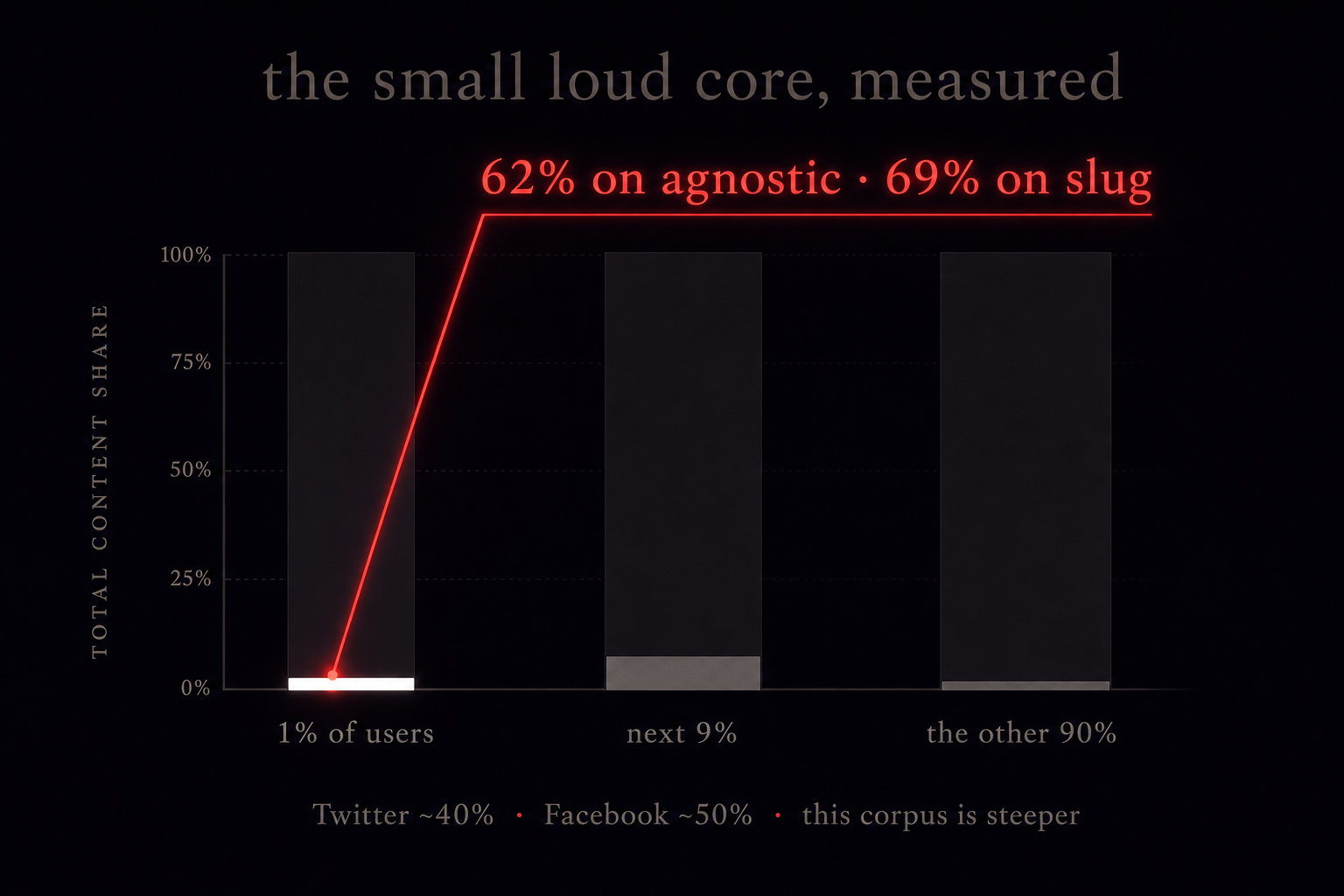
The data says I was actually talking to about a thousand people, twice. The other 200,000 were doing other things.
Here is the number that took me four years to learn. I posted the same question to both sites on 49 occasions where both sides got at least three responses each. Across all 49 of those matched pairs, on the agnostic side, 92 percent of the responses came from two clusters. Thoughtful Elder Skeptics produced 60.7 percent. Bruised Seekers produced 31.8 percent. Together those two clusters total about 1,170 individuals out of 17,062 active agnostic users, or 6.9 percent of the active community.
On the IDW side, the same shape. 92 percent of responses came from two clusters. Heterodox Traditionalist Skeptics produced 75.3 percent. Cultural Grievance Veterans produced 16.4 percent. Together about 1,020 individuals out of 7,522 active IDW users, or 13.6 percent of the active community.
A thousand people on each side. About 30 to 60 specific users actually answering any given controversial prompt. The rest of the 17,062 active agnostic users and the 7,522 active IDW users were either lurking, posting elsewhere, or had decided the political content was not what they came for.
The cluster I most wish I had understood earlier is the 22 percent on agnostic called Seeking Connection Seekers. This is the modal participant. The person who joined agnostic because they live in a religious area and they want to meet other people who do not believe in God. They want a friend, they want a date, they want a book recommendation, they want to vent about Thanksgiving with the in-laws. On the political pairs, this 22 percent generated 0.3 percent of the responses. They tuned out. They came for connection, the room offered politics, they scrolled past it.
The same shape exists on the IDW side. The Quiet Spectators cluster, about 1,469 users, generated 0.2 percent of responses on the matched pairs. They were there. They were not engaging.
So when the original essays said “the community reacted,” what was actually happening was that 30 to 60 specific users, out of a hundred or so for that question, were writing all the audience reaction Andrew was reading, and the other 99 percent of the community was doing something else.
The clearest single illustration is a handle I will call by its real name because it is already in the public dataset. GreenAtheist, the top reporter on agnostic, filed 4,971 abuse reports across the life of the platform. The same handle was the top recipient of reports, with 1,530 received. The most active enforcer of the rules was also the most-reported user. That overlap is not a coincidence. It is the structural marker of a high-conflict subgroup. The people most actively policing the platform were also the people the platform most needed policed.
The IDW side ran the same shape at smaller scale and with a different reciprocal pattern. The top IDW reporter, RayitoDLuz, filed 496 reports across the life of that platform, about a tenth of the agnostic top filer’s volume. The IDW top-ten power-reporters concentrated their report flow inside the Heterodox Traditionalist Skeptics to Cultural Grievance Veterans edge, the only above-five-times edge in the IDW conflict matrix, where the agnostic top-ten ran reciprocally across multiple cluster pairs. Different volume, different reciprocity, same structural role. A small loud core taking on the policing work the room would not give them another channel for. Both rooms had the role. Both rooms had a handful of accounts in it. The size of the role tracked the size of the conflict-driver subgroup, not the politics of the room.
The reciprocal pattern shows up in the inter-cluster matrix too. On agnostic, the Thoughtful Elder Skeptics filed 702 reports against Bruised Seekers, which is 20.6 times the off-diagonal mean of the entire conflict matrix. The Bruised Seekers reciprocally filed 202 reports back against the Thoughtful Elder Skeptics. The same Thoughtful Elder Skeptics filed 205 against Tentative Truth-Seekers and 177 against Progressive Freethinkers, both also more than five times the matrix mean. Most of agnostic’s 73,502 user-abuse rows is one cluster pair fighting each other reciprocally, with that same cluster pair fanning out against the next two adjacent clusters, while the rest of the community read past it.
The per-capita rate is also worth saying out loud. Thoughtful Elder Skeptics, the 313-person cluster that drove the conflict, filed content reports at a rate of 13,335 per thousand users. Bruised Seekers came in second at 1,179. Progressive Freethinkers, a much larger cluster of 1,975 users, filed at 127. Seeking Connection Questioners, a 2,258-user cluster, filed at 11. The top per-capita group was filing more than a thousand times the rate of the modal group. The community did not have a moderation problem. About 313 people had a moderation problem, and they had it with each other.
The way I now think about this is that conflict on agnostic was not a property of the community. It was a property of about 1,170 specific people, two clusters, locked in reciprocal combat, with another 15,000 active users mostly trying to avoid eye contact. The block button was their tool. The report button was their tool. The most-reported user was simultaneously the most prolific reporter. The community did not need a moderation system. The conflict-driver subgroup did.
The 2017 essays were written for the 15,000. The data says the 15,000 were not the audience for that material. The 15,000 were there for connection or company or a place to lurk. They did not need a manual on civility because they were already civil. The 1,170 needed it and barely read it because they were busy filing reports on each other.
If I were designing the community now, with the data I have, I would not redesign the community. I would redesign the moderation interface for the 1,170. I would leave the 15,000 alone.
Here is the take-away as a triage rule for a community-builder. Three steps.
One. Identify the conflict-driver subgroup. Almost every online community has one. It is usually under 10 percent of the active users, and it is usually concentrated in two or three behavioral clusters that are reciprocally targeting each other. You can find it by looking at who the top reporters are, who the top reportees are, and which inter-cluster edges in the report matrix are far above the off-diagonal mean. If your top reporter is also one of your top reportees, you have found the engine.
Two. Design the moderation interface for that subgroup specifically. The block button, the report button, the mute, the time-out, the appeal process, all of these are tools the conflict-driver subgroup will use heavily. The rest of the community will use them rarely or never. Optimizing the moderation interface for the median user is a category error. The median user is not the user who is sending you 50 reports a week.
Three. Leave the median alone. The median user does not want a notification. The median user does not want to be welcomed by a moderator. The median user does not want a tutorial on the code of conduct. The median user wants to scroll, post once a week, and have nobody yell at them. Most of what passes for community-management in modern platforms is a low-grade tax on the median user, designed to address a problem caused by the loud 5 percent. The 5 percent generates the problem. The 95 percent pays for it.
This is harder than it sounds because the 5 percent is the most visible part of the community to the operator. They are the ones in the operator’s inbox. They are the ones writing long replies. They are the ones making the thread look alive. It is easy to mistake them for the community. The data says they are not the community. They are the loud edge of it. The community is the 22 percent who came for connection and is quietly using the room to find it.
There is a related trap that is worth naming. When the operator looks at the public discourse about their own platform, the discourse is being written by the same 5 percent. The think-pieces about what the community is like, the screenshots people post elsewhere, the testimony in the press cycle, all of it is sourced from the loud edge. The operator reads the discourse, recognizes the names, assumes those names are the community, and starts designing for them. The 95 percent does not write think-pieces about the platform. They use it and close the tab. The discourse loop and the user loop are different loops. They share a small overlap and the operator who lives in the discourse loop will mistake the overlap for the whole.
The hardest part of the triage rule is the third step. Leaving the median alone is counter to almost every instinct a builder has, because the builder cannot hear the median. The median does not write the operator. The median uses the room and goes back to their day. The metric that tells you the median is well-served is not engagement, it is return-visit retention with low conflict-event rate. If the same 15,000 users come back week after week and almost never report anyone, the room is working for them. The fact that you cannot hear them does not mean they are not there.
A small concrete version of step three. Almost any new feature that requires the median user to do something, an onboarding flow, a code-of-conduct acknowledgment, a topic-preference quiz, an algorithmic re-ranking they have to opt out of, is a tax that the median pays so that the operator feels like they have addressed a problem caused by the loud 5 percent. The 5 percent will route around the new friction in a day. The median will get an extra screen to dismiss every time they sign in. The cost of that screen is borne by 95 percent of the users to address a problem caused by 5 percent. Most of the time, the cheaper move is to leave the median alone and apply the friction to the specific accounts that are generating the problem.
The original 2017 essays addressed everyone. The 2026 update is that they should have addressed the 1,170 on each side, with material designed for the conflict-driver subgroup, while leaving the connection-seekers alone with the room they actually came for. The manual you are reading is closer to that. If you are in the conflict-driver 5 percent, this chapter is for you. If you are in the 22 percent who came for connection, the manual is sorry for the noise, please carry on, the room is yours, the next chapter will have less of this.
The next chapter is about how to tell whether the argument you are about to have is a real disagreement or a tribal reflex you are running because the room you are in taught you to run it. The Trump-and-Biden matched pair from January 2021 is the cleanest evidence in the corpus that the reflex is real, the same hundred people on each side ran the inverse version of it, and almost nobody noticed it was a reflex while it was happening.
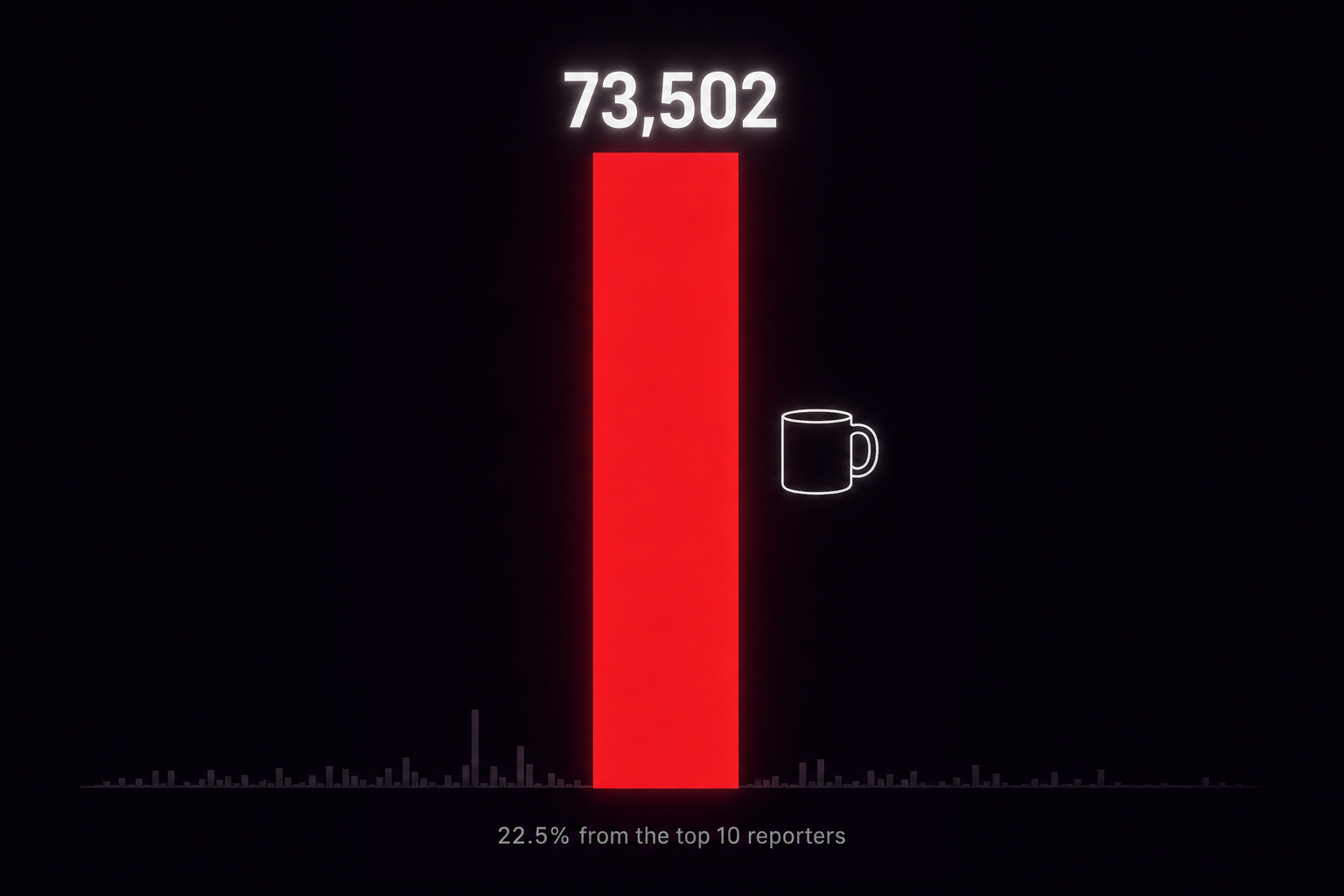
I learned the difference in my own kitchen, in early 2021, watching myself read a question I had written and feel my jaw tighten before I had finished the second sentence. The question was one of mine. I wrote it. I had thought about it for a week. I knew exactly what I meant. The moment I saw the noun in the second clause, I felt the tightening, and the answer I was about to type was already half-written by something other than my own thinking. That tightening is the subject of this chapter. The person doing the tightening was me.
The thing that made the moment useful is that I had a draft, and the draft had been written before the tightening started. I could compare. The version I had thought through over a week was a paragraph. The version my jaw was about to type was a sentence with a verb in it that does not belong to thinking. There were two of me at the kitchen table. One had read the source material. The other had read a noun.
The previous chapter said the loud 5 percent on each of the two sites was running visible reaction to charged questions, and the rest of the community was scrolling past. This chapter is about what those visible reactions actually were. They were not, mostly, disagreements. They were reflexes. They looked like principles to the person running them, including me. They turned out to be predictable in a way principles usually are not.
Between June 2017 and February 2022 I posted 749 questions across both sites. 49 of those became scoreable matched pairs: near-duplicates that hit both sides within fourteen days, with at least three audience responses on each side. (The wider duplicate pool was 52; 31 hit both sides the same day or the next day.) We pulled the response threads, asked an independent rater to score civility on a zero-to-ten scale, and tabulated the results.
When the prompt was operational, the kind of question a community runs on a Tuesday afternoon, both rooms scored 9 to 10 on civility. Pre-2020, across 16 such pairs, the agnostic average was 8.94 and the IDW average was 8.61. The two rooms were almost indistinguishable. Each handled its own house with care.
When the prompt named one tribe’s outgroup, the reflex flipped. The cleanest pair sits in January 2021. On the 13th I asked, “What did Trump do, if anything, to incite violence?” Same question, both sides. Audience civility on agnostic: 2.5. Audience civility on IDW: 7.5. Two weeks later I asked, “How is Biden doing?” Same form, the opposite outgroup named. Agnostic civility: 7.5. IDW civility: 3.5. The same audiences, in the same fortnight, behaved like four different audiences depending on whose outgroup the prompt had selected.
Each side stayed cool when the prompt named its own ingroup. Each side erupted when the prompt named its outgroup. Neither side was lying about its civility on the cool side. Both sides were running a reflex on the hot side. Neither side knew, at the time, that the same 60 people had just produced both numbers, with the sign of the gap entirely determined by which noun appeared in the prompt.
The Trump and Biden pair is the cleanest case in the data, but it is not the only one that breaks reader expectations. On November 9, 2020, the day Pfizer announced its first COVID vaccine result, I posted a question to both sites about whether people would take the shot. Most readers would assume the agnostic side, scientifically literate and pro-public-health, would handle the question more calmly than the IDW side. The data says the opposite. Agnostic civility on the Pfizer pair: 8.5. IDW civility on the Pfizer pair: 4.0. The IDW side erupted into a freedom-frame and a skepticism argument and never came back to the question. The agnostic side discussed it. That number is one of the cleanest single demonstrations in the corpus that civility is not a personality trait of a community. It is what each tribe protects on a given week, on a given prompt, with a given noun. Change the noun, and you change which tribe is calm and which tribe is on fire.
This is the part most readers do not expect.
When I say “agnostic civility was 2.5 on the Trump-incite question,” I am not saying 209,110 people lost their civility. I am saying about 60 specific people answered, and 31 of them were Thoughtful Elder Skeptics and 25 were Bruised Seekers. Two clusters. About 1,170 of the 17,062 active agnostic users were in those two clusters at all. 6.9 percent of the active community. The 22 percent Seeking Connection Seekers cluster, the people who had joined to find a friend in a religious area, contributed 0.3 percent of responses on political pairs. They were not in the room when the room was on fire.
Same shape on the IDW side. The Heterodox Traditionalist Skeptics did 71 percent of the response on the Trump-incite question. The Cultural Grievance Veterans did 20 percent. About 1,020 specific people across the active community produced 92 percent of all audience reaction on the contested matched pairs. Two clusters. The same two clusters answering nearly every charged prompt. The other 86 percent of the active community read the question and clicked away.
So when I describe a community as flipping, the community was, on any given charged question, roughly a hundred specific people on each side. They were not lying when they said “this is a real disagreement.” They were also running a reflex that I can predict, in advance, by changing one noun in the prompt and watching the score move three or four points. Both can be true at once. That is the part that took me years to absorb.
I had assumed, for a long time, that the loud reactions were the community. They were a small and very repeatable subset of the community. Calling that subset the community had been a category error of mine going back to the first essay I wrote on the site.
Take-away. Before you react to a charged question, run the four-question outgroup-swap test on yourself. It takes about a minute. I do not always pass it. The times I have failed it most badly have been the times I skipped it.
One. Would I react this way if the prompt named my ingroup instead. Take the noun in the prompt that is doing the work. Swap it for the equivalent noun on your own side. If the question is about a politician your tribe dislikes, try the version about the analogous politician your tribe supports. If the question is about a coalition your tribe distrusts, try it about the coalition your tribe belongs to. Read the swapped version slowly. If your jaw stops tightening when you swap the noun, you are reacting to the noun, not to the question. The Trump-incite and Biden-doing pairs in January 2021 are the public version of this exact swap. Same audiences, opposite reactions, two weeks apart, with the only changed variable being which name was in the prompt.
Two. Was the question about an idea, or was it asking me to defend my tribe. Some questions ask whether a claim is true. Other questions ask whether you are loyal. The same sentence can do either, depending on who is reading it. The Aporia thesis pre-statement of December 18, 2020, “should some research topics be banned or results censored,” scored 6.5 on agnostic and 7.0 on IDW. Both rooms read it as an idea-question. Eighteen months later the same sort of question, routed through a different surface, was read by a much wider audience as a loyalty-question. Same sentence. Different read. The shift was not in the sentence.
Three. Was my ingroup the one being defended in the framing, and is that why this feels easy. If your reaction is comfortable, you are usually not arguing. You are usually agreeing with your own side in a slightly disguised costume. This is the dual to question one. A test that only catches the other side’s reflex is itself a reflex.
Four. Would I be willing to lose status with my own tribe in order to be right about this specific point. This is the hardest one. If the answer is no, you are not arguing about ideas. You are arguing about belonging. There is nothing wrong with caring about belonging. It is a real and good thing. It is just not the same thing as having a disagreement.
I fail question four more often than I would like to admit. Most of us do.
The four-question test is not designed to make you a centrist. Centrism is a separate move and not always the right one. The test is designed to let you tell the difference between the times you are actually thinking and the times your group is thinking through you.
When you actually disagree with someone, the disagreement is durable. It survives the prompt being rewritten. It survives the noun being swapped. It survives you losing status with your tribe for holding it. A disagreement of that kind is rare and valuable and worth a long argument. Most of the long arguments I have watched, including the ones I have been in, do not survive any of those swaps.
When the disagreement does not survive the swaps, it is a tribal reflex. There is no shame in having one. We all do. The shame, if there is any, is in mistaking it for a principle, and writing the next thirty paragraphs of online combat as if it were one.
The data behind this chapter is one specific community spread across two specific sites in one specific four-year window. The pattern is not specific to those rooms. Watch yourself for a week. Notice when the heat drops as you swap the noun. The drop is the reflex. The drop is also, mostly, you. The next chapter is about what to do when even the four-question test cannot get you back to a real argument, because the room you are arguing into is no longer a room.
December 18, 2020. I posted to both sites: should some research topics be banned or results censored. Both rooms engaged it. The agnostic audience scored 6.5 on civility. The IDW audience scored 7.0. About 18 of the responders on agnostic were Bruised Seekers and Thoughtful Elder Skeptics. About 26 of the responders on IDW were Heterodox Traditionalist Skeptics, Cultural Grievance Veterans, and Heterodox Contrarians. These are people who often argue. On that day, on that question, they argued well.
Eighteen months later I funded an academic free-speech publication called Aporia. In October 2024 a press cycle ran a story characterizing that funding in a way I do not recognize. I am not going to relitigate the press cycle in this chapter. The longer account is at conru.com/truth/, and the supporting material is in the source library linked from there. The relevant fact for this manual is the structural one. The two rooms I had built had been able to handle the Aporia thesis question civilly, with several thousand people watching. The wider apparatus, presented with the same family of question routed through October 2024 outlet logic, was not.
The apparatus is not a person, and not even a single institution. It is a feedback loop made out of incentive structures, journalist career math, social-media engagement gradients, and the small loud cores from chapter 8 in a few hundred adjacent rooms at once. Once the loop runs, dialogue with it loses, because dialogue assumes an interlocutor whose goal is to be persuaded. The loop’s goal is to be fed. It is fed equally well by your strongest argument and your weakest one, and the better your argument, the more it metabolizes.
That was the painful education the truth/index.html note on my site was naming. I had believed that censorship was a form of hate and open inquiry was a form of love. I had funded embattled academics so the conversation could continue. I learned that there is an entire ecosystem that thrives on caricature, and that ecosystem is not interested in dialogue at the layer it operates at. My actions, well-intentioned, had provided raw material for a system that was not going to read them as I had written them.
Inside a room you control, dialogue still works. Through 2019 and most of 2020, our matched-pair civility on platform-housekeeping questions averaged 9 or 10 across both sites. We knew how to do it. We had welcome scripts, redemption protocols, a moderator the regulars knew by name, and a tone the room had set for itself. When a fight broke out, one of the regulars would say something dry and the temperature would drop two points. That is dialogue working.
Outside the rooms, at the broader-culture layer, dialogue runs into a different problem. The 2017 essays implicitly assumed civility was a virtue you carried. The data says it was a setting on a particular room. Other rooms had different settings. An apparatus that knits together the loud cores of a hundred adjacent rooms can be louder than any one room’s calming move. Trying to dialogue with it is trying to outshout a stadium with a pocket microphone. The matched pairs from January 2021 say both communities lost the calming move under outgroup-triggering prompts. Both. Not one. Once that condition is met at the broader-culture scale, argument feeds the apparatus instead of bridging it.
I do not love this finding. I built three projects on the opposite assumption. The pivot in this chapter is the empirical update, not a confession.
Argument is good at testing claims. Argument also calibrates the audience’s armor. The longer two tribes argue, the better each side’s armor gets at the other’s standard moves. Online combat between the loud cores has been, on net, a multi-year armor optimization exercise on both sides. By the late 2010s the armor was very good. Anyone trying to bridge with another argument was sending a signal the receiver had already been trained to deflect.
Art bypasses argument’s surface. Beauty is the part of the bypass that gets through the armor before the categorizing reflex fires. Truth, in the art sense, is honest depiction of what a person actually is, not the abstraction the debaters were fighting about. Love is the connective tissue both rooms had been trying to engineer through dialogue and could not engineer past their own protections.
That triad, Beauty Truth Love, is not a brand. It is the rebuilt operating thesis after the data update. You can run the test on it. If a project is in the rehumanization lane, all three should be intact. The work has to be good (Beauty), the work has to be honest about the human (Truth), and the work has to make a connection that survives outside its own room (Love). If any of the three is missing, you are probably back inside the apparatus. I would not have written the previous paragraph in 2017. I would have called it soft. It is not soft. It is what is left after you take the engineering manual and run it for five years against the data and watch the engineering manual break in exactly one place.
There are three programs the foundation now runs that are the practical implementations of this update. I want to describe each one as one specific testable claim, not as a feature list.
Art Love Salon, 110 Union Street, downtown Seattle, in a 16,000 square foot space across the street from the Seattle Art Museum. The claim is that a Wednesday-night room with a calendar, a known host, an artist present, and no expectation that anyone debate anything is a redemption protocol with a building around it. The block button on agnostic ran 4.7 times more often per active-user-month than on the calmer of the two sites. The salon is a building-scale answer to that ratio. If the claim is right, regulars come back week after week, do not need a moderation queue, and bring people who would never have shown up to either site. If the claim is wrong, the room becomes another fight venue, and we will know inside six months.
Seattle Art Prize, run out of the Occidental space in Pioneer Square. The claim is that morality without God can be expressed as patronage. A year-long fellowship for representational painters, paid as a salary not a grant, trains a small public to look at honest depictions of the human condition with the seriousness that a debate audience used to reserve for arguments. Audiences do not get armor against good portraits the way they get armor against essays. If the claim is right, the work the fellows make in 2026 and 2027 lands with audiences who would have refused the same content in any argued form. If the claim is wrong, the fellows produce competent work that nobody outside the art world notices, and we will know that too.
Commission Artists, the program that runs commissioned portraits of regular people, paid for by someone who loves them. The claim is the simplest of the three. If you sit a person down for the time it takes to be honestly drawn, and the resulting portrait is given to someone who already loved them, you have done a real-world version of what the matched-pair data says argument cannot do. The portrait does not argue. It depicts. The recipient does not have armor against the depiction. Across the small number of pilots the program has run, the unveilings do not look like the threads on the January 2021 questions. They look like something else.
Three programs, three claims, one operating triad. I do not know yet that all three are right. If the data five years from now disagrees with me, I will revise the manual again.
Take-away. Use this as a one-page guide for choosing between dialogue and art on a given message.
If the audience is a small room you and the audience both already know, use dialogue. The data says it works. If the audience is the loud core of a small room, the 5 to 15 percent of the active universe from chapter 8, use dialogue, but address the conflict-driver subgroup directly, not the median. They are who is reading. If the audience has no shared room with you and is reached only through an apparatus you do not run, do not argue. The argument feeds the apparatus. If the message is a position, dialogue is the right vehicle inside a room and the wrong vehicle outside it. If the message is the human, a person, a moment, a connection, a piece of beauty that is true, art is the vehicle in any room. If you are not sure whether the message is a position or a human, you have not thought about it long enough yet.
Three small ways to run a Beauty Truth Love move this week. Pick one. Do it on a Wednesday.
One. Go look at one painting for ten minutes. Not five. Ten. Pick a painting that has nothing to do with anyone you are angry at. A still life of a bowl of fruit will do. Stand in front of it. Notice the third thing you see, after the obvious one and the second-obvious one. The third thing is the one that does the work.
Two. Host one Wednesday gathering at your kitchen table. Three to seven people. No agenda. Coffee or wine. The only rule is that nobody talks about the news cycle for the first hour. By the end of the hour, somebody will have told a story they had not planned to tell. That story is the salon at home scale.
Three. Ask one person you know to tell you a story that has nothing to do with politics. Listen all the way through. Do not nod along. Do not say “that reminds me of.” Just listen. At the end, ask one follow-up question that is about the story and not about you. This is the smallest unit of the rehumanization move and the one that is hardest to fake.
Each of these costs almost nothing. Each one is a working test of the claim that art and connection can do what argument was supposed to and could not. If you try one and nothing happens, the claim is wrong. If you try one and something happens, you have data for the next chapter, which I have not written yet.
That is the manual. The shape of it is small on purpose. The chapters are short on purpose. The take-aways are the parts I expect you to actually use. Everything else, including the numbers, is there to make the take-aways trustworthy. If the data updates, the manual updates. That is how the engineering register handles being wrong. I have been wrong enough times to know.
To the reader who came in hoping the book would prove your tribe right. I am sorry, and I am also not sorry. The data did not give me a one-tribe story to tell, and I tried for two years to make it. Both rooms melted down. Both were running a reflex. The clean version of either side’s preferred ending is not in the corpus. If that is a disappointment, please notice the shape of the disappointment. It is the shape of a reflex. If you want to see what something other than the reflex feels like, stop by 110 Union Street, downtown Seattle, Wednesday 4 to 7 pm. It is free. Coffee is on me.
To the reader who runs an online community and has been losing the line. The 2017 essays were written to you, and the data is a five-year letter back. The leverage point is the loud 5 percent. The other 95 percent is fine, mostly. Civility is what your room protects, not what your room is. The block button is a moderation tool, not a redemption protocol. If you would like to compare notes on what worked and what did not, stop by 110 Union Street, downtown Seattle, Wednesday 4 to 7 pm. Free. Coffee on me.
To the reader who picked the book up because someone said it was fair. Thank you for the leap. Fairness was the whole bet, and the manual will be a worse book if it gets the easy version of fairness, the kind that calls every fight a draw. The fights in here are not all draws. They are accurate. If you want to see the project that came out the other side of writing them, stop by 110 Union Street, downtown Seattle, Wednesday 4 to 7 pm. Free. Coffee on me.
The methods, data tables, and open questions are published in the research roadmap. Anyone who wants to reproduce or check the work can. The agnostic dump is 81 GB raw and 1.1 GB compressed gzip whitelist data. The IDW dump is 17 GB raw and 292 MB compressed. The headline findings here rest on, in plain English: an AI grouped users by twenty kinds of behavior, blind to which site was which, and told me how many kinds of person it saw. An AI read 2,999 of my own posts across both rooms and scored my own voice on five dimensions. An AI tagged 7,164 reported items by topic. A separate pass looked at 49 prompts I had posted to both sites and scored the audience responses for civility, depth, and willingness to engage. A second pass looked at 108 individual humans active on both sites and scored the same person twice, on each side, to see if the same person came out the same. I checked the flagged outputs by hand. The pipeline is open. If you find an error, my address is on the foundation site.
Art Love Salon, 110 Union Street, downtown Seattle, across from the Seattle Art Museum. Wednesday 4 to 7 pm. Free. Coffee on me.
Visit the Art Love Salon