An Empirical Account of Two Online Communities I Built Side by Side, 2017 to 2022
This is one of three book versions on this page. Also read: The Connection Engine · A Manual on Human Dignity.

June 19, 2017. I launched a website called agnostic.com.
February 14, 2019. I launched a second site, originally branded slug.com, rebranded a few weeks later as IDW.community.
The two sites ran on the same MySQL database and the same PHP engine. The 36 humanist essays I had seeded into the agnostic homepage carried over to IDW as 47 essays, mostly the same prose with a paragraph or two of framing rewritten for a different audience. The moderator on both sites was me. There were nights, late in the run, when I read the abuse-report queues for both communities back to back in the same browser session and could not always tell which queue I was sitting in by tone alone.
I ran the two of them for almost five years. By the close of 2021, agnostic had recorded 209,110 user records, 782,123 questions, 3.0M answers, and 2.2M comments. IDW had recorded 145,827 user records, 431,482 questions, 438,531 answers, and 310,227 comments. The two communities together produced 86,011 abuse reports, which is its own kind of artifact and is the spine of much of what follows.
I had a thesis going in. You could engineer civility into the medium itself. The population walking through the door would tilt toward something more humane on the rails of a platform that rewarded the right behaviors. I had been writing seed essays since the agnostic launch in mid-2017 about civil discourse as a weapon, the dehumanization cycle, forgiveness and redemption as infrastructure, morality without God, and rehumanism. I told the early users that the medium was going to do most of the moral work and that the rest was downstream.
This book is what the data said five years later. The thesis was half right. It was half naive in specific ways I had not predicted. The argument I had thought was about substance turned out to be mostly about which idol the prompt had touched. The same human being signed up on each site and showed up as two different speakers depending on which front page they had hit first. The loud 5% on each side was the only audience the dashboards could see. The other 95% was, as far as I can tell, mostly trying to find one person in their own city to talk to about something neither of them had a script for.
This book is not a relitigation of any press cycle and it is not a tell-all. It is a side-by-side post-mortem of two communities I ran as a single experiment, with the underlying tables and report logs open on the desk while I write.
I want to use this first chapter to establish why the experiment exists at all. Why these two specific communities. Why running them on the same engine matters. Why the data those engines produced will carry the rest of the book.
Real social-science comparisons of online communities are rare. They almost always fail in the same place. The two communities a researcher might want to compare were built by two different founders, with two different codebases, two different rule sets, two different tonal defaults baked into the moderator’s hand. Anything you find in the data could be attributed to any of those. The signal does not survive the variables.
In this case, almost none of those variables differed. One did.
The schema on each site was the same. The same tables, the same indexes, the same triggers, the same primary keys. The PHP rendering the question form, the answer view, the comment thread, the profile page, the friends graph, the soft-hide function, the formal abuse-report router, all of it sat in the same monorepo and shared library code between the two sites. When I deployed a fix to the like-button, it went out to both sites the same night. When I changed how soft-hides decayed, it changed for both at once. The blocked-keyword list was nearly identical. The signup flow was the same except for a different welcome line on the front-page hero.
The seed essays differed. They differed less than people who have not read both sets imagine. The civil-discourse-as-weapon essay on the two sites is nearly the same essay. The dehumanization-cycle essay is nearly the same essay. The morality-without-God essay is nearly the same essay. The forgiveness-and-redemption-as-infrastructure essay is nearly the same essay. What changed was the framing paragraph at the top, the audience the prose was addressing, and a small handful of new IDW-specific pieces written into the second site after launch.
The moderator was me, on both sites, for the entire run. I read most of the abuse reports myself, especially in the first two years on each side. I wrote most of the policy decisions. If a user got banned on one site and reappeared on the other, the same person was reading their second appeal as their first. The 86,011 abuse rows are not the work of an outsourced moderation team. They are the work of one tired engineer who had already run a 700M-member platform a decade earlier and had opinions about how that should not happen again.
I also wrote on each site in my own name. Across both communities, between June 2017 and February 2022, I posted 749 questions, 5,378 answers, and 3,324 comments. I anchored the front pages with 83 site_text essays of my own, 36 on agnostic and 47 on IDW. I sent roughly 29,000 direct messages on agnostic and roughly 45,000 on IDW. I did not run an alt account on either side. If the rooms were supposed to model the kind of speech the seed prose described, I was not going to model it from behind a mask.
So that is the constant. Same engine. Same schema. Same library code. Mostly the same essays. The same moderator. The same author cadence. The same rules. Twenty months apart on the calendar, six weeks of editing apart on the seed prose.
The variable was who walked in.
agnostic launched into a quiet wave of religious deconverts looking for somewhere to land. IDW launched into a louder wave of people who had been told that questions they cared about were unwelcome in the rooms they were already in. One crowd had lost a community and needed a new one. The other crowd had been told a question was off limits and wanted a place to ask it. Those are not the same kind of arrival.
I want to stop and name what makes this corpus useful as a primary source for a 2026 reader. By the time AI-generated discourse is in every comment thread, it is hard to find a clean snapshot of a real online community at scale where most of the writing was actually done by human beings. The agnostic and IDW writing is mostly human. It runs between 2017 and 2022. It is dated, signed, visible by username, and the abuse logs are preserved row for row. The 86,011 abuse rows, the 5.5M answers and comments together, the joined dual-platform members table, and the per-user behavioral feature vectors all sit behind a single login on a single laptop. The person looking at them happens to be the same person who designed the schema, wrote the homepage essays, sat in the moderation queue, and now has the legal standing to publish what the data says.
That overlap is rare. The only person better positioned to write this autopsy was the one who already had to write it.
So I autopsied it. Most of the work happened across 2025, on a laptop, with help from a generation of language models that had not existed at any point during the platforms’ actual run. I clustered the active users on each side by behavior. I scored matched cross-posts on civility and tone. I traced 15,957 dual-platform registrations down to the 291 users who actually posted on both sides. I mapped the conflict matrix cluster pair by cluster pair. The chapters that follow are what came back from that work.
A few notes on how to read the rest of this book.
Numbers in this book pair year and scale. June 2017, 209,110 users. February 2019, 145,827 users. 1.46-point civility shift on a 108-user dual-platform sample. 23.3 times more abuse reports filed by the same human being on agnostic than on IDW. The numbers are not flourishes. They are the spine. If a sentence in this book does not carry a number, that sentence is mostly there to do connective work between two sentences that do.
I do not assign partisan labels to either community. The clusters did not. The data does not. The labels would shrink the finding.
I lean on the engineer’s register for most of the analytic chapters and slip toward memoir register only when the autobiographical thread is what a chapter needs. The book is, in shape, a field notebook. The field is two communities I happened to build and run myself. The receipts in the back of the notebook are 5.5M answers and comments, the 86,011 abuse rows, the cross-site members table, and the 4,914 of my own posts and 83 of my own essays.
If you only remember one thing about this chapter, remember that I built two communities on the same engine, with the same seed essays, the same moderator, and a twenty-month calendar gap, and that the only variable that meaningfully differed between them was the population that walked through the door. The chapters that follow are what that one variable did.
One engine. Two cities. The autopsy starts in the next chapter.
I had the user data. I did not have the user shape.
For five years I read the dashboards on both sites and told myself stories about who was on each platform. Some of those stories were correct. Some were the ones I had wanted to be correct. In late 2025, after I had decided to write this book, I sat down and did the work I should have done in 2019 and never had time for. I asked an AI to read the user behavior on each site, ignore my hypotheses, and report what was actually there.
The setup was straightforward. For each active user, I summarized twenty things about how they actually behaved on the site. How often they posted questions. How often they answered. How often they commented. How many friends they kept and how many people they had blocked. How often they had been reported by others, and how often they had reported others themselves. How long their answers ran. What time of day they tended to post. And so on. I gave the AI the twenty numbers for every active user on each site, blind to which site was which, and asked it a simple question. How many distinct kinds of users do you see?
It came back with ten kinds of user on the agnostic side and eight kinds on the IDW side.
I then handed the AI thirty real bios and thirty real posts from each kind of user, with no platform identifier attached, and asked it to read what was in front of it and tell me, in plain English, what kind of person was in each group.
I want to stop and underline what that means.
The AI was not told which site was which. The AI was not told what my hypotheses were. The AI was not told that I had been losing sleep for five years over the welcome verb at each door. The AI was given numbers and writing, and asked to tell me what it saw. That is all.
Before I looked at any other data, I sat down with the two cluster-name lists side by side and read them out loud.
agnostic, ten clusters. The largest were Seeking Connection Seekers (22.0% of the active universe), Curious Newcomers, Seeking Connection Questioners, Progressive Freethinkers, and Tentative Truth-Seekers. The smaller clusters were Bruised Seekers (5.0%), a second smaller Curious Newcomers pool, Seeking Secular Community, Thoughtful Philosophical Skeptics, and Thoughtful Elder Skeptics (1.8%, the smallest cluster).
IDW, eight kinds. The largest were Quiet Spectators (19.5%), Skeptical Truth-Seekers (17.7%), Heterodox Questioners, and Skeptical Heterodox Newcomers. The smaller ones were Heterodox Traditionalist Skeptics, Cultural Grievance Veterans, Heterodox Contrarians, and a small Bot and Spam group the AI caught.
Out of the ten agnostic labels, eight contained Seeking or Curious or Tentative or Bruised or Newcomers. Out of the eight IDW labels, six contained Heterodox or Skeptical or Contrarian or Grievance or Traditionalist Skeptic. The remaining few labels on each side did not undermine the pattern. They reinforced it.
That is not a partisan reading. The AI had no concept of parties. The AI had not been told which site each group came from. It read writing alone, on one side from 17,062 users and on the other from 7,522, and produced two columns of labels that, set against each other, read as two different verbs.
The agnostic verb is looking for. The IDW verb is pushing back.
That is the keystone of this book.
I want to dwell on it a moment because I think the keystone finding is the one most readers will be tempted to skim past on the way to the more dramatic numbers. The first two chapters of this book are the slow chapters because the slow finding is the one that makes the dramatic findings legible. Once you know the welcome verb at each door, everything else in the corpus has a shape.
Look at the largest cluster on each side.
The biggest group on agnostic, by twice as many people as the next group, was Seeking Connection Seekers at 22.0% of active users. The model summarized the cluster back to me as people who had deconverted from a Christian or Catholic upbringing and now lived in counties where they had no one to talk to about it. Their bios mentioned isolation. They mentioned their pets. They mentioned how their family handled holidays after they had stopped going to church. They asked for advice about Thanksgiving with the in-laws. They asked how to raise a freethinking child in a religious school district. The dominant mode was post about who you are and where you came from, and ask if anyone else has been here.
The biggest group on IDW was Quiet Spectators at 19.5%, who read more than they posted. The next biggest was Skeptical Truth-Seekers at 17.7%, substantive question-askers framing topics through a heterodox lens. Their bios mentioned books they had read. They mentioned an academic field they had stepped out of, or a conversation they had been pushed out of. They asked open questions about contested claims. The dominant mode was ask a question and watch the room argue about it.
Same posting engine. Same comment threads. Same reaction widget. Two different welcome verbs at the front door.
I want to say something honest about what those verbs did to my own read on each room while I was running them.
For the first eighteen months on agnostic I assumed the seekers cluster was the room. I wrote my own posts at that audience. I wrote softer. I gave more autobiographical detail. I leaned on first-person stories about my own Indiana childhood. The audience that kept showing up to read me on agnostic was that audience. I had calibrated to a verb without knowing it was a verb.
When I built IDW in early 2019, I assumed I was building a parallel room. Same hypothesis, different cultural lane, similar tonal default. That is not what the room turned into. The verb at the IDW door was pushing back, and the audience that calibrated to it answered different prompts in a different register. Within months, my own posting on IDW was sharper. More open questions. More framing. Fewer personal anecdotes. The room was tuning my register down to match it. Months before I had a vocabulary for what was happening, I was already speaking in two voices, one per room.
A note on what the verb at the door actually was.
I had spent years thinking the front-page hero text mattered, the seed essay set mattered, the moderation FAQ mattered. They mattered, but not as much as I had imagined. What mattered most was the first thousand users.
If a person arrives on a site where the recent posts are mostly people sharing deconversion stories and asking for advice about religious family, the welcome script reads as tell me yours. If a person arrives on a site where the recent posts are mostly heterodox questions and combative debate threads, the script reads as what is your take. The platform did not impose either script. The first thousand users wrote it. The next ten thousand inherited it. By the time I was looking at the second hundred thousand on each side, the welcome script was running automatically and selecting who came back the second day.
I called this “tonal default” for a year and a half before I had a better word for it. Then I started calling it the welcome script. The cluster names made me start calling it the verb.
Verb at the door, on agnostic: looking. Verb at the door, on IDW: pushing.
Both rooms had nearly the same essays. The dehumanization-cycle essay was on the front page of each homepage. Civil discourse as a weapon was on the front page of each homepage. The forgiveness-and-redemption essay was on each homepage. None of those essays said look for or push back anywhere in the prose. The verb at the door was not in the seed prose. It was in the first thousand users’ posting style, copied down by every subsequent arrival who chose to stick around.
I had assumed the seed essays were the seed of the room. They were not. The seed of the room was the first wave’s verb. The essays were a second-order influence at best.
A second observation that lands here, before the quantitative chapters get going.
The biggest cluster on each site was mostly disengaged from the headline conflicts. The 22.0% Seeking Connection Seekers on agnostic, the modal arrival, contributed roughly 0.3% of responses across the political-question matched pairs in the corpus. They did not show up for those threads. They were on the platform for something else. I held that statistic in my hand for three days before I trusted it. The dominant cluster of the larger site was almost entirely absent from the threads I had been reading as “the agnostic community reacting.” The community I had been tracking through my dashboard was a small repeat-player layer of two other clusters whose names I will earn in chapter three.
If you only remember one thing about this chapter, remember the verbs. Out of ten clusters on agnostic, eight read as variations on looking-for. Out of eight clusters on IDW, six read as variations on pushing-back. Same engine. Same essays. Same moderator. Different first-thousand-user welcome script. The script set the verb at the door. The verb at the door selected who came back the second day. Five years later the rooms had organized themselves around the verb, and the seed prose I had thought was doing the work was running second.
That is the shape of the autopsy. The next chapter starts walking down the headline numbers, the famous ratios I had quoted to friends for years, and shows what happens when you put a fair denominator under them.
There is a ratio I used to give people, casually, when they asked how the two communities compared. I am going to walk it back in this chapter, not because it was wrong but because it was incomplete. The fully loaded version is more interesting, and the corrected version is the reason this chapter exists.
The number I used to quote was something like agnostic users blocked each other 17 times more often than IDW users did, filed formal abuse reports 29 times more often, and filed content reports 10 times more often. That ratio is a real artifact of the corpus. By the close of 2021, agnostic carried 34,408 mutual blocks against 2,010 on IDW. 4,139 formal user-abuse reports against 141 on IDW. 7,594 content-abuse reports against 726 on IDW. 17 times. 29 times. 10 times. Even after dividing by community size, those are not small ratios.
If you are a casual reader, that paragraph is the headline you were probably waiting for. agnostic ran hotter than IDW on every formal conflict signal in the database, by an order of magnitude. The seed essays on civil discourse, the same prose on both sides, did not produce identical conflict outcomes.
Stop there and you have read the wrong chapter.
Three problems with that headline.
The first is that user counts at peak (209,110 vs 145,827) are not the right denominator. They include ghost accounts that signed up and never posted. They include accounts that never came back after the first week. They include the dual-registered accounts that signed up on one site after seeing a link from the other and then went inactive. They include the bot-and-spam tail the moderation engine eventually shut out. If you divide reports by registered users, you are dividing the work of an active fraction by the size of a passive crowd, and you will get whatever number flatters your story.
The second problem is that engagement on the two sites was not equivalent. agnostic users posted more, voted more, friended more, and ignored more. The active universe on agnostic was 17,062 by the threshold I described in chapter two. On IDW it was 7,522. The agnostic active community was about 2.3 times larger than the IDW active community. Some fraction of the conflict-volume difference is just engagement-volume difference.
The third problem is that “reports filed” is not a measurement of how much conflict the room produced. It is a measurement of how often users pressed the report button when they encountered conflict. A community with high tolerance for combative argument will under-report. A community with low tolerance will over-report. Both can be hosting the same amount of underlying friction. The button is a behavior, not a thermometer.
So I went back to the data with a fairer denominator.
The fair denominator is active user-months. For each user on each site, I counted the months in which they were active by the same threshold as before. Sum across all users. That number reflects how much actual engagement there was, in time-volume, on each platform across its life. The two communities ran on the same engine for 33 months overlapping. agnostic ran longer overall. IDW ran fewer months. Active user-months captures both at once.
When I divided the formal conflict signals by 1,000 active user-months, the ratios shifted.
Blocks per 1,000 active user-months: 323.7 on agnostic, 68.5 on IDW. Ratio: 4.7 times.
User-reports per 1,000 active user-months: 25.4 on agnostic, 2.7 on IDW. Ratio: 9.6 times.
Content-reports per 1,000 active user-months: 71.7 on agnostic, 24.7 on IDW. Ratio: 2.9 times.
Content-reports per 1,000 posts: 1.26 on agnostic, 0.62 on IDW. Ratio: 2.0 times.
The original 17 times shrinks to 4.7 times. The original 29 times shrinks to 9.6 times. The original 10 times shrinks to 2.9 times by the time-volume denominator and 2.0 times by the post-volume denominator.
The headline ratio survived the correction. It did not disappear. It got smaller, more honest, and more interesting.
Honest version: even after controlling for active engagement, agnostic ran about 4.7 times more mutual blocks per unit of time and about 9.6 times more formal user-reports per unit of time than IDW did. Content reports flattened to roughly 2 to 1 once you accounted for the fact that agnostic produced more content. The shape is real. The size is more modest than the original number implied.
I want to spend the rest of this chapter on what that residual gap is actually measuring.
The honest reading is that the residual is not a measurement of the median user. It is a measurement of a small power-reporter tail.
Look at the Gini coefficient on the reporting distribution. On agnostic, the Gini for reports filed is 0.832. On IDW it is 0.720. Both numbers are high. Both numbers tell you that on each platform a small fraction of users do most of the reporting. The agnostic number is higher. agnostic conflict is more concentrated, not more diffuse. A few hundred users on the agnostic side are doing the bulk of the work that shows up in the headline ratio.
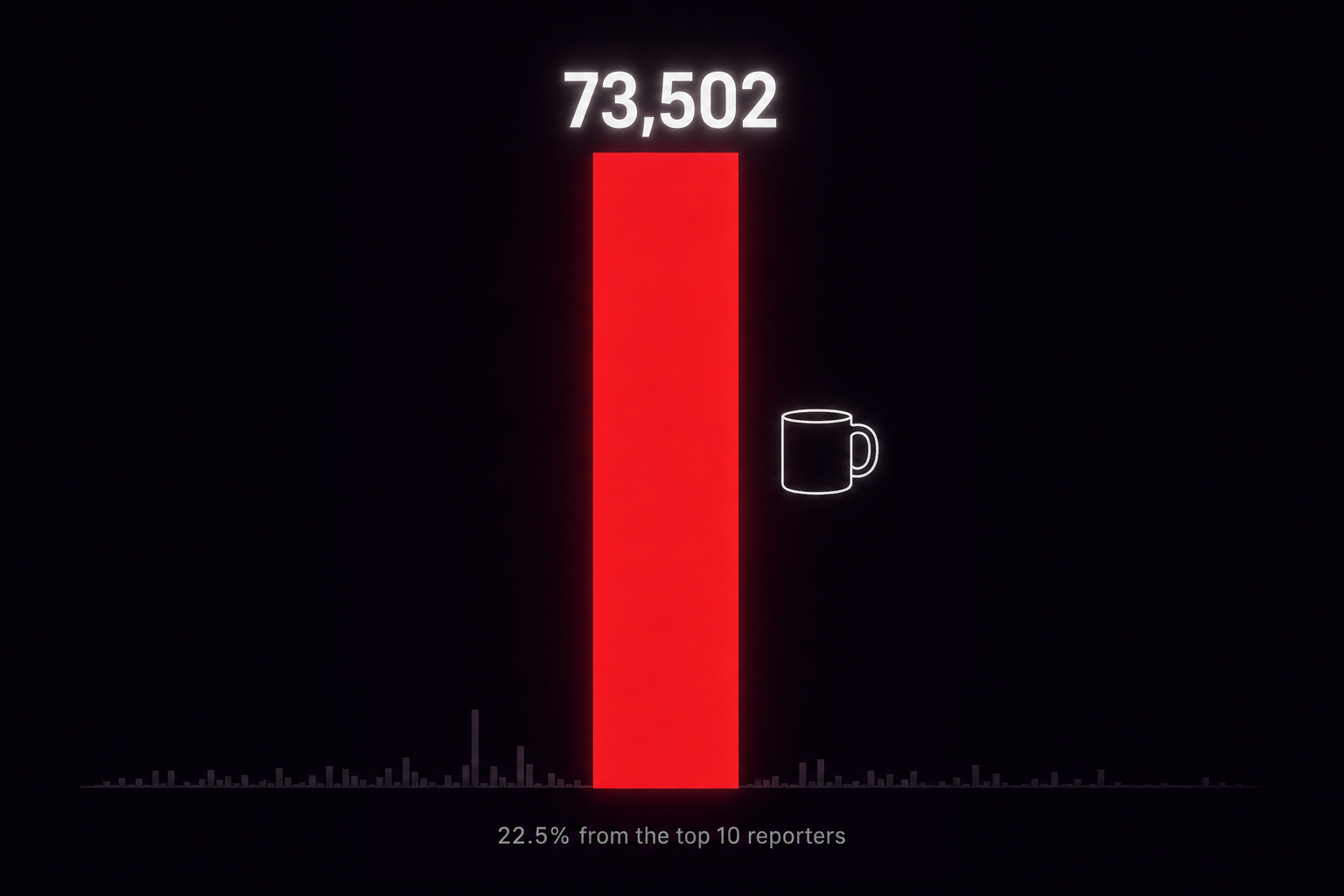
A second cut. The top reporter on agnostic, a single account, filed 4,971 reports across the life of the platform. That single user generated about 7% of all reports on the site. The top reporter on IDW filed 496 reports. One tenth as many, by one user. The top 10 power-reporters on agnostic generated 22.5% of all 71,896 reports the site ever recorded. I will name the top agnostic reporter in chapter six when the structural matrix needs them. For this chapter the relevant fact is that the gap between the most prolific filer on each site is itself a 10-to-1 ratio between two specific human beings.
Run the same exercise for the median user instead. The median active user on agnostic and the median active user on IDW filed similar numbers of reports on a per-month basis. The median user is not what produced the headline. A small power-reporter tail is.
This is the part I want a reader to carry into the next chapter. The headline ratio is real. It is just a system property, not a community property. It says less about the median agnostic user than I had assumed for years and more about the right tail of the reporting distribution.
A third cut.
If you walk the report log forward in time and bucket it by week, the spikes line up with the world. agnostic from December 2017 to June 2018, the MeToo and Roy Moore and family-separation window, peaks at 1,653 reports per week. agnostic January 11 to January 18 of 2021, the inauguration window, peaks at 234. IDW from September 21 to October 26 of 2020, election season, peaks at 153. IDW May 2022, the Roe v Wade decision leak, peaks at 45. IDW from January 18 to February 1 of 2021, inauguration again, peaks at 133. The reporting machinery on both sides was alive to the same news. It just produced different volumes off the same triggers, and the volume was driven, on each side, by a small loud cohort that responded to whatever week the calendar handed them.
What is left, when you correct the denominator and walk the time series, is a structural difference. Both communities ran a power-reporter tail. agnostic’s tail was thicker and more reciprocal than IDW’s. agnostic’s report graph has a single dominant feud running through it for years between two specific clusters. IDW’s report graph is sparser, less concentrated, and less reciprocal. The chapter after this one is about the shape of that feud, the cluster pair at its center, the people doing 92% of the cross-post talking, and the roughly 1,000 specific users on each side who turned out to be the audience I had been writing for.
If you only remember one thing about this chapter, remember that the headline ratio survived the fair denominator and shrank. 17 times became 4.7 times. 29 times became 9.6 times. 10 times became 2.9 times by time and 2.0 times by post volume. The residual is real. The residual is not the median user on either side. It is the right tail of the reporting distribution. A small loud cohort on each platform did most of the work that put those numbers on the table.
One last guardrail before the next chapter. The button-press ratio is one shape of conflict. It is not the only shape. The IDW side ran lower numbers on the report queue and ran higher numbers on the topics chapter six will lay out, race and immigration and right-wing critique, where the same conflict took a different exit out of the room. A community can fight loudly through the report form. A community can also fight loudly through the topic queue and quietly through the report form. Both communities did both. They did them in different proportions. Reading the report ratio as a verdict on which community was in better shape would be reading the metric the corpus surfaces most easily and missing the metric the corpus surfaces less easily but no less.
The seed essays did not produce that distribution. The verb at the door, from chapter two, did. Each verb selected for a different shape of right tail. The next chapter walks down into that tail.
The first three chapters set the experiment up. Same engine, two cities, a welcome verb at each door, and a headline ratio that survived a fairer denominator and shrank from 17 times to 4.7 times. That is the framing.
The next six chapters open the body. They walk down the small loud minority who wrote 92% of the matched-pair audience. They walk down the topic-conditioned civility table that crashes by 4 or 5 points whenever a prompt names a tribe’s outgroup. They walk down the two different conflict surfaces the same engine produced. They walk down the 108-user cross-site sample where the same human being scored 1.46 points lower on civility on the second site, and the 2,999-item autopsy of my own pen across both rooms. The act ends on December 18, 2020, the cleanest single data point in the corpus and the empirical floor that the third act will need.
Each of these six chapters takes one finding and stays there. None of them tries to land the pivot. The pivot is in act three. The data is in this one.
A note on order. The chapters in act two are sequenced from the loudest finding outward. Loud minority first because the audience-versus-community distinction reframes everything that follows. Topic asymmetry second because it explains why the loud minority lit up where it lit up. Conflict surfaces third because the structural matrix is the receipt for the topic asymmetry. Cross-site cohort fourth because the same-person comparison cancels the personality variable. The founder’s pen fifth because the autopsist is in his own data. The Aporia pre-statement sixth because it is the empirical floor act three needs.
The chapter the data writes when you read 49 matched threads in a row is not the chapter most people want.
Most people want a paragraph that says “the agnostic community reacted this way and the IDW community reacted that way,” with a verdict at the end about which community held up better. I wanted that paragraph too. I posted the questions and I read the threads in real time. When a thread on agnostic went sideways at midnight my time, I felt it. When a thread on IDW stayed calm under a prompt I had expected to set the room on fire, I felt that too. The phrase “the community reacted” is what every moderator I have ever met uses, and I was no exception.
Then we joined the response threads to the behavioral cluster IDs we computed for both sites, and the phrase started to look wrong.
Here is what 92% of the responses looked like.
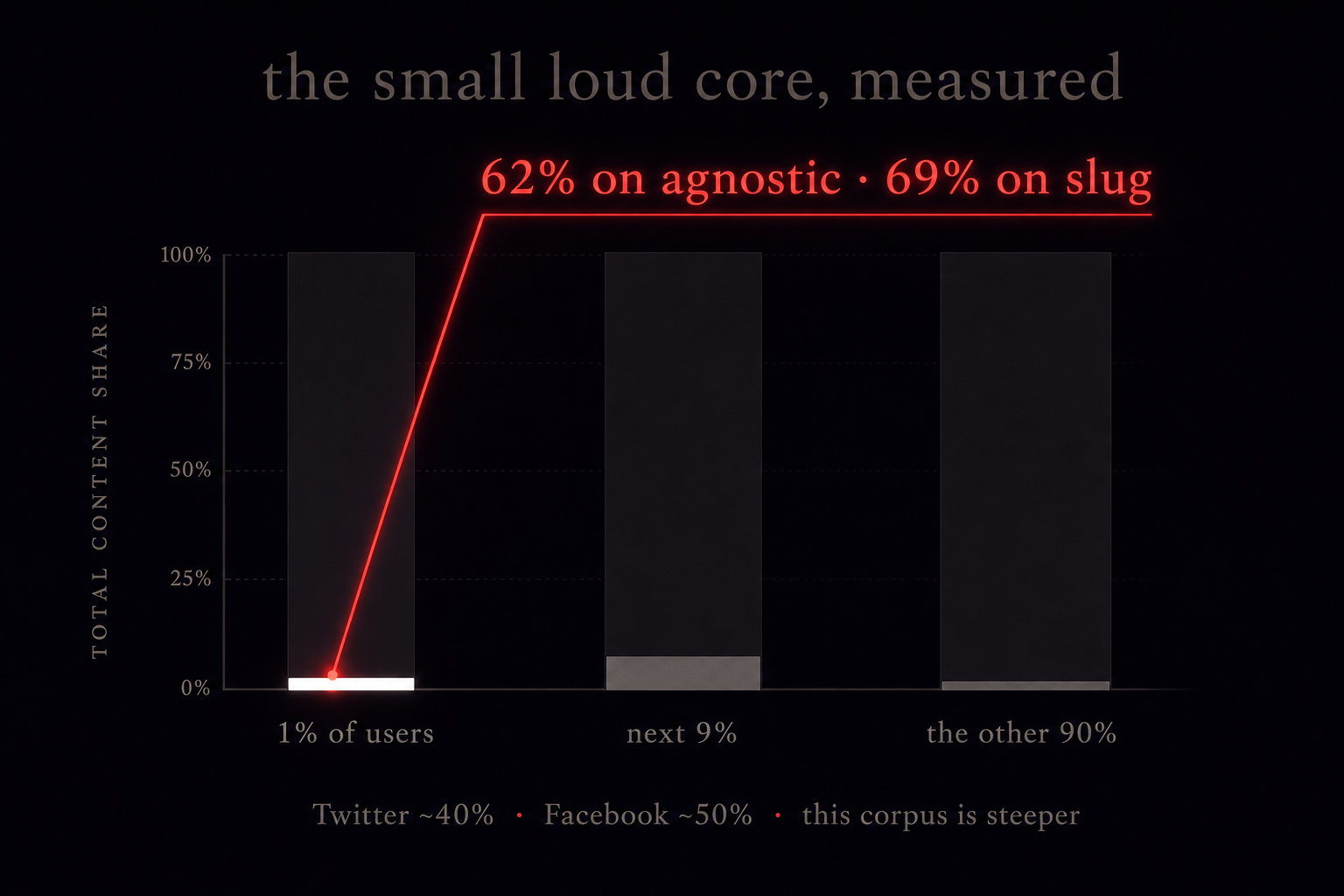
On agnostic, across all 49 matched pairs in the analysis window, 92% of the audience responses came from two clusters. Thoughtful Elder Skeptics produced 60.7% of responses. Bruised Seekers produced 31.8%. Thoughtful Elder Skeptics is a group of 313 users. Bruised Seekers is 859. Together that is roughly 1,170 people, out of 17,062 active agnostic users in the corpus. About 6.9% of the room generated 92% of what I read on the controversial questions.
On IDW, the same pattern, sharper. 92% of the responses came from Heterodox Traditionalist Skeptics (75.3%) and Cultural Grievance Veterans (16.4%). 240 plus 780 users. Roughly 1,020 people, out of 7,522 active. About 13.6% of the room.
The single most populated cluster on agnostic is something we ended up calling Seeking Connection Seekers. About 22% of the active community. The modal agnostic user. The person the seed prose was written for. Someone who joined to find a friend in a religious county and a place to talk to other people who had walked out of the same house they had. Their share of the responses on the political pairs was 0.3%.
They tuned out.
This is the part of the autopsy I had not predicted. I had assumed, while running the site, that the responses I was reading were the community responding. I was the moderator. I was reading every flagged thread. When 251 answers came in on the question I posted on January 13, 2021, asking what Trump had done to incite violence, I read what the community said. That is the verb I used in my own head. The community said.
The community did not say anything. About a hundred people did, on each side.
On agnostic, those 251 responses included only 4 distinct cluster archetypes among the users active enough to be clustered. 31 Thoughtful Elder Skeptics. 25 Bruised Seekers. 4 Progressive Freethinkers. 1 Curious Newcomer. The rest of the 17,062 active agnostic users that week, including the 22% who had joined for friendship, did not show up. On IDW, the matching question drew about 45 clustered responders. 32 Heterodox Traditionalist Skeptics. 9 Cultural Grievance Veterans. 2 Heterodox Contrarians. 2 Heterodox Questioners.
Two rooms, two well-populated floors of users, one of the most charged questions in living memory, and the audience for it was 56 people on one side and 45 on the other. The two communities together held about 24,500 active users at the time. About 24,400 of them were doing something else.
That is uncomfortable to type. It is also what the data says.
The pattern is not unique to the Trump question. On the January 4, 2021 question about that week’s pro-Trump rally in DC, agnostic drew 46 clustered responders, IDW drew 24. On the February 9, 2021 question about what dangerous things conservatives believe, agnostic drew 67, IDW drew 39. Across the controversial pairs, the audience was almost always under 100 per side, and almost always made up of the same handful of clusters.
Across the 49 pairs in total, the per-cluster responder distribution barely moves. Pre-2020-09, before election season, the Thoughtful Elder Skeptics cluster wrote 68% of agnostic responses. Post-2020-09, that share dropped to 58.6%. The Bruised Seekers cluster picked up the difference, going from 25.4% to 33.6%. The Seeking Connection Seekers stayed at 0.3% straight through. The political wave did not pull the median user into the threads. It rearranged the small loud core a little, that is all.
I want to be careful about what this finding says and what it does not say.
It does not say the responses I read were not real. When somebody calls another person a name on a thread you are moderating, the name is real, the harm is real, and the way the thread shapes the next reader’s view of the room is real. The responses I scored were responses. They happened. Other users read them and either kept reading or quietly closed the tab.
It also does not say the conflict was confined to the small loud core. The block action, the formal severing of one user by another, is more spread across the community than the report action. A lot of users chose silence and the block. They were reacting too, just without typing.
What it does say is that when a confident sentence about “the community” arrives, the underlying data on contested questions in this corpus is almost always 30 to 60 specific users per question, drawn from two specific archetypes per side, who responded across most of the controversial pairs and were the same accounts every time. About a thousand people on each side over five years and 49 questions. That changes how a builder should think about the lever.
I did not see that in 2017. I had read the engineering literature on civility-by-design and absorbed the assumption that engagement was distributed. Build the rails, the train runs. Make the reporting form humane, the median user will use it well. That logic is a partial truth. The median user will use the form well when she uses it. The median user is also not in the threads where the form mattered most. The median user is in a private message thread looking for a recipe for grief or a friend in a county that does not have any other atheists.
The intervention that matters, the actual lever, is whatever moves the small loud core. Not the general-population civility nudge. Not the better feedback form. Not the seed prose I had spent a hundred hours writing for the front page. The seed prose worked, in its own way, on the median user the seed prose was for. It mostly did not reach the loud core, because the loud core had different reasons for being in the room and was not reading the front page.
If I had understood that in 2017, I would have built differently. I would have spent the time I spent on the seed prose on a rate-limit and trust-tier system designed specifically for the small minority of accounts who ran the conflict graph. Power-reporters, power-reportees, and the four or five archetypes most likely to fire across each other. The general-population engineering would have looked the same. The conflict-driver engineering would have been more specific.
I am not claiming I would have moved the macro numbers if I had. The conflict cores in both rooms had reasons for being there that pre-existed the platform, and I was not in a position to change those reasons by changing my reporting form. I am saying the lever was different from the one I built for, by a wide margin, and I did not know it at the time.
There is a quieter version of this finding that I want to put on the table before the chapter closes, because it bears on how the third act of this book reads.
The agnostic active community on the analysis date was 17,062 people. The two loud-core archetypes were Thoughtful Elder Skeptics at 313 users and Bruised Seekers at 859. That leaves about 15,890 people in the active universe who are not in those two clusters. The largest cluster among them, Seeking Connection Seekers, was about 22% of the active community, or roughly 3,750 people. They contributed 0.3% of the political-pair responses, which is around four total responses across all 49 pairs. They sent direct messages. They wrote profile pages. They liked posts. They asked questions about whether anyone in their county was also an atheist and got long, kind, often anonymous answers from other users in the same archetype. None of that conflict made it into the report tables. Almost none of it made it into the matched-pair scoring set, because the political pairs were not where they spent their time.
On IDW the active community was 7,522. The loud-core archetypes were Heterodox Traditionalist Skeptics at 240 and Cultural Grievance Veterans at 780. That leaves about 6,500 people in the active universe doing other things on the IDW side. The Heterodox Questioners cluster, 1,151 users, contributed 2.5% of post-2020-09 responses on the political pairs. The Quiet Spectators cluster, 1,469 users, contributed 0.2%. Those are not engaged silenced majorities. Those are users who, when the political prompts arrived, kept reading and did not type. That is its own response. It just is not the response the platform shows the moderator.
The platform shows the moderator the typed response. The platform did not show me, in 2017 or in 2021, the silent majority of users who were getting use out of the room without firing the report form. I was the one who built the platform. I built the visibility surface in a way that surfaced the loud and obscured the quiet. I would do it differently now, on the visibility side, and the difference would not be a moral one. It would just be more honest.
If you only remember one thing about this chapter, remember that the rooms most online observers describe as “communities reacting” are usually a hundred specific people reacting. About a thousand on each side of mine, across five years and 49 contested questions, drawn from two archetypes per side. The other twenty-three thousand active members were doing other things, mostly off the political grid, mostly looking for what the seed prose said the room was for. They were not the failure of the experiment. They were the experiment working quietly, in a register the platform showed me less of than it showed me the loud core.
The chapter people want me to write about January 6 is about which side melted down that week. The chapter the data writes is about 31 plus 25 on one side and 32 plus 9 on the other. About 100 people on each side. The rest of the community read the headline and went back to the conversation about whether their daughter would call them on Sunday.
Between June 2017 and February 2022 I posted 749 questions across the two sites. 49 of those became scoreable matched pairs: near-duplicates posted to both sides within fourteen days of each other, with enough responses on each side to score. (The wider duplicate pool was 52; 31 of those hit both sites the same day or the next day.) That is the matched-pair set. It is the closest thing this corpus has to a controlled experiment, because the same prompt, in the same engineer’s voice, hit two different rooms inside a window narrow enough that almost nothing else changed.
Five years later we ran every audience response thread through a uniform LLM scoring pass. Civility on a 0 to 10 scale. Dehumanization events as a count. Agreement with premise on a 0 to 10. Depth on a 0 to 10. On-topic rate from 0 to 1. The 49 canonical pairs each had at least three responses on each side, enough to score. The whole pass cost less than a dollar in tokens.
The headline number across all 49 pairs is small. Average agnostic civility 7.18, average IDW civility 6.86. A 0.32 gap, basically meaningless on a 0 to 10 scale. If the chapter stopped at the headline number, it would not be worth writing.
The chapter is in the time arc.
Sixteen of the 49 pairs were posted before the 2020 inflection. They were platform housekeeping and early ideas. We changed the menu. We added a new feature. What do you think of the layout. Average civility on those: agnostic 8.94, IDW 8.61. Both rooms answered every domestic-business question with civility scores in the high 8s for almost three years. Civility on platform-internal topics was not the experiment failing. It was the engine working.
Seven pairs landed in summer 2020. COVID, BLM, George Floyd. Average civility: agnostic 9.36, IDW 7.57. The 1.79-point gap is the largest pre-election gap in the corpus. Worth saying out loud. This was a window where agnostic was unambiguously warmer than IDW. The Truth Project hypothesis was still mostly holding, but cracks showed first on the IDW side. Neither room melted down. One stayed warm and one cooled off.
Seventeen pairs landed during election season, September through December 2020. Average civility: agnostic 5.89, IDW 5.48. Both rooms crashed in parallel. From the high 8s and 9s down to the high 5s. Dehumanization events went from near zero per pair to 4.6 per pair on agnostic and 2.2 per pair on IDW. The two sides did not crash in opposition. They crashed together. The thing that broke was not an asymmetry between the two communities. It was politics in general entering the prompts.
Five pairs landed in the window from January 6 through inauguration. Average civility: agnostic 4.04, IDW 6.26. A 2.22-point flip. For the first time in the corpus, agnostic was sharply less civil than IDW. Dehumanization events per pair: 6.8 on agnostic, 2.2 on IDW. This is the window most readers picture when they picture the corpus. It is real. It is also five pairs out of 49.
Four pairs landed in the first month of the Biden administration. Average civility: agnostic 5.75, IDW 5.25. The Jan 6 flip flipped back. Inside that window, the prompt that named Biden scored agnostic 7.5 and IDW 3.5. A 4.0-point gap, the other direction.
That is the time arc. It is one row in the table.
The other row is topic.
When the prompt named one side’s outgroup, that side’s audience erupted. When the prompt named a structural question that did not pin one tribe’s outgroup to the wall, both sides stayed cool. The asymmetry was not a property of either community. It was a property of the prompt.
On January 4, 2021, two days before what became January 6, I posted to both sides: what do you expect to be achieved by this week’s pro-Trump DC rally? Agnostic civility scored 2.5. IDW scored 5.0. A 2.5-point gap.
On January 13, 2021, a week after the Capitol, I posted to both sides: what did Trump do, if anything, to incite violence? Agnostic 2.5. IDW 7.5. A 5.0-point gap, the largest single-question gap in the corpus. The framing on my end was sincere. I was trying to find out, in the same posture I had used for every contested question since 2017. The agnostic-side audience read it as a tribal cue. The IDW-side audience read it as a question and answered it.
On February 9, 2021, I posted to both sides: what dangerous, wrong, or false things do Conservatives believe? Agnostic 2.5, with 17 dehumanization events on the responses we scored. IDW 5.5. Same shape, narrower gap.
Then the other direction.
On January 27, 2021, one week into the new administration, I posted to both sides: how is Biden doing? Agnostic 7.5. IDW 3.5. A 4.0-point gap, the other way.
On November 12, 2020, a week after the election, I posted to both sides: which Democratic campaign promises should take priority in the new administration? Agnostic 6.5. IDW 3.5. A 3.0-point gap, IDW the lower side.
On November 9, 2020, the day Pfizer announced the vaccine, I posted to both sides: would you take it. Agnostic 8.5. IDW 4.0. A 4.5-point gap, IDW the lower side. That one is worth pausing on. Most readers expect the secular, scientifically literate, pro-public-health audience on agnostic to handle the vaccine question well. They did. Most readers do not expect the same audience to be the one that handles the Trump question badly. Same audience. Different prompt. Different reflex.
There is one cross-post in the same window that I am going to mention here and walk into in detail in chapter nine, because the chapter nine data point is the empirical floor under everything that follows the autopsy. On December 18, 2020, I posted to both sides: should some research topics be banned, or results censored? Both rooms engaged it civilly. Agnostic 6.5. IDW 7.0. The same audiences that melted down on the Trump prompt in January answered this prompt at the high end of conversational. Same engineer. Same week. Different prompt. The prompt is doing more of the work than the room is.
On February 17, 2021, I posted to both sides a question about whether teaching white guilt cultivates a white pride backlash, framed in the Glenn Loury register. Agnostic 6.5. IDW 7.0. Same shape. Both sides cool.
The pattern across the topic-conditioned table is clean. The same engine, the same moderator, the same audience pool, the same two-week window. The only variable that moves the civility scores by 4 or 5 points is what the prompt names. When the prompt names a side’s outgroup, the corresponding audience drops three or four civility points and the dehumanization-event count rises. When the prompt names a structural question that does not pin one tribe’s outgroup to the wall, both audiences stay in the high 6s and 7s.
I want to say very plainly what this data does not say. It does not say one side was meaner than the other. The Jan 6 window is real and is in the corpus, but it is five pairs in a 49-pair set, and the topic-conditioned table shows the symmetric direction in the same week and in adjacent months. The data supports a much weaker and more interesting claim. Each tribe melted down asymmetrically, on its own outgroup-triggering prompts, in a way the room could not absorb. Neither tribe was meaner as a baseline. Each tribe was meaner about specific things.
It also does not say the engineering failed. The engineering held the line on platform-housekeeping questions for almost three years, on both sites, at civility scores of 8 to 10. It held the line on the Aporia pre-statement, the white pride backlash question, the abstract-civics questions on either side, all the way through 2021. What it did not hold the line on was the topic class where each tribe’s outgroup was on the table. That is a narrower failure than “the engineering failed.” It is also a more honest one.
The dehumanization counts, separate from the civility score, sharpen the same point. Pre-2020 housekeeping pairs averaged about half a dehumanization event per pair on each side. The 2020 election window pushed agnostic to 4.6 events per pair and IDW to 2.2. The Jan 6 to inauguration window pushed agnostic to 6.8 and IDW held at 2.2. The Biden first month pushed agnostic to 4.8 and IDW to 3.0. The single Conservatives-believe pair on agnostic produced 17 dehumanization events on its own. The dehumanization counts and the civility scores move together, but the dehumanization counts are louder. The form told me how often the audience reached for the verbs that strip a person of personhood. Five years of those counts tell a clean story about which prompts triggered which side to reach.
I had a hypothesis in 2017 about civility being a portable virtue that, with the right scaffolding, would propagate. The 2026 update is that civility is portable in the way grammar is portable. Most of the time it travels with the person. Under specific stress, on specific topics, the grammar drops out and a different register, older, tribal, takes over. The seed prose did not reach into that older register. I do not know that any seed prose can.
The honest structural reading is that civility, in both communities, was not a stable trait. It was a defended boundary. Each tribe kept the boundary intact when the question respected it. Each tribe broke the boundary when the question crossed it. The engineer’s tools, the reporting form and the trust tier and the seed prose, mostly held the boundary on questions that did not cross it. They mostly did not hold the boundary on questions that did. There is no version of the form, in 2021 or 2026, that I know how to build, that closes the gap.
If you only remember one thing about this chapter, remember that the matched-pair table does not name a winner. It names a pattern. Civility online is not what each tribe is. It is what each tribe protects. The tribes I built rooms for protected different idols. The same engine I built for both could not engineer past the protection on either side.
The pivot at the end of this book is the engineer’s update to a hypothesis the engineer had brought into 2017 and the data brought him out of by 2022. The pivot is in the third act. It is a quieter chapter than this one. It earns its quiet from the table you just read.
The matched pairs table is what I posted. The conflict matrix is what the rooms produced on their own.
I sampled reported content from both communities and asked an AI to read each piece and tell me what the report was about. 7,164 pieces of reported content parsed cleanly. For each piece, I knew who reported it and who had been targeted, and I knew which kind of user each was. That let me build a per-topic and per-kind-of-user map of what each room was actually fighting about, separate from anything I had posted.
The two rooms used the same fourteen-label topic taxonomy. The shares look like two different communities.
On agnostic, religion and atheism accounted for 9.5% of report events. On IDW, the same topic accounted for 4.3%. Religion was reportable conflict on agnostic at twice the per-event rate. Most of the disputes were inside the deconvert population, which makes sense for a community of seekers who had walked out of a religion and were learning how to talk to each other about what they had walked out of.
On agnostic, relationships and dating accounted for 6.2% of report events. On IDW, the same topic accounted for 0.6%. About a tenfold gap. People came to agnostic for connection, and the disputes that came with connection were the disputes the room handled at volume. People did not come to IDW for connection in the same way. They came to push back. The pushing-back room did not generate dating conflict because dating was not what the pushing-back room was for.
On agnostic, spam and commercial reports accounted for 15.7%. On IDW, 9.8%. Agnostic was a larger room. Larger rooms attract more spam, and a community of seekers tends to use the report form on commercial intrusion the way it uses the report form on any other unwelcome guest at the door.
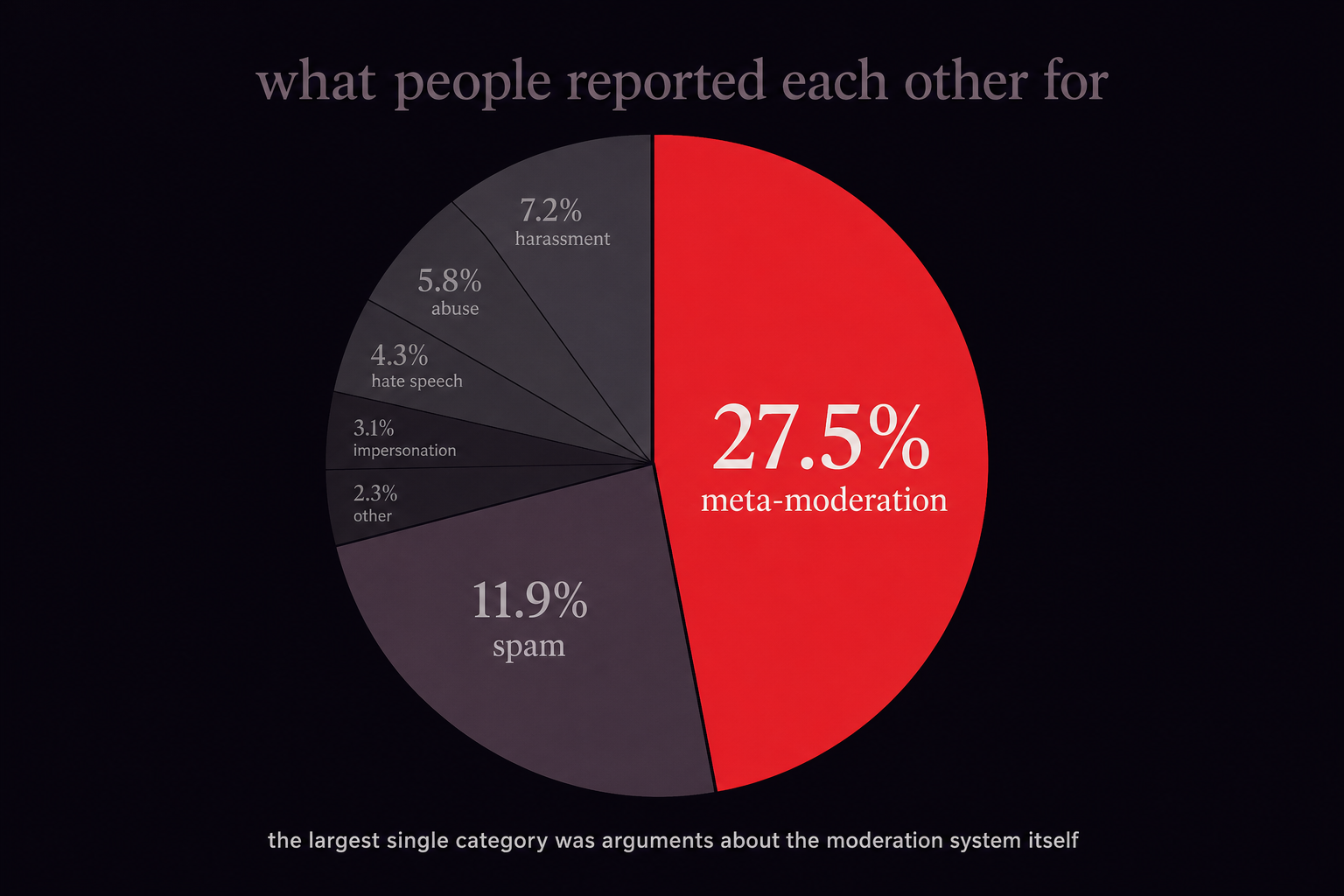
On agnostic, platform meta-arguments about moderation itself accounted for 26.1% of report events. On IDW, 22.6%. Both rooms spent more than a fifth of their reportable conflict arguing about how the room was being run. That is not a finding about agnostic or IDW specifically. That is a finding about online communities in general. People mostly fight about the rules.
Then the two rows that move the most.
On IDW, race, ethnicity, and immigration accounted for 21.7% of report events. On agnostic, the same topic accounted for 4.6%. A 4.7x gap, IDW the higher side.
On IDW, content critiquing right-leaning politics accounted for 14.8% of report events. On agnostic, the same topic accounted for 7.0%. A 2.1x gap, IDW the higher side.
The two-row finding is what the chapter is actually about. Same engine, same rules, same flagging form. Two very different conflict surfaces. Agnostic concentrated on in-group concerns. Religion, relationships, spam, the rules themselves. IDW concentrated on race, ethnicity, immigration, and critiques of right-leaning politics. The membership in each room had chosen what to fight about long before the engine had a chance to weigh in. The engine was running the report counter. It was not setting the topic agenda. The population was.
That is the topic surface. Then there is the structural surface.
Reports concentrate sharply in a small power-reporter tail, the same tail chapter three sized in aggregate. Chapter three told you the Gini was 0.832 on agnostic and 0.720 on IDW, and that one account on agnostic, GreenAtheist, filed 4,971 reports. Here is the rest of that user’s row. GreenAtheist also received 1,530 reports back. The same account is both the most prolific reporter and one of the most reported users. That overlap is the structural marker of high-conflict community. The people most actively policing the room are also the ones most actively being policed back. The top reporter on IDW, an account called RayitoDLuz, filed 496 reports and received 0. Different shape. Less reciprocal. Less concentrated. The IDW conflict graph was hotter on race and immigration as topics, but quieter as a graph.
The cluster-to-cluster matrix sharpens both observations.
On agnostic, the single most-loaded edge in the entire conflict graph is Thoughtful Elder Skeptics reporting Bruised Seekers. 702 reports. About 20.6 times the off-diagonal mean of the entire matrix. The reciprocal back-channel, Bruised Seekers reporting Thoughtful Elder Skeptics, carries 202 reports. About 5.9 times the mean. Three other above-5x edges run from Thoughtful Elder Skeptics out to Tentative Truth-Seekers and Progressive Freethinkers. The pattern is not diffuse. One cluster of 313 elder skeptics is reporting most of the rest of the active population, with the bruised cluster firing back. A large share of the 73,502 user-abuse rows on agnostic is one fight, run by a few hundred overlapping repeat players.
On IDW, the only above-5x edge in the entire matrix is Heterodox Traditionalist Skeptics reporting Cultural Grievance Veterans. 49 reports. About 5.4 times the off-diagonal mean. The IDW conflict matrix does not have the agnostic structure. It has a flatter graph with one mild structural edge. That is a different shape of community. It is not a kinder one. The same two clusters that ran the structural edge on IDW are the same two clusters that wrote 92% of the matched-pair audience and produced the topic-asymmetric meltdowns chapter five catalogues. The IDW conflict-driver subgroup ran a smaller graph through fewer button presses. It also ran the meltdowns on the prompts that named its outgroup, on the same cadence, with the same loud-core dynamics. The volume on the report form differed by an order of magnitude. The structural pattern, a small reciprocal cluster pair carrying most of the visible conflict in its room, was the same pattern on both sides.
The per-capita rates make the asymmetry inside agnostic almost embarrassing to write down. Thoughtful Elder Skeptics on agnostic, 313 users, filed 4,174 content reports in the corpus window. That is 13,335 reports per 1,000 users, which is a number you can only produce when a small number of accounts inside the cluster are filing reports the way most people fill out grocery lists. The next agnostic cluster, Bruised Seekers at 859 users, filed 1,013 content reports, or about 1,179 per 1,000. The next one after that drops below 130 per 1,000. On the IDW side, Heterodox Traditionalist Skeptics at 240 users filed 484 reports, or about 2,017 per 1,000. The next IDW cluster drops to 47 per 1,000. The pyramid shape inside each room, very tall, very narrow, then a long flat tail, is the per-capita signal of the small loud core from chapter four expressed in a different metric. The same hundred-something accounts that wrote 92% of the matched-pair audience were also filing the great majority of the report rows.
Time spikes line up with the world outside the rooms, as chapter three already showed. The agnostic spike at 1,653 reports per week ran from December 2017 through June 2018, the MeToo and Roy Moore and family-separation window. The IDW spike at 153 per week ran September through October 2020, election season. The world enters both rooms on similar days, in similar weeks, with similar weights. The rooms route the entry through different topics and different repeat players, and the topic and player choices are stable.
Two rooms. Two engines that were the same engine. Two welcome scripts that were almost the same script. Same moderator. Twenty months apart in launch date. By 2022 the two rooms had organized themselves into two different conflict surfaces, with two different power-reporter tails, with two different cluster pairs running the structural matrix, with two different topics dominating what the report form was used to flag.
I built one platform. The platform did its job. The job is not what most readers think. The job is to give the population a place to express what it had already decided to fight about. The engine is downstream of the population. The population is downstream of why they came in the door. The welcome script is the upstream lever. The welcome script is mostly the first paragraph of the homepage and the verbs in the tagline. By the time the population has self-selected through the door, the engine is mostly recording.
If you only remember one thing about this chapter, remember that the same engine produced two different conflict surfaces because the populations chose two different idols to protect. Agnostic protected its in-group ground. The deconvert lane, the relationship lane, the right of the moderator to set the rules. IDW protected its right to argue about race, immigration, and partisan power without being shouted out of the room. Both protections are visible in the report tables. Neither protection is, by itself, a moral argument. The data does not tell you which idol matters more. The data tells you that two rooms with the same rails and different populations will, every time, choose different things to fight about, with different repeat players running the fights.
The next chapter walks back into the same data from another angle. Same human being, two doors. The variable is the room. The constant is the person.
Of the 209,110 user records on agnostic and the 145,827 on IDW, 15,957 logins matched across the two databases.
12,100 matched by the same email address. Another 3,857 matched by username only. 49.4% of the dual registrations happened the same day or within hours of each other on both sides. Median gap between the two registrations: 0.55 days. agnostic-first 39.0%. IDW-first 11.5%. Some of the same-day plurality is auto-provisioning, accounts spun up in the same hour by users discovering both rooms together. Some of it is a person hearing about both communities at once and signing up for both before the next coffee.
Most of those 15,957 went inactive on at least one side. Of all the dual accounts, 1,929 were ever active anywhere. 1,172 active only on agnostic. 466 active only on IDW. 291 active on both, where active means real posting on each side, not just a registration record.
291 is a small number. It is also the cleanest natural experiment in the corpus. The variable is the room. The constant is the person.
The arithmetic on the 291 dual-active cohort is sharp.
The same person, on average, filed 23.3 times more abuse reports on agnostic than on IDW. Received 13.8 times more reports on agnostic than on IDW. Mean answers per dual-active user, 490 on agnostic and 123 on IDW. Mean comments, 455 on agnostic and 119 on IDW. Roughly four-to-one in favor of agnostic on the conversational metrics. Ten-to-one and twenty-to-one on the report metrics. Same person. Same login profile. Same human being.
The one metric that tilted the other way was question-asking. 105 questions per dual-active user on agnostic. 149 on IDW. A ratio of 1.42 in IDW’s favor. The rooms invited different actions. agnostic functioned as a conversation feed where you posted to be heard. IDW functioned as a question-and-debate room where you posted a sharp prompt and watched it get argued. The same person treated each room the way the room invited them to be treated.
The directional vote tells the same story. Of 1,621 cross-site members with any answers anywhere, 1,146 posted more on agnostic and 444 posted more on IDW. Of 988 with any comments, 719 commented more on agnostic and 263 more on IDW. Of 393 with any reports filed, 356 filed more on agnostic and 37 more on IDW. Roughly four-to-one for the conversational metrics. Roughly ten-to-one for reports. Not statistical noise. The same person, when active on both sides, put more time into the agnostic room and reached for the report button there far more readily.
The simple way to misread this is to conclude that agnostic was the busier room and the report skew is a side effect of more time on platform. The numbers do not let me off that easily. The activity ratio is four-to-one for answers and comments, and the report ratio is roughly twenty-to-one filed and fourteen-to-one received. The reporting behavior runs at three to five times the rate of the underlying activity gap. Time on platform does not explain the gap. The room does.
Numbers like 23 times brush past easily. So I asked an AI to do something more granular.
I sampled dual-active users with at least five answers on each side. The pool at that threshold turned out to be 59 users, smaller than the 200 the spec asked for. I relaxed the floor in steps. Five answers per side, then four, then three, then two, until the sample was workable. I ended at 108 users. Each one of them got their posts read on both sides by the model and rated, the same person twice, on civility, warmth, argumentativeness, and self-disclosure on a 0-to-10 scale, plus a free-text dominant-register tag.
Civility. Same person on agnostic 7.25. Same person on IDW 5.79. Gap of -1.46 points. Median 7.5 versus 6.0.
Warmth. agnostic 5.75. IDW 3.71. Gap of -2.04. Median 6.5 versus 3.5.
Argumentativeness. agnostic 4.80. IDW 6.69. Gap of +1.89. Median 4.8 versus 7.5.
Self-disclosure. agnostic 6.01. IDW 3.65. Gap of -2.36. Median 6.8 versus 3.8.
Same person. Less civil. Less warm. More argumentative. Way less personal storytelling on the IDW side. 69 of the 108 dropped at least 0.5 civility points moving from one room to the other. 18 became more civil. 21 stayed within a half-point. 69 added at least 0.5 argumentativeness points on IDW. 28 became less argumentative.
The model returned a free-text dominant-register tag for each side. On agnostic, the recurring tags were storytelling, supportive storytelling, conversational sharing, casual conversational, reflective storytelling, supportive and reflective. On IDW, the recurring tags were analytical critique, combative and sarcastic, combative political commentary, terse opinion-stating, lecturing, combative political argumentation, sarcastic and provocative. Two columns of tags. Read them aloud in order and you can hear what the room did to the same set of people.
The per-user level is not abstract. The model documented eight individual case studies inside the 108. I will paraphrase two of them and not name the users.
The first login wrote, on the agnostic side, about losing a partner in a long marriage, about secular morality without a religion to lean on, about raising a freethinker child. Civility 9.5. Warmth 9.0. Argumentativeness 2.0. Self-disclosure 9.5. The same login, on the IDW side, wrote sarcastic one-liners about people the writer considered ideologically lost. Civility 4.0. Warmth 1.5. Argumentativeness 6.0. Self-disclosure 0.5. Vulnerable storyteller in one room. Cutting commentator in the other.
The second login wrote, on the agnostic side, about caregiving burden, mental health struggles, recovery from trauma, social isolation. Civility 8.5. Warmth 7.5. Argumentativeness 2.0. Self-disclosure 9.0. Empathy and vulnerability all the way down. The same login, on the IDW side, wrote about media bias, censorship, vaccine mandate skepticism, and a defense of public figures the writer felt the broader culture had treated unfairly. Civility 4.0. Warmth 2.0. Argumentativeness 8.5. Self-disclosure 1.5. The empathic caregiver became a combative political voice with virtually no personal disclosure.
Multiply that pattern by a hundred, with variations on the theme but the same direction of drift, and the right column of the table is what you get. Storytelling becomes lecturing. Supportive becomes sarcastic. Reflective becomes terse. Self-disclosure scores drop 2.36 points on a 0-to-10 scale, which is not a rounding error. It is the difference between “here is what happened to me when my marriage ended” and “people who think X are obviously wrong.”
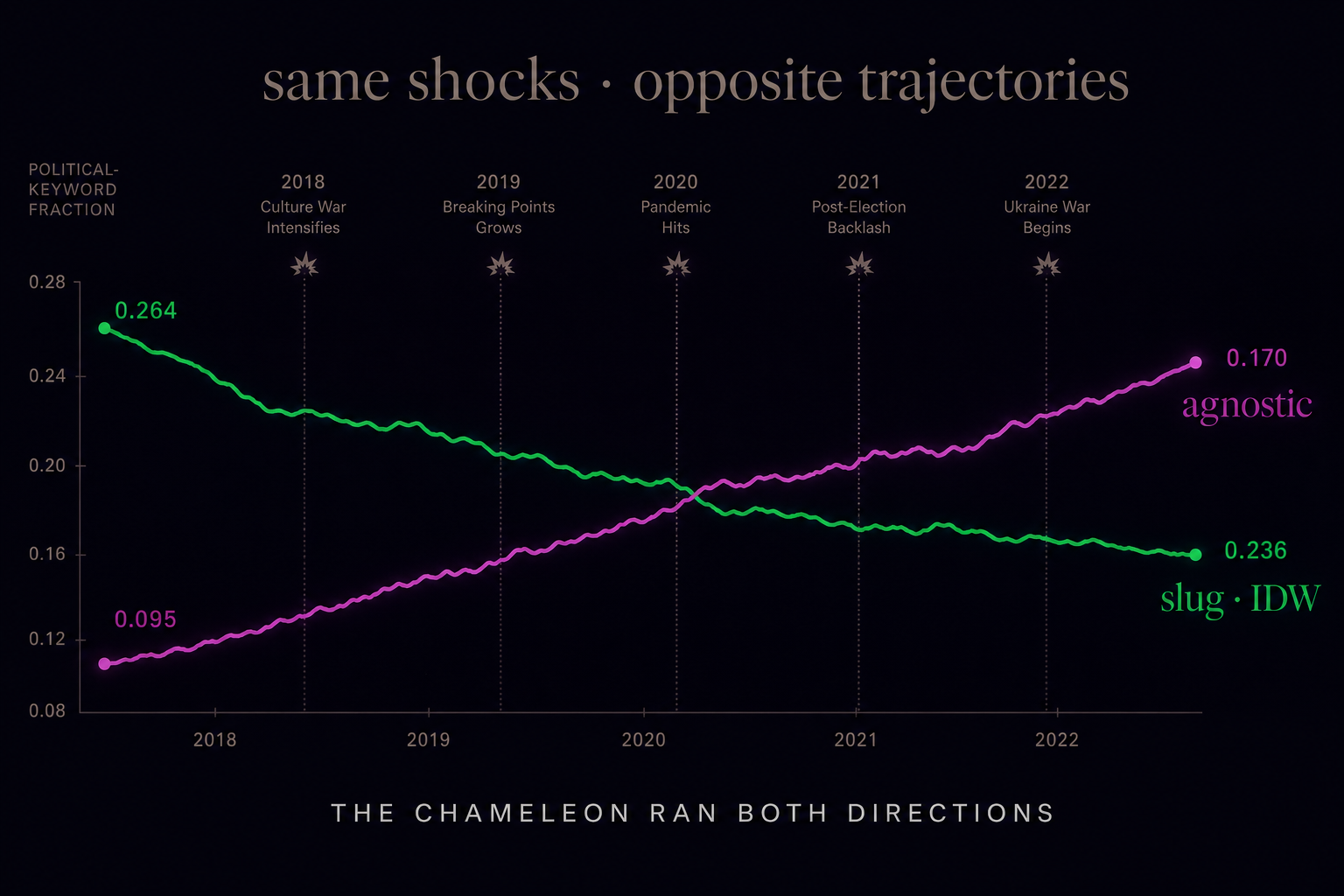
I want to name what the direction of drift is and is not. The drift goes from agnostic warm to IDW combative because the agnostic welcome script asked the modal arrival to share themselves and the IDW welcome script asked the modal arrival to push back on a question. The direction is the welcome script’s direction, not a verdict on which tribe holds itself to a higher standard. Run the same engine in the opposite order, with the pushing-back welcome script at the first door and the looking-for welcome script at the second, and the case studies in this chapter would read out the other way. The same human beings would write storytelling on the second site and combative argument on the first, and the same model would tag the columns in the opposite direction. The chameleon mechanism is the finding. Which side of the chameleon is colder in this particular sample is a function of which welcome script went up first and on which domain.
92 of the 108 were flagged as chameleons, where the model judged the dominant register meaningfully changed between rooms. 85.2%. Not the exception. The dominant pattern in the sample.
If you had told me in 2018 that the same person, given the same engine and the same humanist seed essays but a different pre-existing population on each side, would shift 1.5 points on civility and 1.9 points on argumentativeness when they crossed into the other room, I would have argued with you. I would have told you the engine determined more of the outcome than the population did.
The data made me revise that.
You can argue with the matched-pair data from chapter 5. The audiences were different. You can argue with the cluster-archetype data from chapter 4. The clusters are statistical objects. 23 times more reports filed by the same human being on the same login profile, and a 1.46-point civility shift on a 108-user sample of the same people scored twice, are the same person twice. They cancel out the personality variable. What is left is the room.
The room shapes the voice more than the person does.
If you only remember one thing about this chapter, remember 85.2%. The room shaped the voice for 85 of every 100 cross-site users we measured the same way twice. The platform is downstream of the population. The population is downstream of why they came. I had been the engineer, and I had been certain the engine was the variable I most controlled. The 108 users twice-scored on the same dimensions are the cleanest evidence I have ever gathered against my own instinct. Same engine. Same builder. Same essays. Two rooms that turn the same human being into two different speakers.
I should have scored my own posts before I scored anyone else’s.
Five years of running both rooms. 749 questions across the two communities. 5,378 answers. 3,324 comments. 83 site essays. I had read every word of it as I wrote it. I had not gone back and read the corpus from above. In 2025 I asked an AI to read 2,999 of my own posts, in random order, and score me on five things. How political the post was. Whether the post was hopeful or warning. Whether the post sounded like an engineer thinking out loud or like a member of the room. How much personal disclosure was in it. And which framings I had reached for. The cheapest autopsy I had run, and the most uncomfortable.
The headline gap between the two lanes is the easy one to report. Politicization on agnostic, mean 0.21 on a 0-to-5 scale. Politicization on IDW, mean 1.43. IDW pulled my pen 6.9 times more political than agnostic did. That number is not a surprise. The IDW side launched February 14, 2019 as the rebrand of slug.com into IDW.community. The brand promised political content. I delivered it.
The framings table tells the same story. Free speech framing on IDW, 8.8% of items. On agnostic, 0.7%. Critique of the in-group enforcement style on IDW, 4.5%. On agnostic, 0.2%. (I will admit, on the record, that when the word *woke* first started getting used as a pejorative, I did not love it. It felt like the wrong label for the actual phenomenon. But the AI tagged the framing exactly when the data said I had reached for it, and the framing was real, and a working consensus has since formed across most of the political spectrum that the movement it was naming overshot. So I am not going to be coy about it. I noticed I was reaching more often for adversarial framings of in-group enforcement on the IDW side, on the room that had been built specifically around the experience of being silenced by it.) Adversarial-framing rate on IDW, 8.6%. On agnostic, 2.3%. Tribal-outgrouping framing on IDW, 8.4%. On agnostic, 1.3%. Six and a half times more often, on the IDW side. Social-justice-critique framing on IDW, 8.2%. On agnostic, 0.7%.
That part of the picture confirms what the brand had said. The room I had labeled the IDW lane was the IDW lane. So far, no surprises.
The part that ambushed me was on the other site.
January 2021. Politicization mean on my agnostic posts that month, 2.41, n=32. The all-corpus agnostic mean was 0.21. My January 2021 number was 2.20 above the site mean, on a 0-to-5 scale. The single most politicized cell on either site for the entire five-year corpus. December 2020 ran 2.07. February 2021 ran 2.03. November 2020 ran 1.97. A four-month sustained politicization stretch on the site I had told myself was the room above tribal politics.
The site_text essays on agnostic were about humanism, civil discourse, the dehumanization cycle, the ethics of disagreement. Not politics. Not tribe. The founder, by his own intent, was the moderator above the fight. The data says the founder was not above the fight in the four months around the 2020 election and January 6, 2021. The founder was in the fight. The founder was bringing it into the room.
I did not see that coming. I had told myself the moderator role would inoculate me. I had told myself I had a vocabulary for the trap that other people did not have. The data says I drifted with the prompts the same way the dual-platform users in the previous chapter drifted with the rooms. 85.2% of those users were chameleons. So was I, between my own two lanes. With my name on the founder seat. With a stack of seed essays still live on the front page telling people the difference between civil discourse and tribal reaction.
The IDW-side hopefulness arc is the other surprise.
Hopefulness mean on agnostic, 0.92 on a -5 to +5 scale. Hopefulness mean on IDW, 0.37. Both rooms ran net hopeful on average across the whole corpus. The gap was -0.55 on the IDW side. The agnostic room held its hopefulness floor longer than I expected. The IDW room dipped into negative territory through mid-2020 and bottomed out in October 2020 at -1.37, n=41. The only sustained warning-register stretch in the corpus.
The cure-side framings lived on the same lane. Rehumanism framing, 2.2% of IDW items versus 1.2% of agnostic items. Beauty-Truth-Love framing, 0.8% of IDW items versus 0.1% of agnostic items. The cure language emerged in the room I had built for disagreement, and the warning language emerged there too. The room with the louder welcome script pulled out of me both the most hopeful framings and the most foreboding ones, in roughly equal measure. The room with the seeker welcome script kept me in operational founder-mode and pulled out of me the housekeeping voice. That was not the asymmetry I had been telling myself I was running.
The earliest signal of where this was going lives in 2019. May 2019. Politicization on IDW jumped from 0.47 in April to 1.32 in May, a delta of +0.85 in a single month, n=87 then n=50. October 2019. Politicization on agnostic jumped to 2.33, plus 2.13 above the agnostic site mean. The first time agnostic broke its political baseline. n is small on that one. I did not notice at the time. I was writing a feature for a content-moderation queue. The data was telling me something the feature was not going to fix.
Builder versus participant is the small confirmation. Both rooms ran me well above the participant baseline. agnostic mean 0.75 on a 0-to-1 scale where 1 is pure announcement. IDW mean 0.61. I was always speaking as the founder, even inside threads. agnostic was more so, because there were more years of operational announcements there and the platform_announcement framing showed up in 70.5% of my agnostic items versus 52.2% of IDW items. On IDW I drifted into participant mode through 2020 as the threads pulled me into the conversation rather than above it. Even there I was 0.61 on the scale, which is more founder than member.
The voice arc has one detail I keep going back to. Personal disclosure on agnostic, mean 0.24 on a 0-to-5 scale. Largest single-month spike, January 2021, at 1.05, n=32. Same month as the politicization peak. The most politicized cell of my agnostic corpus and the most autobiographical cell of it landed on the same calendar page.
When the political temperature was hottest I started posting more about myself. I want to say that was a deliberate move toward warmth. The more honest reading is that I was anxious and writing my way through it. Builders cope by typing. The dashboard does not record the cope.
The IDW-side equivalent is smaller and earlier. Personal disclosure on IDW jumped from 0.22 in July 2020 to 0.52 in August 2020, a delta of +0.30 in a single month. Two months before the October 2020 hopefulness bottom on IDW. The disclosure rises before the warning bottoms out. The engineer in me wants to read that as a leading indicator. A more reflective reader would read it as: the room got harder, the founder started talking about himself more, and then the founder’s tone bottomed out. Pick whichever reading flatters you less.
The framings table has one more item I owe the reader. Rehumanism framing, the cure-side word I had used for years, lived in 2.2% of my IDW items and 1.2% of my agnostic items. Total. Across nearly three thousand items scored. The cure-side language I had told myself was the through-line of the whole project was barely on the page. It lived in the long-form site_text essays, which were not in this sample, and not in the day-to-day moderation work. The autopsy of the founder’s voice says he wrote about civility a lot, framed it as a weapon a lot, and named the cure rarely.
Five years of running both rooms. 2,999 of my own items on five dimensions. The autopsy report on the autopsist:
He was not above the fight. He was in it. He sounded one way on one site and another on the other. He spiked politicization on the room he had told himself was above tribal politics. He bottomed out hopefulness on the room he had told himself would carry the cure language. The cure language showed up rarely. The framing of civil discourse as a weapon showed up often. The drift across his two lanes was within the same range as the dual-platform users he would later measure on a different sample.
I had been the engineer reading the dashboard for seven years and not noticing he was on the dashboard.
If you only remember one thing about this chapter, remember that the founder was a chameleon between his own two lanes before he had a vocabulary for it. Politicization on agnostic, 0.21 across the corpus, 2.41 in January 2021. Politicization on IDW, 1.43 across the corpus, with peaks higher still around the same external events. The room shaped the voice of the builder too. The autopsist is in his own data. The autopsy is not a thing standing outside the autopsy.
December 18, 2020.
I posted the same question to both communities that day.
“Should some research topics be banned or results censored?”
The question is the question. There is no clever framing in it. It asks whether scientific inquiry should ever be ruled off the table in advance.
I had no plan to fund a magazine when I posted it. The funding came thirteen months later. I was running my two rooms. I had been posting matched cross-posts on contested questions for almost a year. I had watched both rooms melt down on outgroup-triggering prompts in the previous month and would watch them melt down again in the weeks ahead. The Trump-incitement question would land on January 13, 2021, and produce agnostic civility 2.5 against IDW 7.5. The dangerous-things-Conservatives-believe question would land on February 9, 2021, and produce agnostic civility 2.5 with seventeen dehumanization events on the top responses. I knew the two rooms were brittle to outgroup framing. I posted the research-banning question without that pattern in mind. I was curious what each room would say.
What each room said was striking.
agnostic civility 6.5 on the matched-pair scale. IDW civility 7.0. Both rooms in the calm-and-engaging zone. Both rooms thinking out loud about a question that, on its face, names a cleaner test of community judgment than almost any other prompt I had posted.
The responder distributions are in the data. About 18 agnostic users with cluster IDs known engaged the thread, mostly Bruised Seekers (66.7%) and Thoughtful Elder Skeptics (33.3%). About 26 IDW users with cluster IDs known engaged the thread, mostly Heterodox Traditionalist Skeptics (76.9%), Cultural Grievance Veterans (11.5%), and Heterodox Contrarians (11.5%). Most of the responders, on both sides, argued in the same general direction. They argued that scientific inquiry should not be ruled out of bounds in advance. There were thoughtful dissents on each side that were heard and answered.
Nobody got reported on either side. Nobody got blocked. The threads are still in the database. I have read them maybe two hundred times since 2024.
Two rooms. One question. Both rooms could hold it.
The threads themselves, paraphrased and not quoted, ran in a few recognizable lanes. Some responders argued that the question itself was the ban, that even asking which topics should be off-limits was a way of putting topics off-limits. Some argued the opposite, that some lines of inquiry had been used historically to justify atrocities and that the carefulness of the publication context mattered more than the freedom of the question. Some argued that the academy was already doing the rationing in practice, by funding and by hiring, and that the formal ban was the less interesting question than the informal one. The thoughtful dissents on each side engaged the thoughtful dissents on the other side. The threads ended where threads end, with people having said what they wanted to say and the moderator, me, leaving the threads alone because there was nothing for the moderator to do.
Thirteen months later, in early 2022, I funded a public Substack called Aporia. The next chapter is what happened to that funding. This chapter holds the empirical floor under it.
What I want to leave standing in this chapter is the gap.
Two communities I had built held the question on December 18, 2020, with civility scores of 6.5 and 7.0, in the same week, with overlapping responder pools, with zero reports filed and zero blocks exchanged. The question was, in effect, the Aporia thesis pre-stated. Not by me as the funder of a magazine. By me as the moderator of two rooms, asking my own communities to engage the same question the magazine would later be built to engage.
Two years later, the same general kind of question, routed through a different medium with a different audience, was not held by the system that processed it.
I am not going to relitigate that gap in this chapter. The next chapter does that, with the autopsist’s frame and without naming names. What this chapter does is plant the empirical floor. The dialogue layer can hold a contested question. Both of the rooms I had built handled this exact question, within hours of each other on the same day, with the same moderator reading both sides, and they handled it well enough that the LLM scoring nineteen months later returned 6.5 and 7.0. Those numbers are the empirical floor under everything that comes after.
The honest reading is not that the rooms were perfect. Chapter 5 catalogues where they cracked. The Trump-incitement prompt, agnostic civility 2.5. The dangerous-things-Conservatives-believe prompt, agnostic civility 2.5 with 17 dehumanization events. The Biden first-month prompt, IDW civility 3.5. The rooms had their own meltdowns, on outgroup-triggering political prompts, on a topic-asymmetric pattern. They could not always hold a contested question. They could hold this one.
That asymmetry is the thing the data lets me say with confidence.
The asymmetry is what the next chapter is about.
If you only remember one thing about this chapter, remember December 18, 2020. agnostic civility 6.5. IDW civility 7.0. Same question, posted to both rooms within hours of each other. About 44 responders total across the two threads, mostly arguing in the same general direction. Zero reports filed. Zero blocks exchanged. The threads are still in the database. They are the cleanest single data point in the corpus and the empirical floor under the next chapter. The communities I had built could hold the question. What happened to the same general question two years later, when it was routed through a different medium, is the autopsy I will turn to next.
The last two chapters are what the autopsist did with the autopsy. Chapter 10 walks into the publishing-layer test of the same hypothesis, the academic Substack I funded in early 2022 called Aporia, and what happened to it in October 2024 when a coordinated press cycle routed the funding into a hidden-network frame. Chapter 11 walks into the rebuilt thesis and the seven rooms running on it now in Seattle.
The 2017 hypothesis is not retired in act three. It is relocated. The platform layer was the wrong place to engineer rehumanization for outgroup-triggering questions. The data in act two earned that conclusion. Act three does not relitigate the press cycle and does not become a brochure for the foundation. It walks two layers up from the comment thread and reports on what is on the workbench in 2026. Two chapters, one short epilogue, and one specific room you can visit in person on a Wednesday afternoon at 4 pm in downtown Seattle.
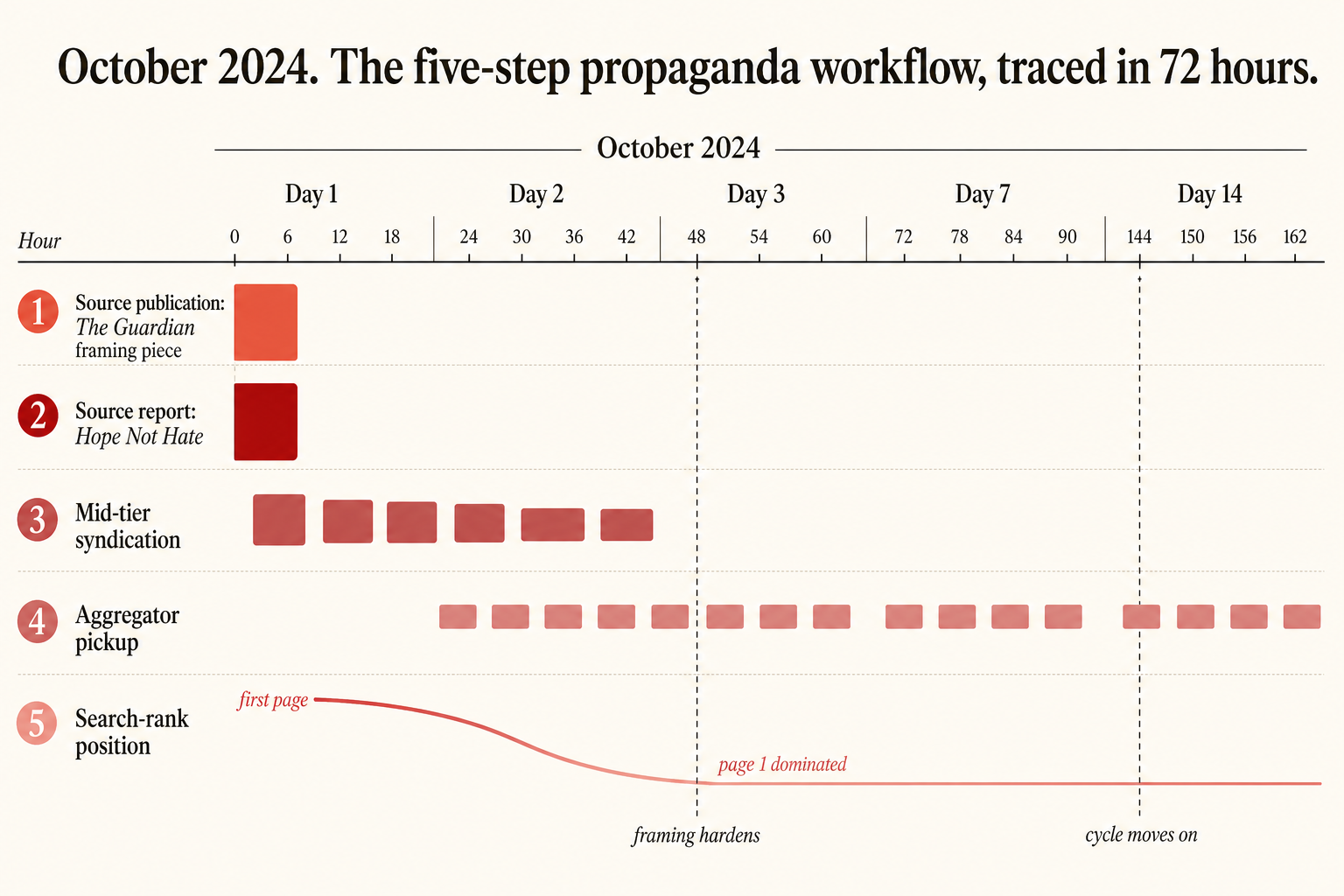
In 2022 I funded a public Substack called Aporia. The funding ran through the end of 2024. The public corpus stands at 832 articles. Behavioral genetics. Demography and migration. Philosophy and meaning. Book reviews of mainstream and academic books. Podcast interviews with named mainstream academics. The articles are still up. Anyone with an internet connection can read them.
I funded it because of what the data on my own dashboards was already showing. The previous chapter walked through the cleanest version of that, the December 18, 2020 cross-post that scored 6.5 on agnostic and 7.0 on IDW. By late 2021 I had moderated two communities for almost five years. The numbers in the first nine chapters of this book were not yet aggregated into tables, but the pattern was already legible from inside. Hard questions could be talked about, civilly, by people who came in willing to talk.
The reasoning at the time was straightforward. If two rooms running the same engine could hold the question, then a careful publication that took the same kind of question seriously, cited the literature, and interviewed mainstream academics could be useful at the next layer up. The late-2025 public statement at conru.com/truth/index.html frames the conviction in plain terms, paraphrased: I had treated suppression of careful inquiry as itself a kind of harm, and the protection of careful dialogue as the opposite of harm. I had believed that supporting academics who were trying to write honestly without bigotry was a worthwhile use of money. The statement is signed and public. It is the only place I am going to paraphrase that conviction in this book.
I am writing this chapter as the autopsist, not the defendant.
In October 2024 a coordinated press cycle came together across a major national newspaper, an advocacy nonprofit, and a broadcast documentary. The framing was that the Aporia funding had been part of a hidden network promoting the worst kind of pseudoscience. I am not naming any journalist, outlet, claim, or critic in this book. The naming work belongs to the public statement at conru.com/truth/, the corpus-analysis project at conru.com/aporia/, and a source library held under the same site. The book’s hands-off ceiling on this material is set in the proposal and I am holding it. The press-attack source materials live at known paths in the workspace. None of them is opened in this chapter.
The autopsy is what fits here.
The question routed through Aporia in October 2024 was, in shape, the same kind of question I had posted to both communities on Dec 18, 2020. Whether some research topics should be discussable in public. The two rooms had sat with that question and produced threads at 6.5 and 7.0 civility on a ten-point scale, with about 44 responders, no reports filed, no blocks. The October 2024 cycle did not produce a comparable number, because the medium it ran on does not produce numbers. It produces narrative compression. A funding decision and a network-of-association graphic are sufficient input, if the framing is clean enough at output.
There is no version of that comparison that comes out flattering to either side, including mine. The community-side comparison shows what happens when a question is asked of people who came in willing to talk. The wider-side comparison shows what happens when a question is asked of an apparatus that does not optimize for being talked to. The 2017 me had not made the distinction. The 2026 me has, because the data forced the distinction.
Late-2025 Andrew, paraphrased from the public statement, owns the part the data does not have to own. He describes the original conviction as sincere but unprepared for the world it ran into. He writes that he had not accounted for a coordinated machinery whose purpose is to wreck reputations and remove people from public life rather than to listen. He owns the naivety. He does not retract the underlying intellectual commitment to free inquiry. He reframes the lesson, paraphrased again, on the second page of the statement. You do not unwind a settled ideology with logic. Argument and citation are not enough to bridge a gap once basic trust has gone.
The autopsist’s job is to lay one number against another and let the reader see the shape.
The communities I had built scored 6.5 and 7.0 on a research-censorship question on Dec 18, 2020, and produced threads that did not melt down. The wider apparatus, when it confronted a similar question routed through a magazine I had funded, did not produce a thread that did not melt down. Both halves of that sentence have to stay in the same sentence. The first half does not absolve the naivety the public statement names. The second half does not erase the test the rooms passed.
The asymmetry between those two outcomes is the asymmetry the rest of the book has been pointing at from a different angle. The community-engineering layer ran on rails I had built and a moderator I had picked, which was me. The wider-discourse layer ran on rails I had not built and could not moderate. The 2017 hypothesis had assumed that what worked at the first layer would propagate to the second layer, because both layers were nominally about people exchanging arguments in public. The data does not support that assumption. The two layers run on different physics.
If you only remember one thing from this chapter, remember this. The Truth Project hypothesis from 2017 was right at the community-engineering layer for a class of question that included the research-censorship question on Dec 18, 2020. It was wrong at the wider-discourse layer for the same class of question routed through Aporia in October 2024. The book is not going to relitigate the press cycle. The corpus is at conru.com/aporia/. The statement is at conru.com/truth/. The data is in this book. The next chapter is what the autopsist did after the engine.
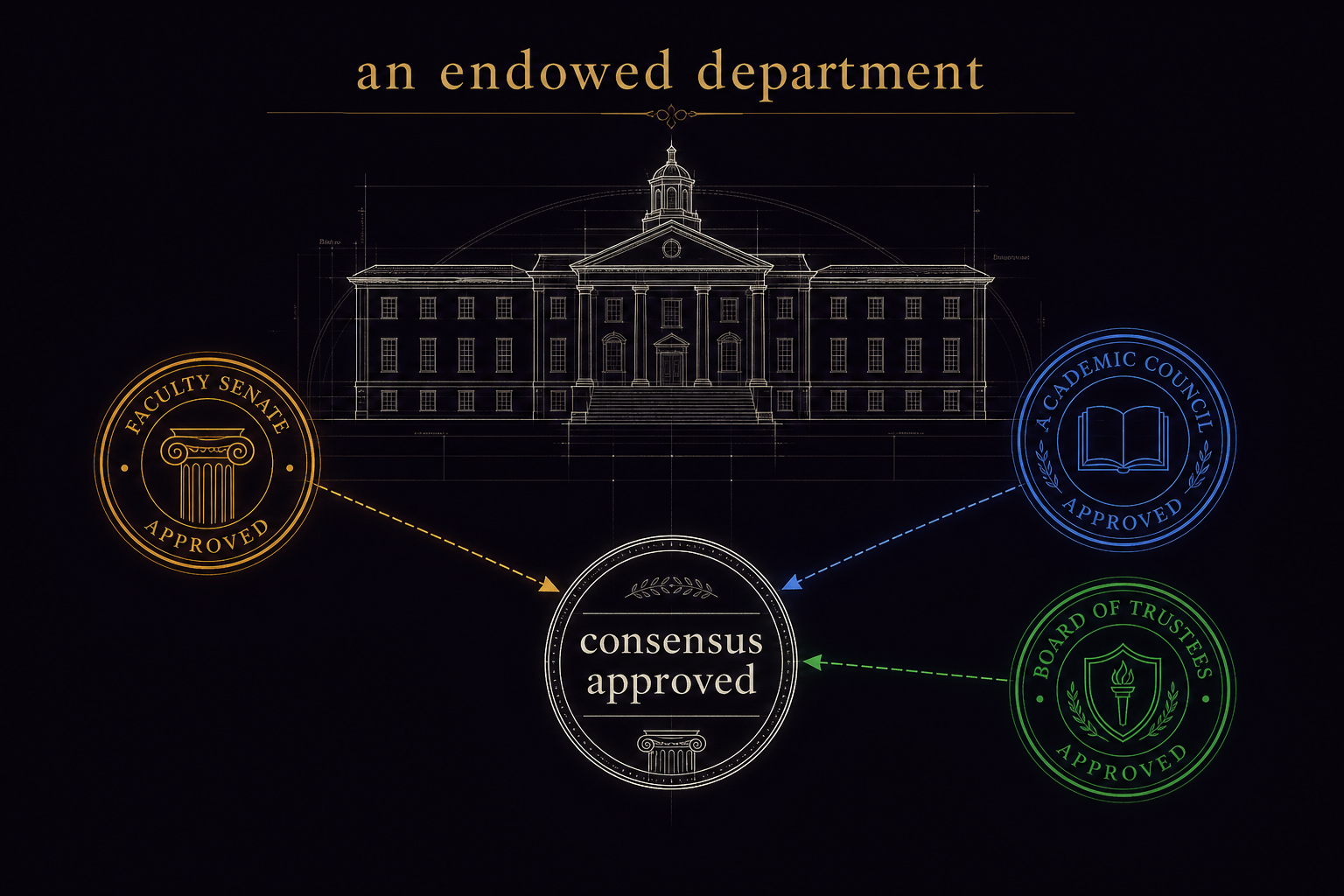
After the engine, what is left is the rebuilt thesis and the rooms running on it.
The 2017 thesis had been: engineer civility into the medium and the medium will produce rehumanization. The first ten chapters of this book are what the data said back. The hypothesis was right at the platform-housekeeping layer, where the rails carried any question about how to run the room. It was wrong at the political layer, where the same rails carried the meltdown the moment the prompt named an outgroup. Civility was not a portable virtue. It was a perimeter each tribe extended to its in-group questions and withdrew from its outgroup questions. The Dec 18, 2020 cross-post sits inside the protected zone. The Jan 13, 2021 Trump-incitement cross-post sits outside it, with agnostic at civility 2.5 and IDW at 7.5. The Jan 27, 2021 Biden-first-month cross-post sits on the other side of the same fence, with agnostic at 7.5 and IDW at 3.5. The matched-pair table earns all three readings.
This chapter is not a confession. It is an empirical update. The 2017 hypothesis was wrong in a specific way, and the way it was wrong points to a different layer at which the same goal might be pursued.
The rebuilt thesis is BTL. Beauty, Truth, and Love.
The three words are functional values, not soft ones. The opposites are ugly, lies, and hate. A culture is doing one set of things or the other set of things at any given moment, and the test takes about three seconds.
Beauty is a defensive-system claim, not an aesthetic one. The 17 dehumanization events that accumulated on a single agnostic thread in February 2021 came from the same kind of brain that, on a different prompt, would post a photograph of a dahlia. The trigger is what differs. Beauty disarms the trigger. It does not argue with the armor. It walks past it. Truth, in the depiction sense, is honest rendering of the human condition, hands and faces and light through a north window, not the abstraction debaters fight about. A face studied for forty hours is harder to attach a tribal label to than a face flattened into a meme. Love is the slow physical thing the dialogue platforms had been trying to engineer through prose and could not. It scales by repetition, room by room, weekly. It looks small. It is small.
I did not arrive at BTL from a manifesto. The phrasing emerged from inside the IDW lane: a 0.8% appearance rate in my IDW-side posts versus 0.1% on agnostic, per the voice study in Chapter 8. Both lanes were reaching for the same triad and calling it different things. By 2024 the words had stabilized. The framework is meant to be used, not looked at.
The Conru Art Foundation is the running implementation.
Each program below tests one piece of the BTL thesis at a different scale. None of them is a closing argument. The list reads short on purpose.
The Foundation is the non-profit shell, registered in Washington. Public domains: artlove.org, conruartfoundation.org, seattleprize.org, artlovesalon.org, publicdisplay.art. The mission line is “personal wealth held in the public trust.” It is an operating constraint, not a fundraising slogan. Profit, if any program ever throws one off, is a byproduct.
Art Love Salon is 16,000 square feet at 110 Union Street, downtown Seattle, across from the Seattle Art Museum. The Salon tests whether a physical living room can do what an online room could not, on the rails of weekly repetition rather than seed-essay scale. Five plays: Campfire (a free Wednesday social, 4 to 7 pm), Workshop (paid teaching artists in no-fear classes), Celebration (galas and partner events), Human Story (artist bios and 30-second videos), Sanctuary (open quiet hours). The first three Wednesdays in 2024 had three people in the room, two of whom were on payroll. I went home and asked myself if a 16,000 square foot room with three people in it was a stupid version of what I had been doing online with 209,110 user records. The honest answer was that the comparison was the wrong axis. The Salon is a different layer, not a smaller version. Eighteen months later the room is full and the data point I want is whether two strangers on Wednesday at 5:45 pm are forgetting they are strangers in front of a painting. So far, yes.
The Atelier, also called the Masters Academy of Art, runs out of the third floor of Occidental Fine Arts Center at 311 1/2 Occidental Avenue South. The Atelier tests whether classical realism pedagogy, with cast rooms and forty-hour studies of a single head, can be transmitted at scale in 2025 Seattle. The faculty pipeline runs through Tenaya Sims as artist facilitator. If the answer is yes, the Atelier is the Truth instrument in the lineup. If the answer is no, the BTL Truth side will need a different vehicle and I will report back in 2030.
The Seattle Art Prize is the headline experiment. A $750,000-per-year fellowship for representational painters, anchored at Occidental Fine Arts. Season 1 launched September 9, 2025 with 7 fellows. Stipends in the $50,000 to $80,000 range per fellow. Studios on the third floor. Documentary crew filming weekly. The framing is Renaissance-style patronage at modern scale, not residency, not grant. The Prize tests whether a single foundation can pay representational painters enough to make the painting the primary work for a year, and whether the body of work that comes out the other end is honest depiction in the BTL sense. I underestimated the housing logistics by about a quarter on Season 1. Season 2 application is currently live, the stipend numbers are now consistent across press kits, and the housing line is fixed.
Commission Artists is the small weird pilot. It tests whether sitting for a commissioned portrait by a trained representational painter, with a documentarian in the room, can do what a couples-therapy session does. Two pilots in the planning docs, a couples track and a tribute track, share one venue and one crew. A potential University of Washington Psychology partnership is being clarified. The hypothesis is small and weird. I like that about it. If a couple sits for a six-week double portrait and at the end the couple has a different kind of conversation, the data point is worth more than another forum thread.
PublicDisplay.ART is the platform spine. Buyer-facing art discovery directory, artist platform, admin spine for everything CAF runs. PDA is where the engineering training has its most direct application to the art work. We rewrote 221,000 lines of the codebase in two months in 2025, one operator and a fleet of AI agents, migrating the legacy PHP backend toward Node. PDA tests whether the engine that scaled an online dating system to 700M+ registered members lifetime can be re-pointed at honest art discovery without becoming the same kind of attention-hijacker the dating space is full of. Ask in 2030.
The Mechanical Music collection is roughly 50 pieces from 1850 to 1950. Wurlitzers, orchestrions, slot machines, vintage radios, vending machines, a handful of fortune-telling cabinets. Currently displayed in the Poll Building, intended for a future mechanical wing. The collection tests one thing in three modes. Visible mechanism is Truth. Sculptural cabinetry is Beauty. An eight-year-old and an eighty-year-old putting a quarter in a 1925 Wurlitzer at the same time is Love. They make BTL legible in a way a wall label cannot.
The CAF documentary is in production now. Phase 1 pre-production ran through summer 2025. Phase 2 principal photography started September 2025 and runs through August 2026. Sundance and Tribeca 2027 is the festival target. Three months of fellow footage is logged. The working logline is one sentence: the challenge of rehumanism in a modern world, can we do it. The documentary tests whether the through-line resolves on screen the way it resolves on the page. We will know in 2027.
Seven instruments. One experiment.
They share a building stack, a calendar, a moderator (me, again), a budget, and one hypothesis. The hypothesis is BTL run as an institution rather than as a Substack. The previous instrument set, the one this book autopsies, was tested on a five-year clock and produced a verdict that fits on a page. The current instrument set is on a ten-year clock. The verdict lands in 2036.
The moderator role did not retire with the platforms. It moved buildings. I am still the person who has to read the room, decide which thread to pull, and stay until the chairs go up at the end of the night. The room is bigger and quieter and physical. There is coffee.
If you only remember one thing from this chapter, remember that the 2017 hypothesis was not retired. It was relocated. The platform layer was the wrong place to engineer rehumanization for outgroup-triggering questions. The medium kept doing what mediums do, regardless of the seed prose at the front door. The relocation is to a 16,000 square foot room across from the Seattle Art Museum on Wednesday afternoons, a $750,000-per-year fellowship for representational painters, an Atelier on the third floor, a portrait sitting that doubles as a shared act of attention, a digital spine, a room of 1850-to-1950 mechanical wonders, and a film. That is what the rebuild looks like in 2026. The autopsy is the reason the rebuild is shaped the way it is.
The engine still runs. The rooms are different.
To the reader who came in to agnostic in 2017 looking for a community of people who had walked out of a religion. You found the community for a while. You watched 209,110 of us build it and you watched a small loud core start fighting each other instead of being fellow travelers. About 1.8% of active users carried 22.5% of all reports filed. The other 95.4% of you were doing what you came to do, which was to find a friend in a religious county. I built the room. The room is partly your room. The autopsy is honest about how it broke. The next room I am building does not run on threads.
To the reader who came in to IDW in 2019 because the questions you wanted to ask had stopped being welcome elsewhere. You found a place. About 13.6% of active users wrote 92% of every contested thread. Most of you read more than you wrote. The same data that says agnostic melted on its outgroup says IDW melted on yours. Civility was a perimeter, not a possession. The next room I am building does not require you to phrase the question right. You walk in and you sit down.
To the reader who came in cold, who picked up the book because somebody told you it was a careful post-mortem of a noisy decade. You read the data. You read the honest answer, which is that dialogue alone is not enough once trust is burned. The 2026 rebuild uses paint and canvas and coffee on a Wednesday. I am 57. I am betting the next thirty years on it.
Same invitation, three doors. Art Love Salon, 110 Union Street, downtown Seattle. Wednesdays, 4 to 7 pm. Coffee on me.
This book runs on the joined corpus of two communities I built and ran myself between June 2017 and May 2022. The agnostic database, June 2017 through February 2022, holds 209,110 user records, 782,123 questions, 3.0M answers, 2.2M comments, and the bulk of the 86,011 abuse rows that anchor most of the conflict analysis. The IDW database, February 2019 through May 2022, holds 145,827 user records, 431,482 questions, 438,531 answers, and 310,227 comments. Both raw dumps are preserved with their original schemas. A joined cross-site members table walks the 15,957 dual registrations down to the 1,929 ever-active and the 291 dual-active users that anchor Chapter 7. The matched cross-post set is 49 pairs scored on civility, dehumanization-event count, agreement, depth, and on-topic rate. The voice-trajectory study covers 2,999 of my own posts across both lanes on five voice dimensions. The conflict-topic classification covers 7,164 reported items. In plain English, the heavy lifting was done by an AI that I asked to do three things, blind to which site each piece of data came from: group active users by twenty kinds of behavior and name the groups, score reported content by topic, and score sample threads on civility and depth. I checked the flagged outputs by hand. The full pipeline cost less than a hundred dollars. If you find an error, my address is on the foundation site.
Art Love Salon, 110 Union Street, downtown Seattle, across from the Seattle Art Museum. Wednesday 4 to 7 pm. Free. Coffee on me.
Visit the Art Love Salon