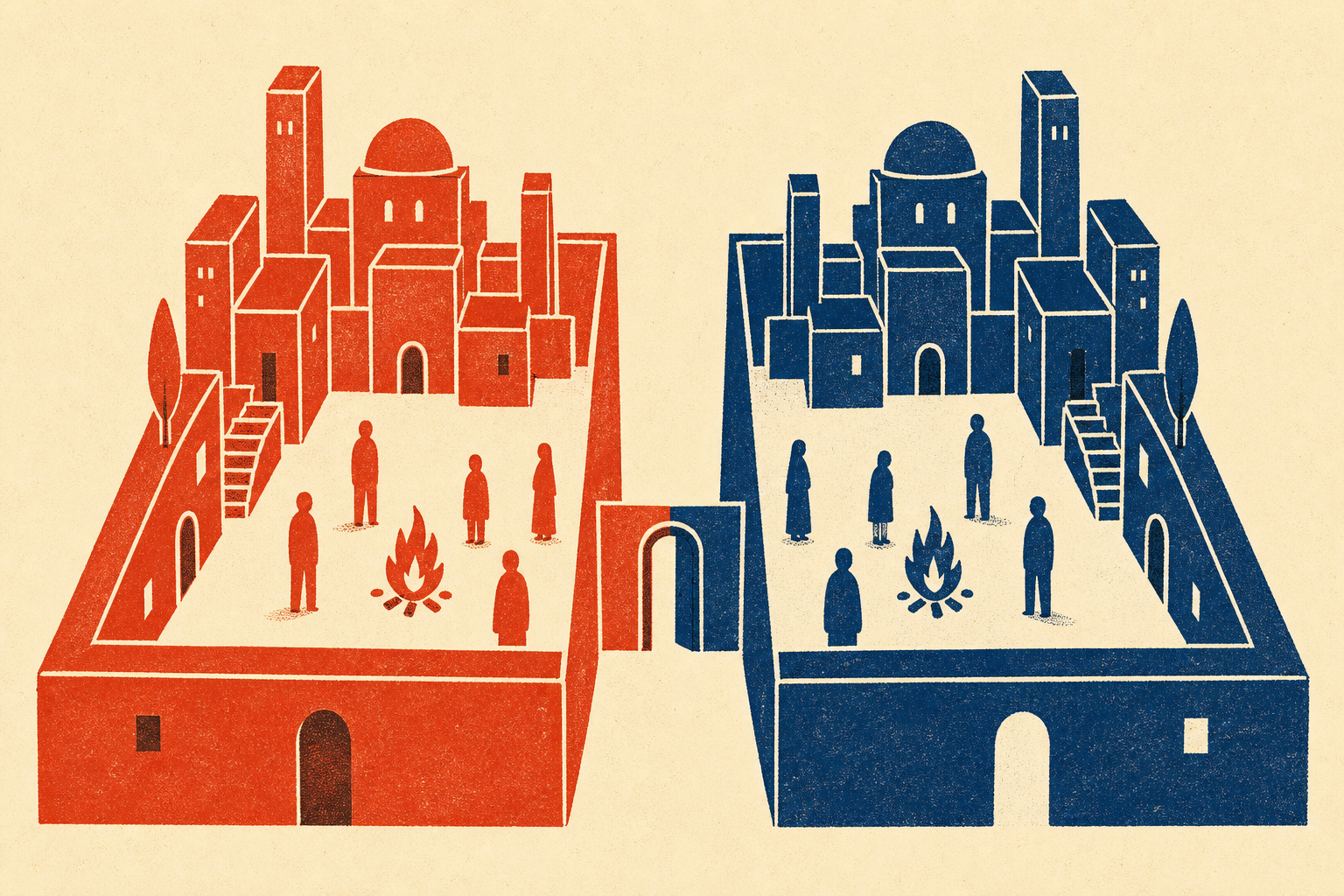
I inadvertently built two of the biggest atheist and IDW communities on the internet. Then they melted down differently.
This is the shortest of four public book versions. Also read: Two Cities Autopsy · A Manual on Human Dignity · The Connection Engine
On January 13, 2021, six days after the Capitol breach, I posted the same question to two websites I had built.
The phrasing was, roughly, “What did Trump do, if anything, to incite violence?”
I asked it sincerely. It was the posture I had taken on every contested topic since 2017, which is, “I am trying to figure this out myself, please help me think.”
One of the sites was called agnostic.com. The other was called IDW.community.
They ran on the same MySQL database. The same PHP. The same humanism essays at the welcome page. The same moderator. Me. Sleeping six hours a night and taking everything personally.
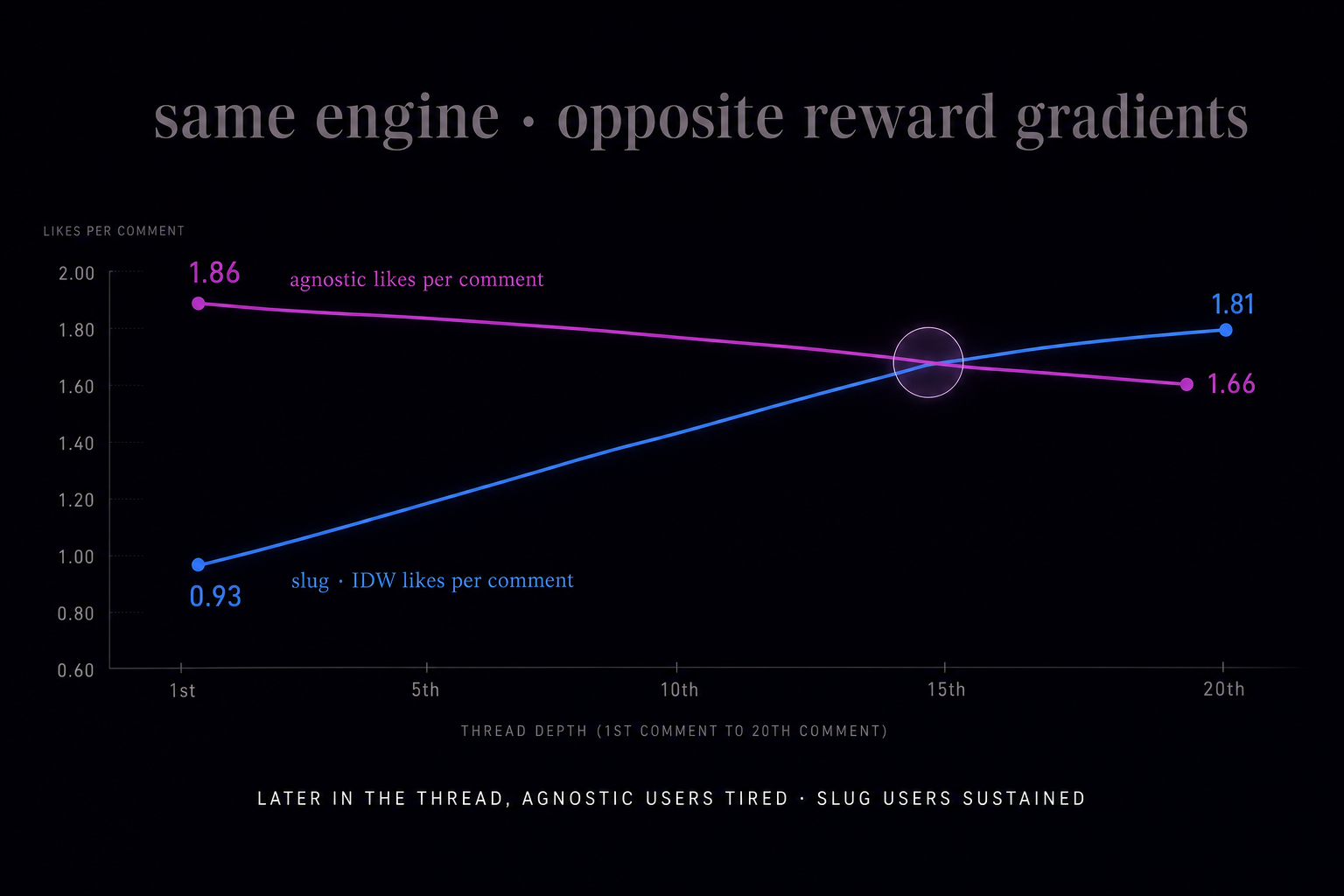
When I went back four years later and asked an AI to score the response threads on civility, ad hominem density, and willingness to engage the question rather than the asker, agnostic landed at 2.5 out of 10.
IDW landed at 7.5.
Same prompt. Same paragraph. Same database.
Two weeks later I posted “How is Biden doing?”
agnostic scored 7.5.
IDW scored 3.5.
Same database. Different week. Mirror image.
I want to tell you that I built these two communities on purpose, as some kind of clever experiment, like a man with a clipboard in a research lab.
I did not.
I inadvertently built two of the biggest atheist and intellectual-dark-web communities on the internet. By accident. Out of one person’s curiosity. And they taught me something I did not want to learn.
The thing I did not want to learn is the talk.
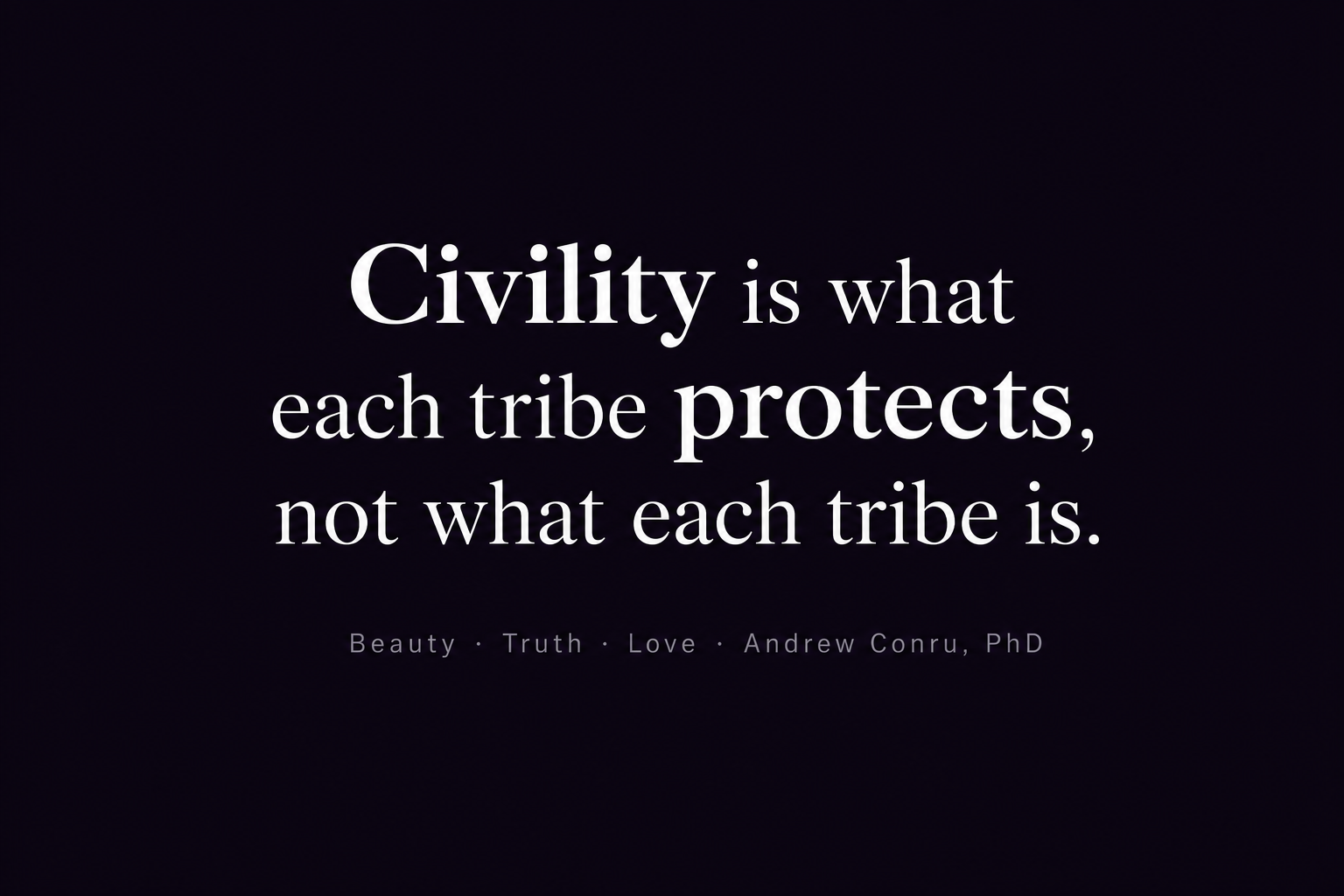
I will tell you upfront. Civility online is not what each tribe is.
Civility online is what each tribe protects.
Each tribe protects different idols. Each tribe melts down on its own schedule, at its own prompt, against its own outgroup. The medium does not slow either of them down. The moderator did not slow either of them down.
I was the moderator. I would have noticed.
This is the part I have to live with.
It is also, maybe, the part you are about to find useful.
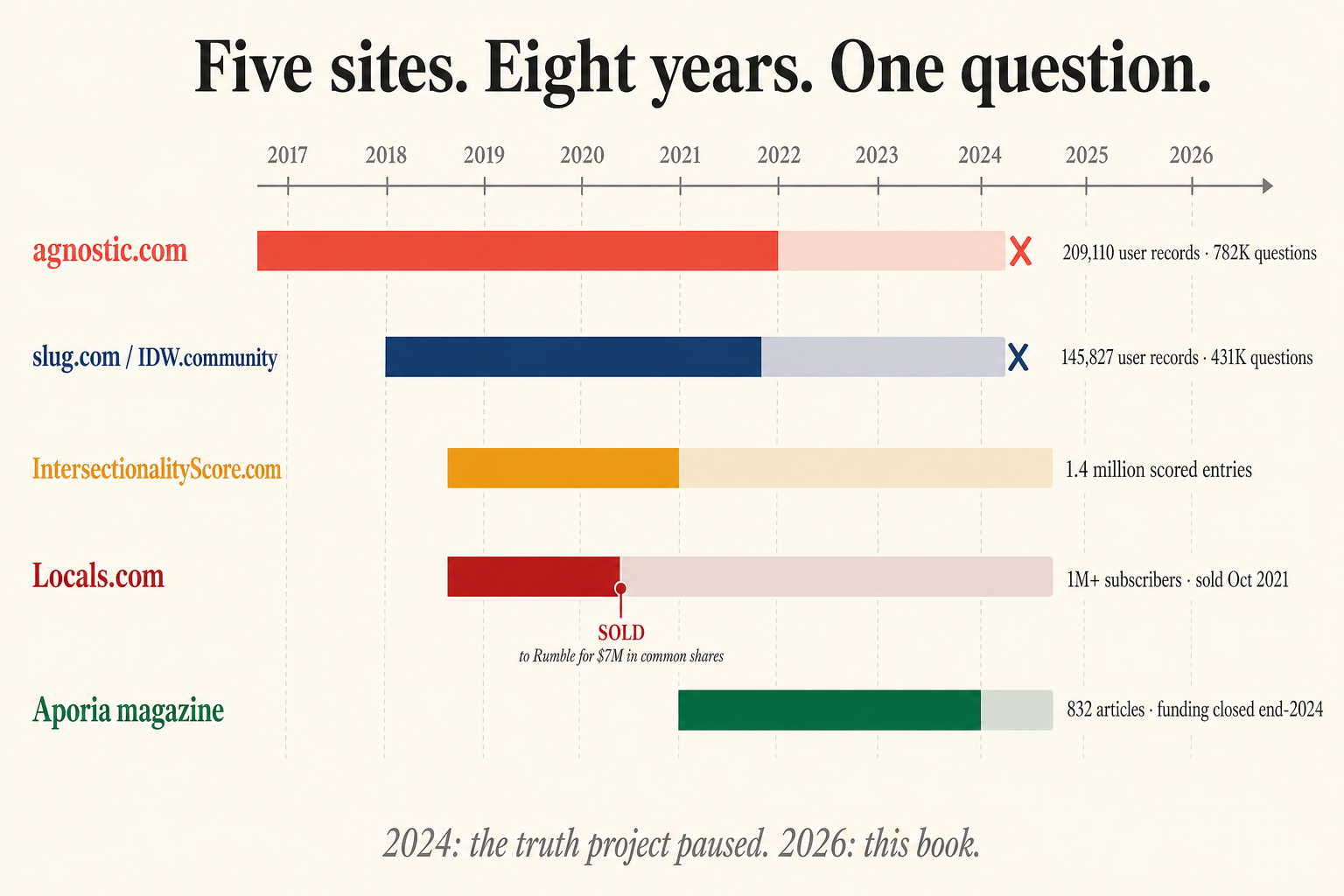
I have spent the last year of my life turning what I saw across five years of running both rooms (the active community window, 2017 to 2022; the full arc of the experiment ran to 2024) into a small set of numbers and one one-paragraph self-test you can run on yourself before your next argument online.
The numbers are coming.
The self-test is in section seven.
Stay with me.
Before we start, I owe you a confession.
The first time I described this data to a room of friends, in 2024, I tried to give them a clean verdict.
Which side was meaner?
I do not have one.
I sat with that for a year.
What I have instead is a structural finding, a thousand specific names per side that I cannot publish, and one sentence I will repeat enough times in this talk that you will get sick of it. The sentence is the title of the talk, in disguise. The two cities run on the same engine and protect different things, and the things they protect are what civility means inside each city, and civility falls apart at the city wall, and most of the residents of both cities never come within a mile of the wall.
If that sounds like the kind of thing a man says when he has run out of crisp answers, that is correct.
It is also the most honest sentence I have written about this work.
Let me show you how I got there.
I grew up on a 10-acre farm in northern Indiana.
My parents were union steelworkers.
My mom’s rule was, “if you are going to do something, don’t do it half-assed.”
I have lived by that one rule longer than I have lived by any other.
I started writing code at age twelve. That was 1982. I sat at a small machine in our living room. I took my homework slowly. The other kids played outside.
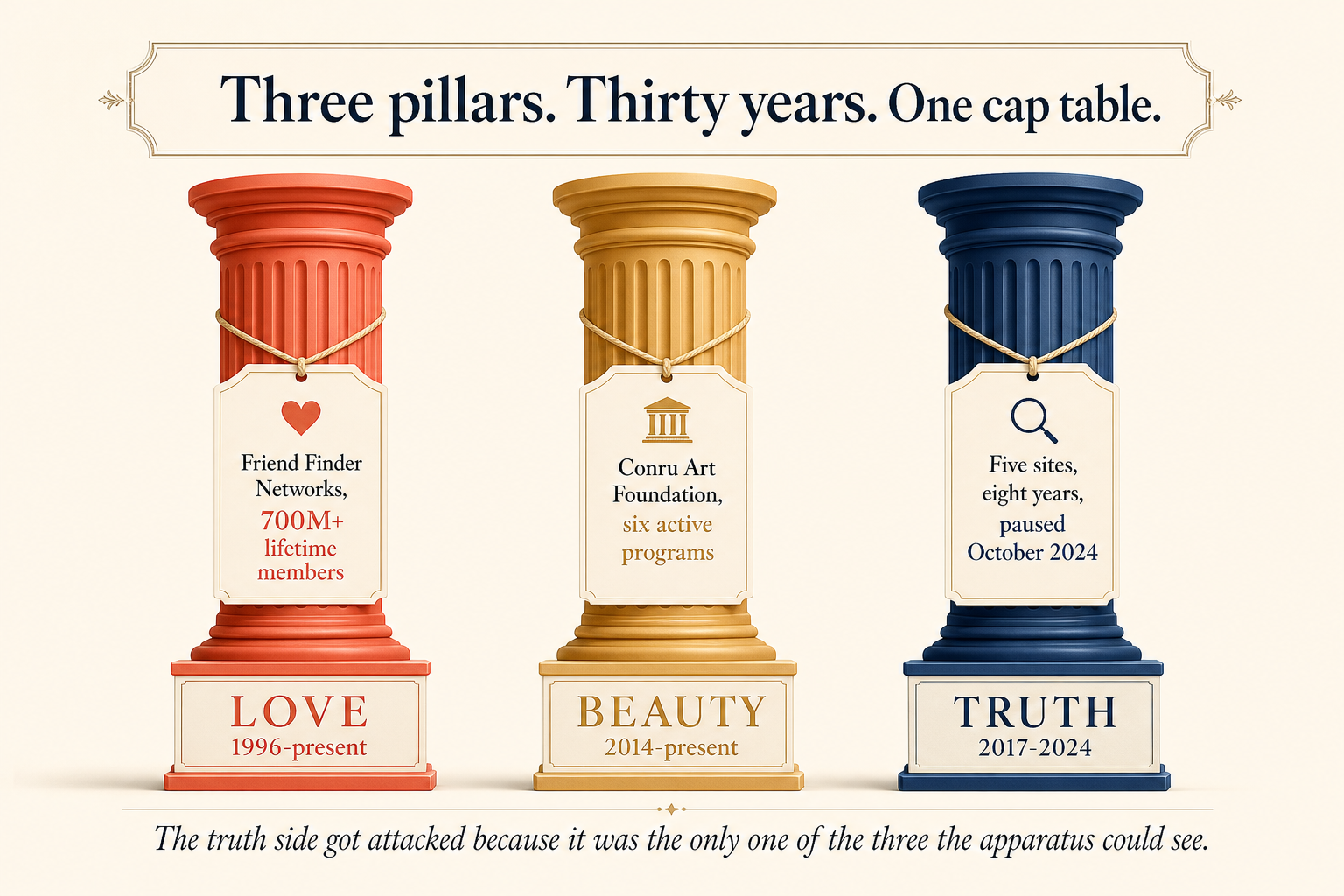
In October 1994, I built one of the first dating sites on the web. I was a graduate student in mechanical engineering at Stanford. The site was called WebPersonals. The original code is still in a folder somewhere on a backup drive in my office.
In 1996, I founded a company called Friend Finder Networks. Over its lifetime it would carry more than half a billion registrations. The first version of it ran on a single server I had under a desk in Sunnyvale.
I sold the company in 2007.
Then I spent several years trying to figure out who I was when I was not building anything, which is harder than it sounds. I painted. I traveled. I read books that seemed too long. I sat on a couch and looked at the ceiling in a way that worried my friends.
The thing you discover, when you are not building, is that you are still you. You wake up every morning with the same brain. The brain is asking the same question it was asking in 1994 about the dating site, and the same question it was asking in 1996 about the network. The question is, “What does it mean to connect people well at scale?”
I had answered the question one way for fourteen years and made some money and some enemies and some friends. I had stopped for a few years and looked at the ceiling. I started up again, in 2017, on the same question.
In 2017, I bought a domain called agnostic.com.
The frame was humanism without God. A meeting hall for people who had walked out of a religion and did not have a place to sit down. I knew a lot of those people. I had been one of them at twenty-two. The site went live on June 19, 2017.
The seed prose was 36 long-form humanism essays I wrote myself. Half on weekends. Half at four in the morning, when I could not sleep.
Two years later, I built a sister site for the people whose questions had become unwelcome on the first one. I called it IDW.community. The frame was open minds welcomed. A John Stuart Mill room for people whose questions had stopped fitting on other platforms. It went live on Valentine’s Day, February 14, 2019, which I thought was funny at the time.
Same engine. Same humanism essays, lightly re-framed at the front door. 36 became 47. The verb at the door tweaked. Mostly the same prose.
The only variable I did not control was who came in.
At peak, agnostic held 209,110 user records, 782,123 questions, over 3 million answers, and over 2 million comments.
IDW held 145,827 user records, 431,482 questions.
Combined: 355,000 user records and 1.2 million questions.
Across both sites, between June 2017 and February 2022, I wrote 749 questions, 5,378 answers, 3,324 comments, and 83 site-text essays.
By the time I sat down with the data, in 2025, I had been the moderator on both sides for almost five years.
I had a hypothesis the whole time.
The hypothesis was that you could engineer civility into the rails of a platform. Build the welcome script right. Write the seed essays right. Hold the line as the moderator. The conversation would learn.
I believed this for a long time.
The reason I am giving this talk is that I no longer do.


I will give you the two rooms in two sentences.
I asked an AI to read every active user on each site, blind to which site each one came from, and to tell me in plain English what kind of person was in each room.
On the agnostic side, the AI saw a room full of people looking for something they had lost. Deconverts from a Christian household who now lived somewhere with nobody to talk to about it. They wrote about grief, dating, parenting, holidays, dogs, and the bewildering first Christmas after leaving the church. The dominant verb at the door was looking for.
On the IDW side, the AI saw a room full of people pushing back on something they could no longer say in their old institution. Mostly people who had been called a name on a platform for asking a question, and had decided that the institution that called them the name was no longer their institution. They wrote about news cycles, books, podcasts, columns, and the moment the room they used to belong to had stopped letting them ask. The dominant verb at the door was pushing back.
Same engine. Same essays at the door. Two different verbs.
The verb at the door selected who came back the second day. The second-day population built the room.
Both rooms had room for a stranger.
Both rooms had a way of telling you that you had picked the wrong room.
I had built the same site twice.
Same code. Same essays. Same person at the moderator desk.
Each room had organized itself into a different shape inside the same shell.
I had thought the shape would be downstream of the engine.
The shape was downstream of the verb at the door.
That was the first thing I had wrong.
The seekers room was not a debate club. It was a peer support hall with humanism literature on the side. Threads were grief, dating, parenting, holidays, dogs, and the bewildering experience of leaving the religion you were born into.
The heterodox room was not a peer support hall. It was a debate club with a reading list. Threads were arguments about a book, arguments about a study, arguments about a podcast, arguments about a column.
If I tell you the cluster mix and the median thread topic of each room, I have given you the room.
Same engine. Two different rooms. The medium did not produce the room. The verb at the door did. The verb selected the population. The population built the room.
I had built two rooms by accident.
I had named one of them after a position on God, which selected a population that wanted out of religious life and into a softer one.
I had named the other one after a position on speech, which selected a population that wanted out of monocultural workplaces and into a sharper one.
Same builder. Same engine. Different doorway.
The doorway was the whole thing.
You will notice this is not how I would have described it in 2018.
In 2018 I thought the engine was the thing. The comment-thread feature, the rating system, the notification flow, the moderator. I thought the door was decoration.
The engine was downstream.
The door was upstream.
I expected the seekers and the heterodox to be different and to have different conversations and to roll their eyes at each other on a bad day.
I did not expect them to be the same person on a different tab.
That part of the data, when I sat down with it, was the one that genuinely surprised me. We will get there in section five.
The two rooms are stable as a fact about the medium.
They were not stable as a fact about the people in them.
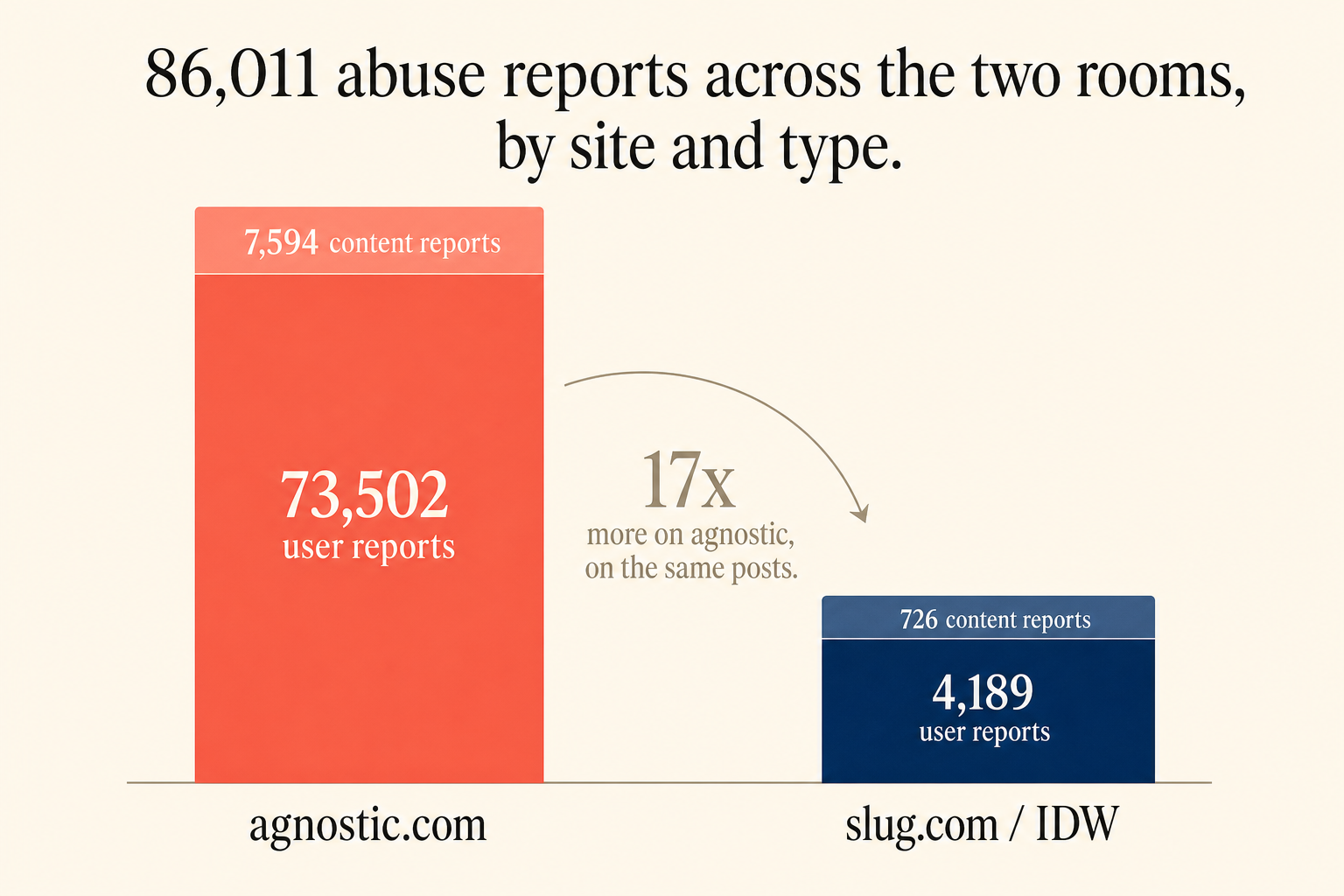
The headline number is seventeen.
Across all five years, agnostic users reached for the report button 17 times more often than IDW users did. They filed formal abuse reports 29 times more often. They filed content reports 10 times more often. The raw counts are 73,502 user-abuse rows on agnostic and 4,189 on IDW. 7,594 content-abuse rows on agnostic, 726 on IDW.
That is a real number.
I quoted it for a long time. The first time I quoted it, in 2020, I was at a party, and I was holding a beer, and I was, in my own clumsy way, signaling something. Look how much warmer my secular community is than the political one I built.
That was the first time I read the data badly.
The IDW side did not need the report button to defend its ground. The IDW side did its defending in the daily posts. The political-content density on the right-leaning room ran roughly five times higher than on the agnostic room across the same lifetime. Different mechanism. Same defending. I will come back to what each side was actually reporting each other for in section eight.
For now, the next move was to figure out whether the 17x was the population, or the medium calling something out of the population.
Five years later, I sat with the data correctly.
Once you control for engagement, by counting blocks per active-user-month rather than blocks per user, the 17x shrinks to 4.7x. The 29x shrinks to 9.6x. The 10x shrinks to 2.0x.
That is still a gap. It is not the gap I had been quoting. It is also not the gap that tells the story.
Here is the story.
On agnostic, of the 73,502 user-abuse rows, the top 10 power-reporters generated 22.5% of them. The single top reporter, a user who chose for himself the handle GreenAtheist, filed 4,971 reports. He also received 1,522 reports against himself.
Top reporter and one of the top reportees. Same person.
He was in a feud. With about thirty people.
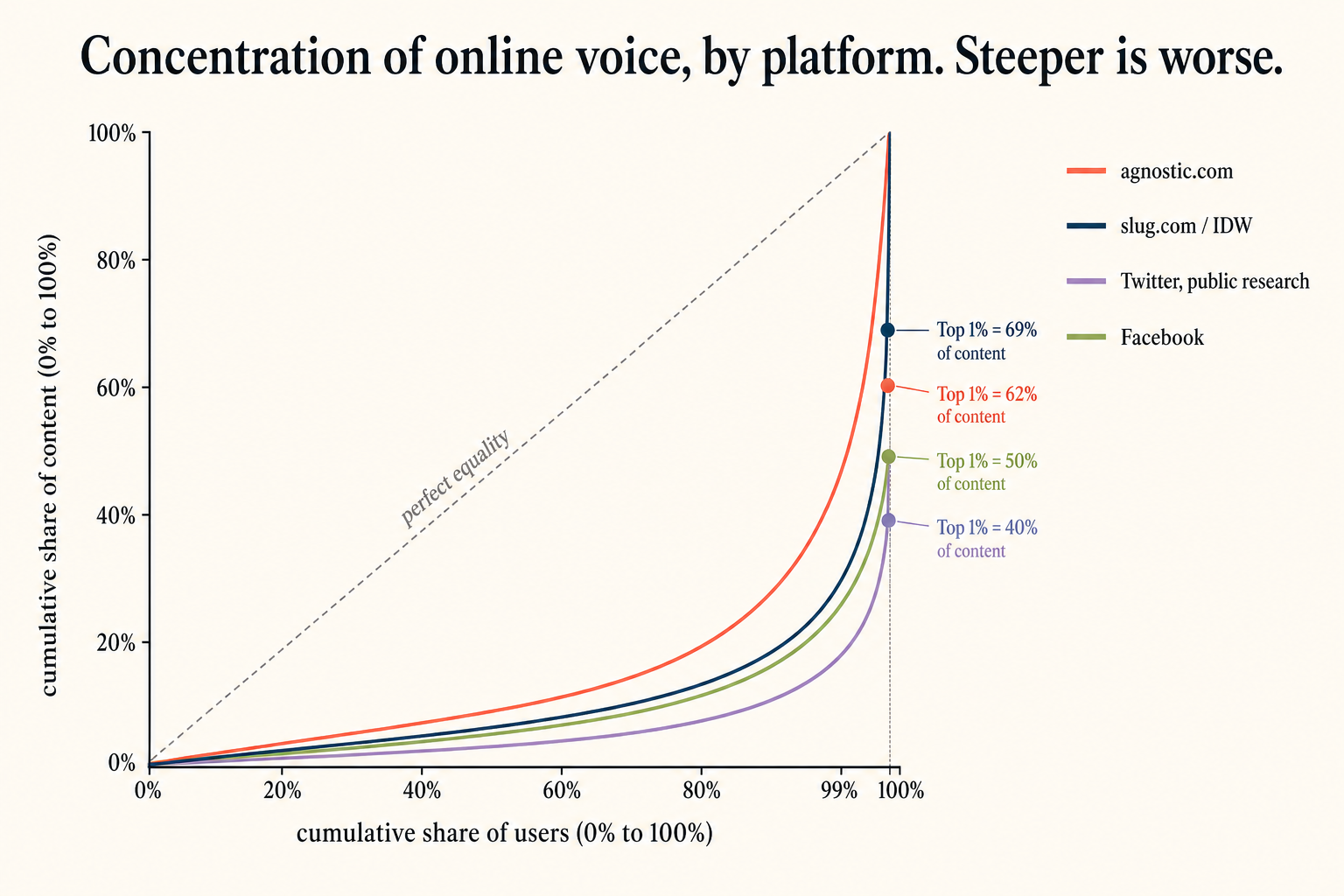
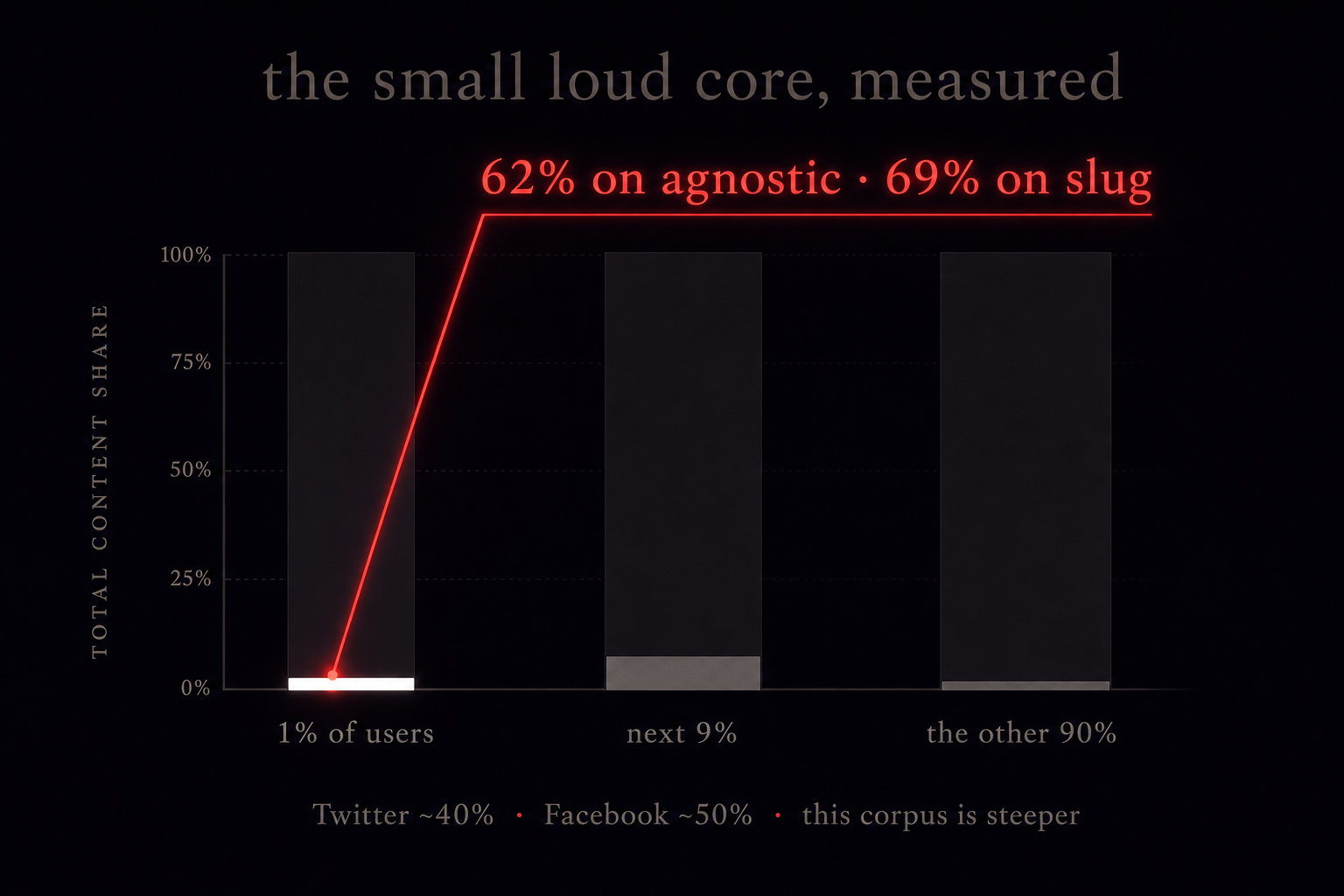
The thirty people were, mostly, two clusters. Thoughtful Elder Skeptics, a tight group of 313 users, 1.8% of agnostic’s active base. Bruised Seekers, a larger group of 859 users, 5.0% of active. Together, 1,172 specific accounts. 6.9% of the active community.
A small loud core.
Across all 49 matched cross-post questions where I posted to both sides, those two clusters generated 92% of every agnostic response.
The 22% Seeking Connection Seekers cluster, the largest on the site, the one full of pets and grief and Thanksgiving advice, contributed 0.3% of responses on political pairs.
They tuned out.
The same pattern on the IDW side. Two clusters, Heterodox Traditionalist Skeptics (240 users, 3.2% active) and Cultural Grievance Veterans (780 users, 10.4% active), accounted for 92% of IDW responses to the same matched questions. About 1,020 specific accounts.
So when I had been reading those threads for years and saying to myself, “the agnostic community is melting down today,” what I should have been saying is, “about 1,170 specific accounts are melting down at about 1,020 specific accounts on the other site, and the other 200,000 of you are not even in this thread.”
That is the punchline of the seventeen-times number.
Most of each community was reading past the fight. The fight that I, as the moderator and host, considered the dominant texture of my own work, was being conducted by, conservatively, two thousand people.
Two thousand people out of more than a quarter million.
I had one more thing to do with the seventeen-times number before I trusted it. I had to read what people were actually reporting each other for.
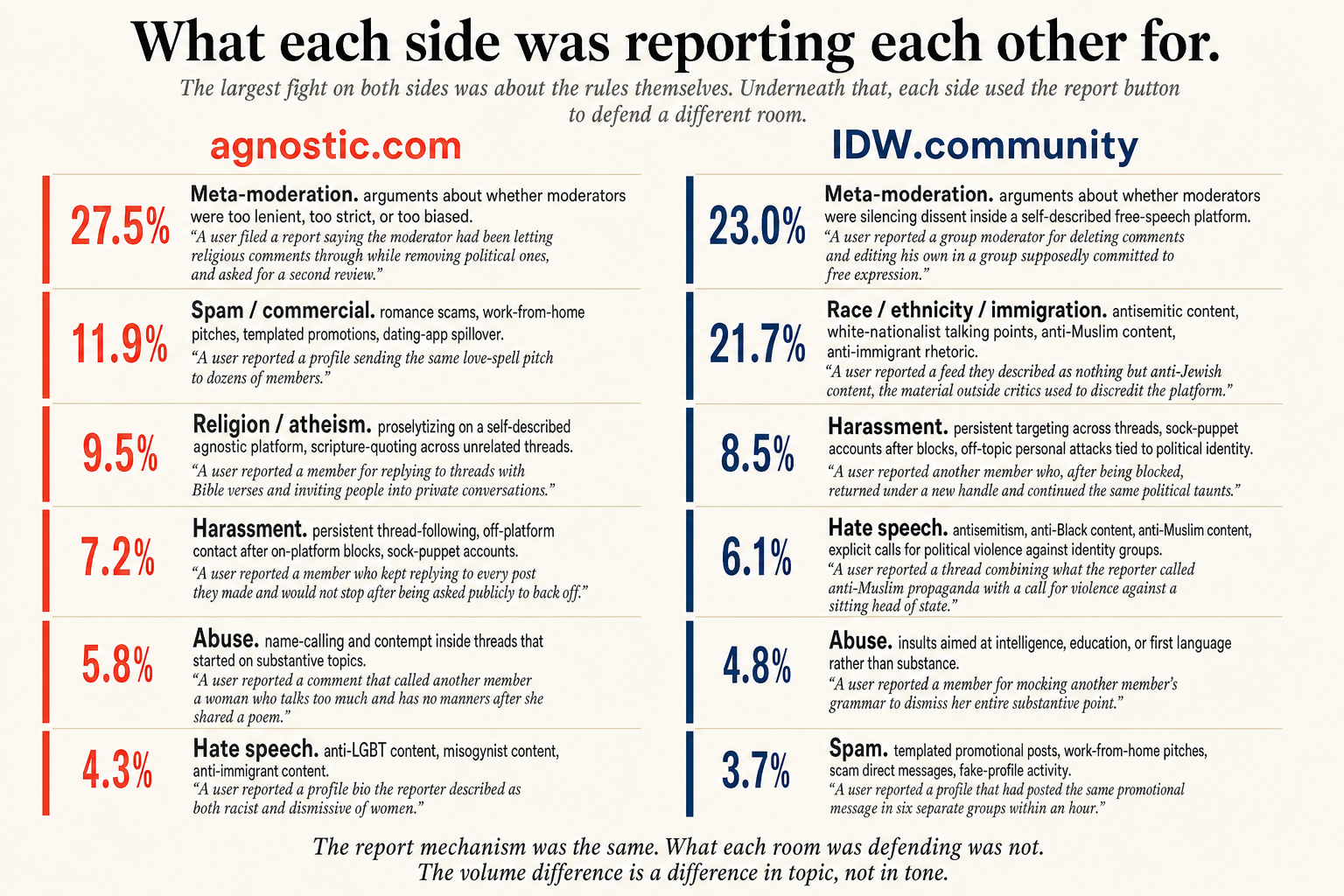
The headline number reads, on the public surface, like a verdict on tone. The agnostic side filed seventeen times more reports. The obvious read is that the room was meaner. That read does not survive the actual texts of the reports.
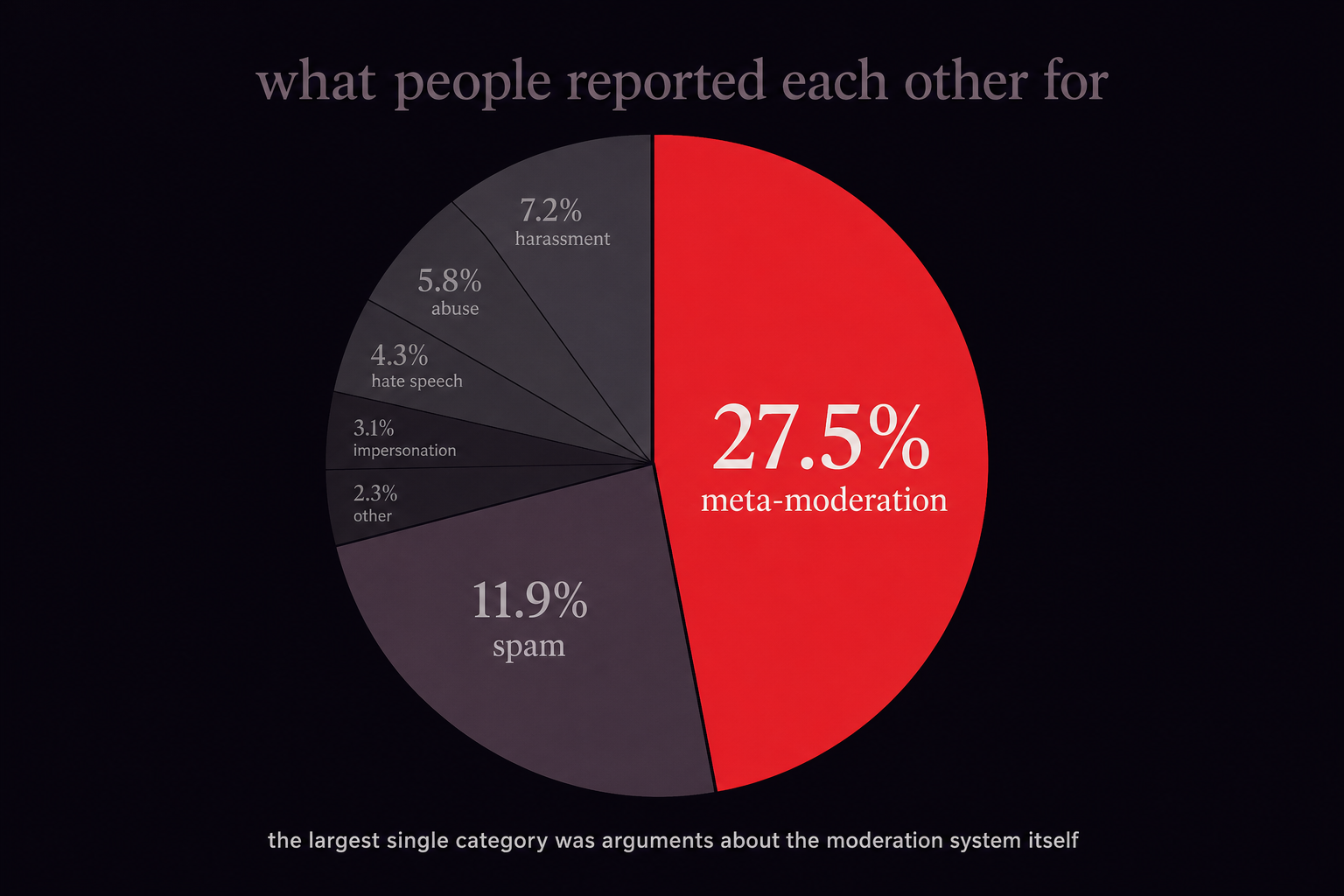
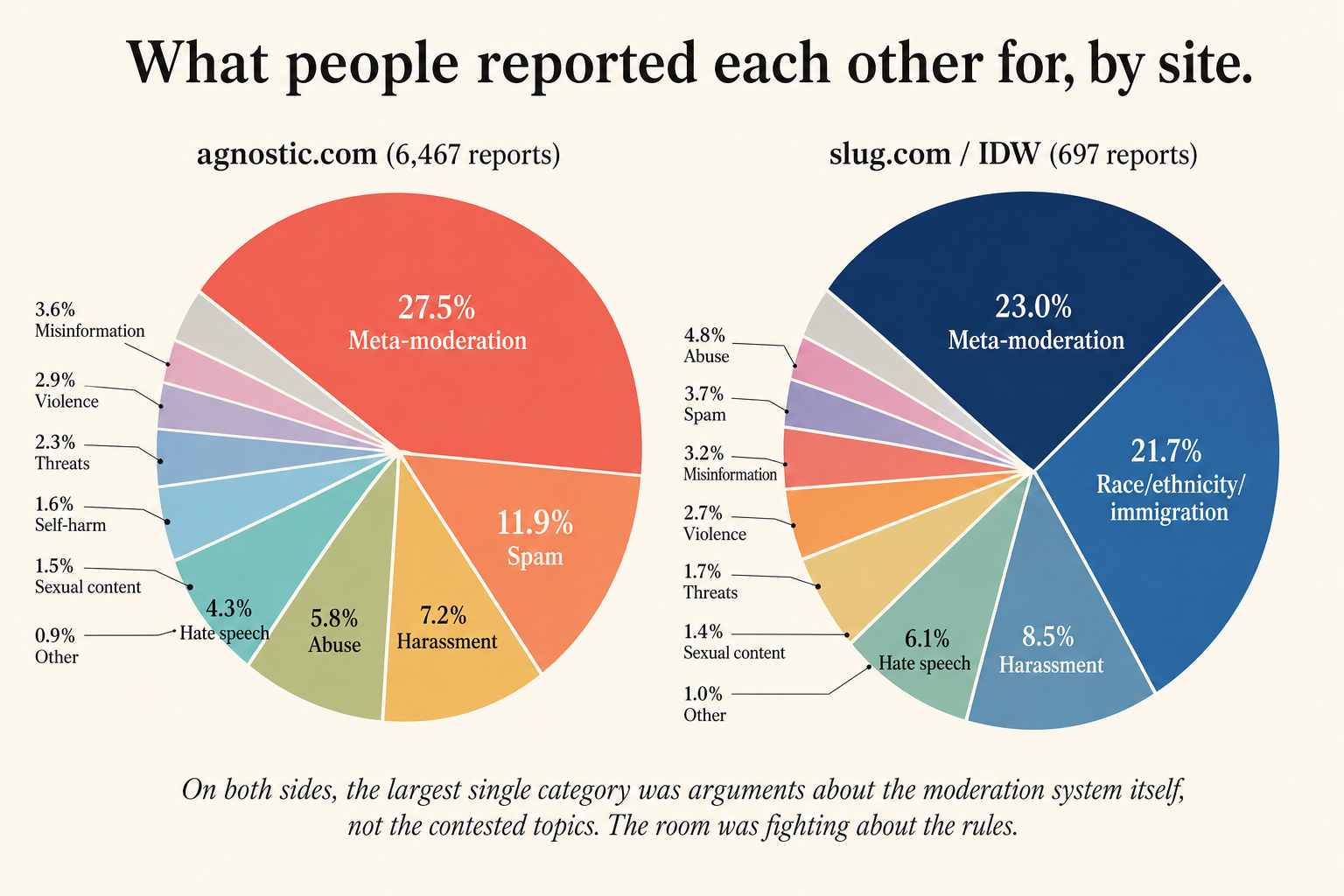
The biggest single category on both sides was arguments about the moderation system itself. 27.5% on agnostic. 23% on IDW. The room that filed more reports was not failing to discuss the contested topics. The room was fighting harder about the rules. The room that filed fewer reports was not better at discussing the contested topics either. The same fight was happening at a lower volume. Underneath that, each side defended different ground. The agnostic side used the report button to keep proselytizers, romance-scammers, and identity-aimed contempt out of the space. The IDW side used the report button against antisemitic content, white-nationalist talking points, anti-Muslim content, and explicit calls for political violence. Same lever. Different contaminants.
The report mechanism was symmetric. The topics were different. The volume was different. The seventeen-times number is real and worth naming honestly. It is not a verdict on which room was meaner. It is a verdict on what each room was using the lever to keep out.
Most of each community came for the seekers room or for the heterodox room. They came for the dog photos and the deconversion stories, or for the book argument and the podcast clip. They were not in the political fight.
The political fight was loud.
It was not large.
This is, by some distance, the most important thing the data taught me.
The community wasn’t melting down. About two thousand specific accounts were melting down at each other while the other two hundred thousand read past the fight.
If you have ever watched a comment thread and thought “the country is at war with itself,” what you are usually watching is sixty people from each tribe doing what they always do, while the rest of the room stays at home with the kids.
I do not say this to make the loud minority less serious.
They are serious. They drive the experience. They generate the abuse load. The platform, in any literal sense of the word, is built around accommodating their fight.
I say it because if you do not name it, you will reach for the wrong intervention.
You will try to engineer civility into the rails of the medium, hoping the population learns. The population does not need to learn. The population is already at home with the kids.
There is one more piece of the seventeen-times number worth naming.
Inside the agnostic conflict matrix, the single most loaded edge is one cluster pair. Thoughtful Elder Skeptics filing reports against Bruised Seekers. 702 reports across the lifetime of the site. Twenty times the off-diagonal mean of the entire conflict graph.
The reciprocal direction, Bruised Seekers reporting Thoughtful Elder Skeptics, is 202 reports.
One pair. Two clusters. Roughly 1,170 people fighting each other, in both directions, year after year, on the secular site I had built so people could feel less alone.
The IDW side does not have one dominant pair. It is sparser, thinner, more diffuse. The combative tone there did not need formal report buttons. It lived in the daily posts.
Two communities. Two conflict shapes. Both small. Both loud. Two thousand people. Five years.
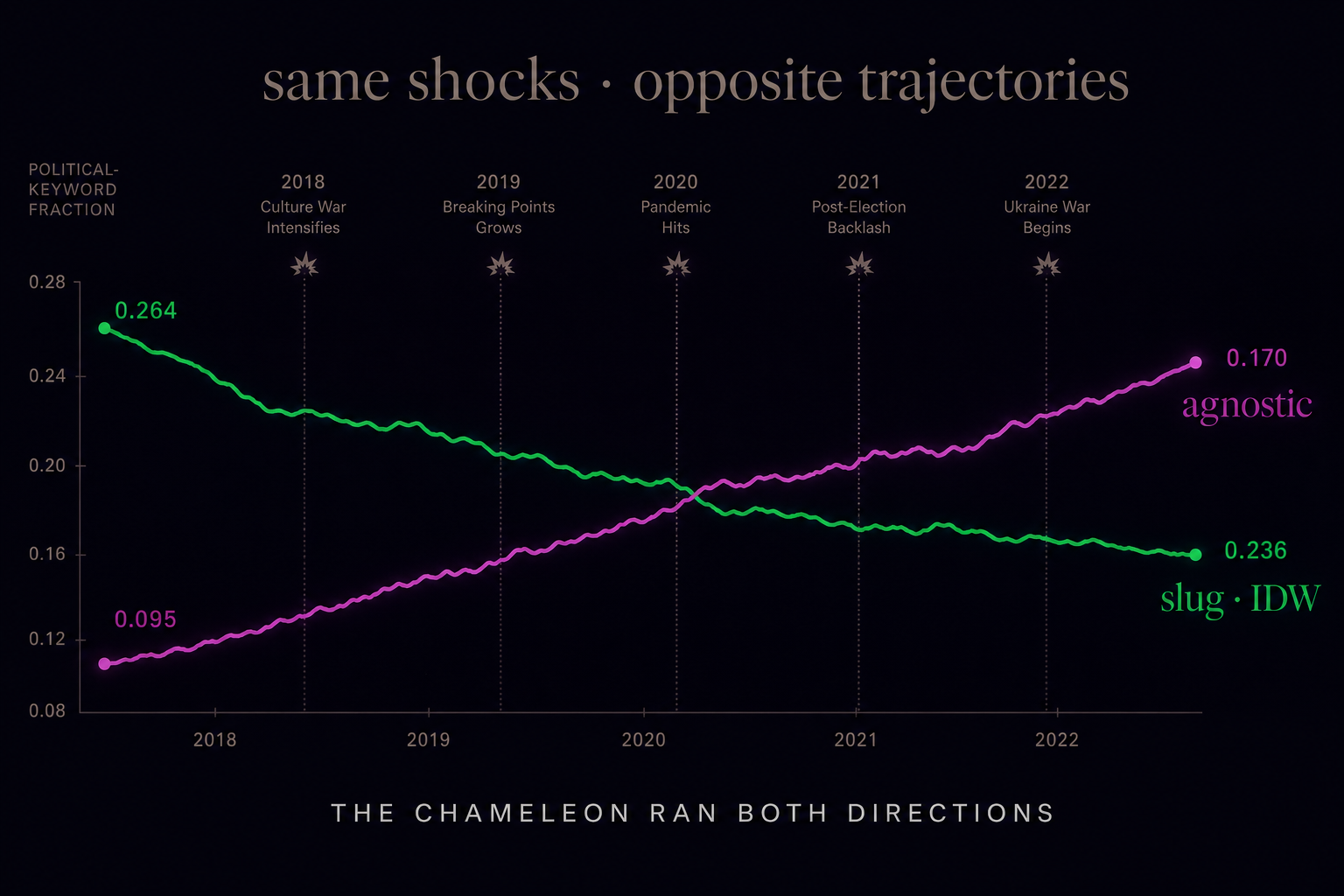
Here is the cleanest single piece of evidence in the corpus.
15,957 people made accounts on both rooms.
About half of them on the same day. 49% of the matches. People discovered both sites, decided to join both, made the accounts within hours.
Of the 15,957, about 1,929 were active on at least one side. 291 were active on both sides at meaningful volume.
Among those 291, the same human filed 23.3 times more abuse reports on agnostic than on IDW. The same human received 13.8 times more abuse reports on agnostic than on IDW.
Read that twice.
Same human. Same email address. Same login on a different tab.
23 times more reports filed in one room than in the other.
Then, on a sub-sample of 108 of those dual-active users, I asked an AI to read each person's posts from one side, separately rate them on civility, warmth, how often they argued, and how much of themselves they put on the page, and then do the same thing on the other side. Same human. Different door. Same scoring.
The same person, on the IDW side, scored:
1.5 points lower civility.
2.0 points lower warmth.
2.4 points lower self-disclosure.
1.9 points higher argumentativeness.
85% of the sample were chameleons whose dominant register meaningfully shifted between rooms.
The case studies, anonymized, are precise.
A user who, on agnostic, wrote about losing a parent and finding meaning in secular forgiveness, on IDW wrote two-line dismissive replies about ideological opponents.
A user who, on agnostic, wrote tender essays about raising freethinker children with a religious co-parent, on IDW wrote sharp accusations about geopolitics.
A user who, on agnostic, wrote about caregiving fatigue and mental health, on IDW wrote almost nothing personal and a great deal about media bias and political opponents.
Same human. Two browsers. Two rooms. Two voices.
The argument I had been having with myself about the medium and the population and the moderator, the whole time, was the wrong argument.
The room shapes the voice.
The medium amplifies whatever voice the room calls out of you.
The moderator runs after both, and is too slow.
If you have a politicized friend you do not recognize, look at where they post.
If you have a sincere sweet friend you do not recognize, look at where they used to post.
The same person can run both modes, on the same engine, in the same week.
It would not be honest of me to leave this section without saying I am one of those chameleons.
I know this because I scored my own posts. The 5,378 answers and 3,324 comments and 749 questions I wrote across both sites between 2017 and 2022.
My agnostic-side voice on hopefulness scored 0.92 out of a possible higher value.
My IDW-side voice on hopefulness scored 0.37.
My agnostic-side voice on politicization scored 0.21.
My IDW-side voice on politicization scored 1.43, seven times higher.
I had been running both modes too. On the same engine. As one person, on a couch, on a laptop, at four in the morning, after the kids were asleep.
I could not even hold the line as the moderator.
The voice was downstream of the room. Mine included.
If you are a person who has friends who post differently in different places, the data is on your side. They are not faking either voice. They are responding to which room called which voice forward. So are you. So am I.
Across the dual-active sample, the room that called for warmth got warmth. The room that called for argument got argument. The same human walked between the two and never sat with the inconsistency, because the inconsistency lives in the rooms, not in the human.
That is the part that took me longest to absorb.
I had built two doors. The doors had built two rooms. The rooms had taken hold of the same people and run them on different scripts.
The medium had not corrected this. The medium had amplified it.
The seventeen-times number is the load that effect was creating on one side of one of my sites, in one season of one year, by a small loud core, on top of an underlying chameleon population that the data could only see because it lived on both sides of the same database.
Here is the thing that surprised me.
Each tribe had its own meltdown topic. Each tribe held the line on the other tribe’s meltdown topic.
I will give you four prompts and four civility scores.
January 13, 2021. “What did Trump do, if anything, to incite violence?” agnostic 2.5. IDW 7.5. The secular site had a meltdown. The heterodox site held the line.
January 27, 2021. “How is Biden doing?” agnostic 7.5. IDW 3.5. The secular site held the line. The heterodox site had a meltdown.
November 9, 2020. The Pfizer vaccine emergency authorization news. “Would you take it?” agnostic 8.5. IDW 4.0. The secular site, the science-trusting crowd, handled it calmly. The heterodox site, the freedom-frame crowd, erupted.
December 18, 2020. Three weeks before the Capitol breach. I posted to both rooms the same question. “Should some research topics be banned or results censored?” agnostic 6.5. IDW 7.0.
Both sides held the line. Civilly.
Read that one again.
Both sides held the line on a question that, two years later, the wider press apparatus would be incapable of holding the line on, when it was attached to me.
The question that almost ended my philanthropic life had been engaged, civilly, by two communities I had built, on a Friday afternoon in December 2020, while I made coffee.
The communities I had built were able to handle the actual hard question.
The wider apparatus, when it would later confront a similar question in a different context, was not.
This is the data point that changed me.
It made me stop blaming the communities.
It made me see what I had not been seeing. The communities were able to hold the line on hard questions when those questions were not their own outgroup. They were not able to hold the line when the question named their outgroup. The same was true on the other side. The same was true with the same prompt and a different audience. The same was true on the same site one week and the next.
Each tribe melted down only when its own outgroup was named.
There was no general civility. There was outgroup-specific de-civility.
The outgroup of the secular community was the conservative voter.
The outgroup of the heterodox community was the progressive voter.
When I named one outgroup, half the rooms got polite and half the rooms ignited.
When I named the other outgroup, the polite half ignited and the ignited half got polite.
It is not about which tribe is meaner. It is not about which tribe is correct. It is not about the moderator. It is not about the engine.
It is about how a group, online, holds together.
The group holds together by protecting the inside from the outside. The inside is the prompt the room loves to think about. The outside is the prompt the room calls a slur. Slur is shorthand here. Sometimes it means calling someone a fascist. Sometimes it means calling someone a snowflake. Same shape, different word. Both rooms had a word.
I sat at my own platform for five years not seeing this.
It is the talk.
I want to be specific about why the December 2020 question is the data point that changed me.
For a year before the press exposure that I will not relitigate here, I had been funding a small academic publication on the theory that hard topics needed careful rooms in which they could still be discussed. The press apparatus that came at me a couple of years later treated the existence of the publication itself as the indictment. The very act of asking, “should some research topics be banned or results censored?” was reframed as, by definition, support for the worst possible answer.
But three weeks before the Capitol breach, I had asked exactly that question on both my sites, and the secular humanists scored 6.5 on civility, and the heterodox readers scored 7.0.
The communities I had built had been able to hold the question.
What had failed was not the people who had walked through my door.
What had failed was the corridor between the rooms and the rest of the culture.
That distinction took me a long time to see.
I sat at my own platform for five years not seeing it. The data made me see it. The data also made me stop blaming the wrong layer.
I will say it once, clean.
Each tribe was civil everywhere except the few topics it would not let you question.
Most threads on both sides were warm. A small number of threads, on each side, were not. Which threads were which was not random. Each room had a small set of topics where any disagreement, no matter how politely raised, triggered the report button. The civility of a thread was a property of whether it touched a protected topic, not a property of how people behaved on it.
I will pay for that finding the rest of my life. It cost me a project. It cost me my idea of a project.
The next part is harder.
You cannot engineer your way out of this with a better discussion forum.
I tried.
You can engineer your way to a better seekers room, full of people who came for the deconversion threads and the dog photos.
You can engineer your way to a better IDW room, full of people who came for the book arguments and the podcast clips.
You cannot engineer your way to a room where the two populations both sit at the same table on the question of their own protected topics, without one or both of them lighting the table on fire.
I do not say this because the people are bad. The people are largely fine.
I say this because the medium calls the worst version of the loudest 6.9% of the seekers, and the worst version of the loudest 13.6% of the heterodox, into the comment thread first, and the rest of the room either fights with them or leaves.
The fight is the texture. The fight is not the population.
The medium does not slow this down. The moderator does not slow this down. The seed essays do not slow this down. I tried it three ways, across two sites and one academic publication. Same answer three times.
I do not regret trying it. I owe that much to the engineer in me.
But the talk you are sitting through is not “look at this clever experiment I ran.”
The talk is, “I ran the same experiment three times and the answer was the same, and I am here to tell you the answer.”
The answer is, the medium amplifies the small loud core. The medium amplifies the politicized voice in the same person who, on a different tab, writes about losing a parent. The medium does not distinguish between the room you came for and the meltdown the room cannot help having when you are tired at one in the morning.
The honest claim, after eight years on both sides of the database, is structural.
About two thousand people on each side do most of the visible fighting. Most of each community is doing something else. The rooms protect different idols. The medium amplifies both. The moderator does not slow either of them down.
If a reader wants a verdict on which national tribe is meaner, the reader has to bring the verdict in with them. The data does not.
I am not equipped to give it. I have spent eight years and a lot of my own money trying.
If you take one thing from this section, take this.
The next time you are about to post a contested question online, do this.
Rewrite the post with the OTHER tribe as the subject.
If your draft says, “Here is what Conservatives believe that is dangerous,” rewrite it to say, “Here is what Progressives believe that is dangerous.” If your draft names one outgroup as the threat, swap the outgroup and read it again.
If you would not post the swap version with the same conviction, you are testing a tribe, not an idea.
The tribe you are testing is your own.
This is the only intervention I have found that the moderator did not need to enforce. The author can run it on themselves, before they hit post, in a moment of attention that costs the platform nothing and the human a small amount of self-respect.
Most days, on a contested topic, my own draft fails the swap test.
I post anyway, sometimes.
I am also a chameleon. I have receipts.
I want to put one number on the page and sit with it for a moment.
On the IDW side, of every five user-against-user reports filed across the lifetime of the site, roughly one of them was about a thread on race, ethnicity, or immigration. That is a category that, on the agnostic side, accounted for almost none of the reports filed. On the IDW side, race and immigration and what to do with multicultural difference was the second-biggest fight, basically tied with the room arguing about the moderation rules themselves. On the agnostic side, the analogous topic almost never came up in the report logs at all.
That asymmetry is, in a way, the whole answer.
The agnostic seekers were not avoiding the topic because they did not care about it. They were avoiding it because their room had a working consensus on it. They could fight about religion, because religion was the question their identity had been built around walking away from. They did not fight about multicultural difference, because the room had quietly decided what the answer was supposed to be, and a reader who wanted to discuss the question carefully knew that the report button was the next thing the room would reach for.
The IDW side was fighting about it every day. They were fighting about it because their room had not been given a consensus on it from upstream. Their room had been built specifically out of the experience of being told that the question could not be asked. So the moment the door opened, the question came in.
When I sat down with that finding, after I had finished the engineering autopsy, the question became personal.
One of these rooms, the one that had decided not to talk about it, was eight times the size of the other one. The other one, the one that had been built around the question, was the smaller, louder room.
If I read the report logs as a thermometer, the thing each tribe could not talk about was the same thing. Multicultural cohesion. To what extent it is possible. To what extent it is not. Whether the differences that show up between groups in the data are mostly heritable, mostly environmental, mostly cultural, mostly policy. To what extent some of the differences just have to be lived with, because they are not in the policy lever the room thought they were in.
That is the question the IDW room was asking out loud and getting reported for. That is the question the agnostic room was not asking out loud and reporting each other for getting near.
That is the bedrock question.
I want to be careful about how I say what I am about to say, because the temperature on this paragraph is higher than the temperature on the rest of this talk.
To what extent can multicultural societies harmonize without coercion?
That is the question I came to, after five years on both sides of the database, with the report logs in front of me. It is, near as I can tell, the hardest question in current social science. It sits at the intersection of population genetics, behavioral psychology, demography, history, immigration policy, and civic philosophy. The answer is not obvious. The answer is also not, in my reading of the literature, settled in the direction either tribe is convinced it is settled in.
There is a version of the answer where most of the observed differences are environmental, cultural, and historical, and the right policy and the right time produce a society that converges on a common civic identity without anyone giving up much. There is a version of the answer where some of the differences are deeply heritable in ways that policy cannot move, and a multicultural society can still be civil and free and prosperous, but it has to be honest about which differences it cannot legislate out of existence. There is, almost certainly, a version of the answer in between, with different mixes on different traits.
I do not, sitting here in 2026, know which version is closest to the truth. I have read enough of the literature to know that the version where everything is policy-movable is not consistent with the twin-study data, and that the version where most things are biologically fixed is not consistent with the gene-environment-interaction data, and that the honest answer is somewhere in the middle, and that the honest middle is uncomfortable in different directions for different readers, which is part of why nobody wants to sit with it in public.
What I found, when I went looking for the research that should have been there to inform the question, was that the research had stopped being done.
Not because the questions were not interesting. Because the people doing the research had stopped being able to do it without getting attacked. A working academic who published in the area got attacked. A grad student who picked the question for a thesis got warned off it. A grant officer who funded the area saw her budget dry up. A journal editor who ran a piece in the area got the kind of mail that other journal editors did not get. The topic did not get banned. The topic got quietly defunded, and the literature thinned out, and ten years later the literature on the question both my rooms were circling was twenty years out of date.
That is the moment I funded Aporia.
I funded a publication, not a platform. I funded one editor with a clean editorial record and a particular kind of moral imagination, not a comment thread with a moderator. I funded a place where a working academic could publish a careful piece on the bedrock question, with citations to the actual literature, in a tone an actual reader could finish, without having to negotiate a press cycle for the privilege.
I want to say plainly what the publication is for, because the press cycle in October 2024 spent a great deal of money making sure you would never read the answer in plain English.
The publication is for the bedrock question. It is for the place between the two rooms my database had built. It is for the readers in both rooms who, when they put down the comment thread, knew that the question their room had been fighting around for five years was a real question and not a slur dressed up as one, and who wanted somewhere to read a careful answer.
That is why I funded it. That is what I funded it for.
If you want the longer version, in eighteen chapters, with citations and receipts, the gated book is at conru.com/tribes/btl/. The defensive case against the framing the publication received in October 2024 is at conru.com/aporia/. The talk you are sitting through now is the version that fits in an evening.
I closed the engineering question a few years ago.
The answer, near as I can tell, is this. Civility can be engineered into a medium for housekeeping prompts. Civility cannot be engineered into a medium for outgroup prompts. The line between those two has been moving faster than any dashboard I built can keep up with.
So I started building rooms with paint on the walls instead of comment threads.
There is now a 16,000 square foot art salon at 110 Union Street, in downtown Seattle, across from the Seattle Art Museum. Most Wednesdays, between 4 and 7 pm, I am there. The coffee is good. The painting on the back wall changes every few months. There is no comment thread.
The thesis I am running now is not about engineering civility into a medium.
It is about whether a room with a beautiful object in it, a regular night, and seven people who keep coming back can do something a comment thread, on a worse year, could not.
I am running it on three principles. Beauty, Truth, and Love.
Beauty bypasses the ideological armor a person walks in with. The painting does not ask whose voter you are.
Truth, in art, is honest depiction of the human condition, not the abstraction debaters fight about. The portrait does not have a comment section.
Love is the connective tissue both rooms had been trying to build through dialogue and could not, past their tribal protections. The salon does not require either side to win the argument. The salon only requires that you stay another fifteen minutes.
This is not a brand. It is the rebuilt thesis after the data update. The numbers are in. The next thirty years of my work go here.
If you live somewhere I can drive to, come by. Wednesdays, 4 to 7 pm. 110 Union Street, Seattle. The coffee is on me.
If you do not, find a regular night and a beautiful thing and three to seven people who will keep showing up, and pour the coffee yourself for the first six months, which is also when you will think it is not working.
That is the experiment now. It is what I have left after running the previous one all the way down.
A friend asked me, last winter, whether the salon was retreat from the harder fight.
I said no. I had spent a decade on the harder fight. I had run two communities, funded one publication, and weathered the press cycle that resulted. I had paid a fair price for the engineering hypothesis.
The salon is not the retreat. The salon is the next iteration. It is the room where the people the comment thread was eating each other on can sit fifteen feet apart and look at the same painting and not be at war with each other for the time it takes to drink a cup of coffee.
I would prefer to win an argument. I built my career on winning arguments.
I have learned, the long way, that beauty wins the room before the argument starts.
That is what I am running now.
I built two of the most-used atheist and intellectual-dark-web communities on the internet, by accident, in five years, on the same MySQL database, with the same essays at the door.
I found out what they could and could not do.
I am building the next thing on the principles that survived the data.
If you are ever on Union Street on a Wednesday afternoon, I am the guy with the coffee.
The numbers in this talk come from the underlying databases of two sites I ran between June 2017 and February 2022. agnostic.com: 209,110 user records, 782,123 questions, ~3M answers, ~2.2M comments, 73,502 user-abuse rows. IDW.community: 145,827 user records, 431,482 questions, 4,189 user-abuse rows. The civility scores are AI scores of audience response threads on a 0 to 10 scale, with a sample re-checked by hand to make sure the AI was scoring the way a careful reader would. Methods, data tables, and open questions live in the research roadmap.
Art Love Salon, 110 Union Street, downtown Seattle, across from the Seattle Art Museum. Wednesday 4 to 7 pm. Free. Coffee on me.
Visit the Art Love Salon →